Spanish introductions and agreement
Introduit| English | Sens |
|---|---|
| number/ˈnʌmbə/ | in grammar, whether a word is singular or plural |
| grammatical gender | the class, such as masculine or feminine, that a noun belongs to in languages like Spanish |
| agreement/əˈɡriːmənt/ | concordance |
| agrees | takes the same gender and number (or person) as the word it goes with |
| ser | être (verbe être) |
The first grammar of Spanish, 1492
- In 1492 Antonio de Nebrija published the Gramática de la lengua castellana, the first printed grammar of a modern European language. He wrote down rules that Spanish speakers already followed without thinking — including how adjectives change to match nouns.
- Today about 500 million people speak Spanish as a first language, most of them in Mexico. The rules Nebrija described let you introduce yourself and describe things correctly from your first lesson.
What did Antonio de Nebrija publish in 1492?
Difficulté 1/5 · 100 pièces + un petit bonus lors de la première réussite aujourd'hui
It was the first printed grammar of a modern European language.
Introducing yourself
- Hola, me llamo Ana. — "Hello, my name is Ana." Soy estudiante. — "I am a student." Tengo dieciséis años. — "I am sixteen" (literally "I have sixteen years").
- Ask a friend: ¿Cómo te llamas? ("What is your name?"). Ask politely: ¿Cómo se llama usted?
How do you say "I am sixteen" in Spanish?
Difficulté 1/5 · 100 pièces + un petit bonus lors de la première réussite aujourd'hui
Spanish uses tener for age.
Gender and number
- Every Spanish noun has a grammatical gender 语法性别: masculine (el libro, the book) or feminine (la casa, the house). Many masculine nouns end in -o, many feminine in -a.
- Number 数: singular or plural. Add -s after a vowel (casas) and -es after a consonant (ciudades).
Match each noun to its gender.
Difficulté 2/5 · 140 pièces + un petit bonus lors de la première réussite aujourd'hui
Most -o nouns are masculine and most -a nouns feminine, but there are exceptions.
What is the plural of ciudad?
Difficulté 1/5 · 100 pièces + un petit bonus lors de la première réussite aujourd'hui
Add -es after a consonant.
Adjective agreement
- An adjective agrees 一致 with its noun in gender and number: la casa nueva, las casas nuevas; el libro nuevo, los libros nuevos.
- Adjectives ending in -e or a consonant change only for number: estudiante inteligente, estudiantes inteligentes.
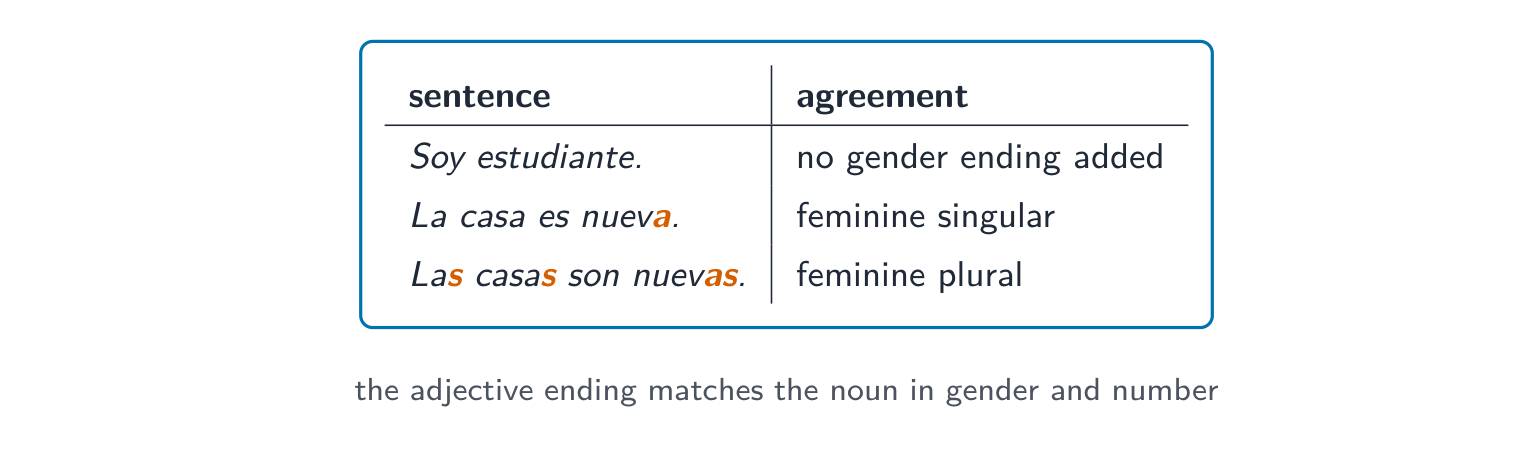
Choose the correct phrase.
Difficulté 1/5 · 100 pièces + un petit bonus lors de la première réussite aujourd'hui
Feminine plural noun and adjective.
Worked example: correcting a description
A student writes: Mi escuela es grande y moderno. Las profesoras son simpático.
- Check each noun: escuela is feminine singular; profesoras is feminine plural.
- Fix the adjectives: grande ends in -e, so it stays; moderno must become moderna; simpático must become simpáticas.
- Correct text: Mi escuela es grande y moderna. Las profesoras son simpáticas. — "My school is big and modern. The (female) teachers are nice."
Correct Los profesores son simpática.
Difficulté 1/5 · 100 pièces + un petit bonus lors de la première réussite aujourd'hui
Masculine plural noun needs a masculine plural adjective.
Ser for identity
- Use ser for identity, origin, profession and lasting description: Soy de China. Soy estudiante. Mi hermano es alto.
- Forms: soy, eres, es, somos, sois, son.
Soy de China uses ser for origin.
Difficulté 1/5 · 100 pièces + un petit bonus lors de la première réussite aujourd'hui
Ser is used for identity, origin and profession.
Do not translate "I am sixteen" as Soy dieciséis. Spanish uses tener for age: Tengo dieciséis años. And keep checking agreement: la mano ("the hand") is feminine even though it ends in -o.
Introduce yourself with me llamo, soy and tengo … años. Spanish nouns have gender and number, and adjectives agree with them: -o/-a/-os/-as, or only -s/-es for adjectives ending in -e or a consonant. Use ser for identity and lasting description.
Write four sentences in Spanish introducing yourself and describing your school.
Introduce, describe, check agreement.