Rights, development, sustainability and peace
Introduit| English | Sens |
|---|---|
| rights/raɪts/ | Entitlements that the law or a contract gives a person at work. |
| development/dɪˈveləpmənt/ | A process of growth, change or increasing complexity over time. |
| sustainability/səˌsteɪnəˈbɪlɪti/ | durabilité |
| peace/piːs/ | A condition without war, or more broadly with justice and security. |
| actors | in global politics, the states, organisations, groups and individuals who take part in political events |
| negotiated agreement | a settlement reached through talks in which the parties involved take part |
| sustainable development/səˈsteɪnəbl dɪˈveləpmənt/ | Development that meets present needs while preserving future generations' ability to meet their own needs. |
| positive peace | The presence of justice and fairness that remove the causes of violence. |
A treaty that outlasted wars, 1960
- In 1960 India and Pakistan signed the Indus Waters Treaty, brokered by the World Bank. It divided the six rivers of the Indus basin: the three eastern rivers to India, the three western rivers mainly to Pakistan, with a commission to settle disputes.
- The treaty survived several wars between the two states. In April 2025, after a terrorist attack in Kashmir, India declared it in abeyance. Shared resources link four key concepts: rights 权利, development 发展, sustainability 可持续性 and peace 和平.
Who brokered the 1960 Indus Waters Treaty?
Difficulté 1/5 · 100 pièces + un petit bonus lors de la première réussite aujourd'hui
The World Bank mediated between India and Pakistan.
How many rivers of the Indus basin did the treaty divide?
Difficulté 2/5 · 140 pièces + un petit bonus lors de la première réussite aujourd'hui
Three eastern rivers to India, three western mainly to Pakistan.
Actors and their needs
- List the actors 行为体 — states, communities, companies, international organisations — and what each needs: access to water, livelihoods, protection of the environment.
- A dispute is easier to analyse when needs are separated from stated positions.
Which are actors in global politics?
Difficulté 2/5 · 140 pièces + un petit bonus lors de la première réussite aujourd'hui
Actors are people and organisations that act.
Two responses to a resource dispute
- A negotiated agreement 谈判协议 involves the actors and is durable if it is fair and enforceable. An imposed restriction made without consultation is likely to be contested.
- Durability also depends on trust: even a long-lasting agreement can fail when relations break down.
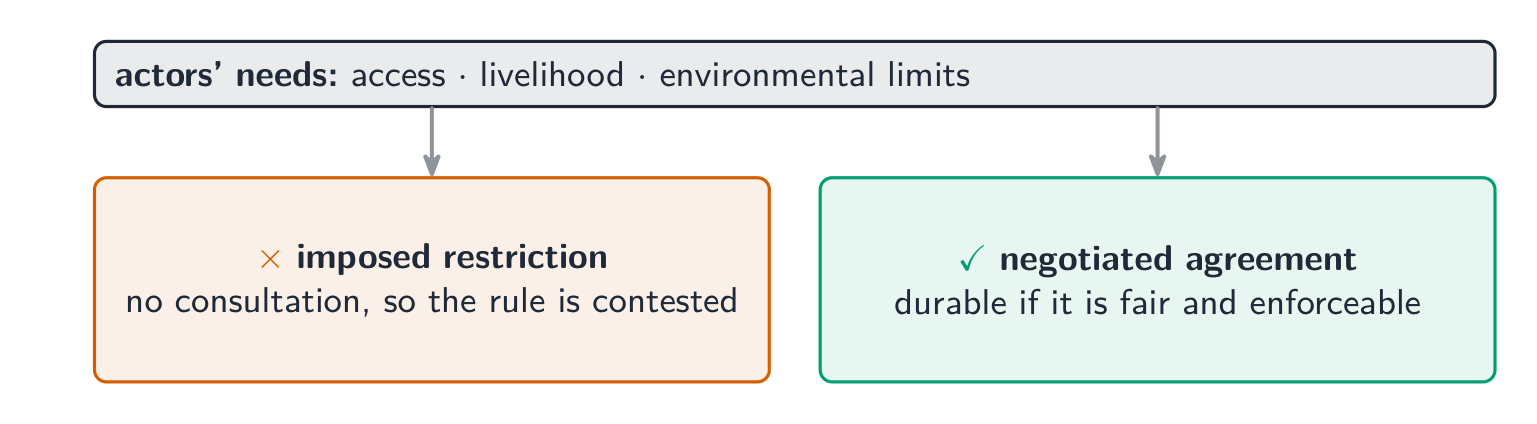
An imposed restriction made without consultation is likely to be contested.
Difficulté 1/5 · 100 pièces + un petit bonus lors de la première réussite aujourd'hui
Negotiated, fair, enforceable agreements are more durable.
Worked example: a dam on the Nile
In 2011 Ethiopia began building the Grand Ethiopian Renaissance Dam on the Blue Nile. Egypt, downstream, gets most of its fresh water from the Nile.
- Needs: Ethiopia — electricity for millions without power (development); Egypt — secure water supply (rights and security); Sudan — flood control and fair sharing.
- Response: talks over years, including US and African Union mediation, did not produce a binding agreement on how fast to fill the reservoir. Ethiopia filled it in stages anyway.
- Analysis: without a negotiated, enforceable deal, each filling raised tension. The case shows development and rights in conflict, and peace depending on agreement rather than force.
Match each state to its main need in the Nile dam dispute.
Difficulté 2/5 · 140 pièces + un petit bonus lors de la première réussite aujourd'hui
Separating needs clarifies the dispute.
Sustainability and development
- Sustainable development 可持续发展 meets present needs without harming future generations' ability to meet theirs (Brundtland Report, 1987).
- A dam can bring clean electricity (development) yet reduce river flow and fish downstream (sustainability).
What does sustainable development mean?
Difficulté 1/5 · 100 pièces + un petit bonus lors de la première réussite aujourd'hui
The Brundtland Report definition, 1987.
Positive and negative peace
- Negative peace is the absence of war. Positive peace 积极和平, Johan Galtung's term, means also removing structural violence — injustice, poverty and exclusion that harm people without open fighting.
- A resource treaty can create negative peace; fair sharing builds positive peace.
Match each type of peace to its meaning.
Difficulté 2/5 · 140 pièces + un petit bonus lors de la première réussite aujourd'hui
Galtung distinguished the two.
Do not treat "development" as automatically good. Ask whose development, at whose cost, and whether it is sustainable. The same dam can be progress for one actor and a threat for another.
Rights, development, sustainability and peace meet in resource disputes. Map the actors and their needs, compare negotiated and imposed responses, judge development by its costs, and distinguish negative peace (no war) from positive peace (fairness and no structural violence).
Analyse a resource dispute you know using actors, needs and the type of response.
Actors, needs, response, judgement.