Environmental systems, feedback and perspectives
Introduit| English | Sens |
|---|---|
| stock/stɒk/ | stock |
| flow/fləʊ/ | flux |
What would explain this observation?
- A lake can respond to the same nutrient input differently depending on its current state. Environmental outcomes depend on stocks 储量, flows 流量 and feedback.
Build the model
- A system model has a boundary, stores and flows.
- Negative feedback counteracts change; positive feedback amplifies it.
- An environmental perspective shapes what people value and which management outcomes they prioritize.
- stock: An amount held within a system.
- flow: Transfer of an amount per unit time.

What makes a reservoir budget incomplete?
Difficulté 1/5 · 100 pièces + un petit bonus lors de la première réussite aujourd'hui
A budget is incomplete if any real flow is missing: an unmeasured outflow means the books balance only because something was ignored. Consistent units and an explicit boundary are features of a good budget, not defects.
Match each technical term to its precise meaning.
Difficulté 2/5 · 140 pièces + un petit bonus lors de la première réussite aujourd'hui
Use the definitions to distinguish related quantities and processes.
Choose evidence that can test it
- Separate physical evidence from value judgements.
- A stock is an amount at a time; a flow is an amount per time.
- Sustainability decisions require ecological, social and economic evidence and a stated scale.
In the lab: Draw the system boundary before calculating a budget. Identify inflows, outflows and possible unmeasured terms. Compare stakeholder claims using the same evidence, then explain where values lead to different choices.
Which two habits make the investigation or model in this case more defensible?
Difficulté 2/5 · 140 pièces + un petit bonus lors de la première réussite aujourd'hui
Stating the conditions and assumptions lets others repeat the work exactly, and recording the supporting evidence lets them check the conclusion. Hiding disagreeing results removes the evidence that could challenge a wrong conclusion, and one measurement can never establish a wider claim.
Work from known quantities
- Known: a reservoir begins with 800 units, receives 120 and loses 90 during a week.
- Change in storage = inflow-outflow = 120-90 = 30.
- Final storage = 800+30 = 830 units.
- The model assumes no omitted flow.
Your turn: A stock starts at 600, receives 80 and loses 110. Find final stock.
Stock change = inflow − outflow
The reservoir starts at 800 units, gains 120 and loses 90 in a week: storage rises by 30 to 830. Here the inflow is the regrowth slider and the outflow the harvest slider; make the outflow larger and the stock falls.
A stock starts at 600, receives 80 and loses 110. Find final stock.
Difficulté 2/5 · 140 pièces + un petit bonus lors de la première réussite aujourd'hui
The result is 570 . Known: stock 600; inflow 80; outflow 110. Use change in stock = inflow - outflow. Change = 80 - 110 = -30. Final stock = 600 - 30 = 570 units. The negative change signals a shrinking store.
Check the conclusion and its limits
- A balance that closes mathematically can still omit a real process if terms were estimated to fit.
- Positive feedback does not mean a socially desirable result.
Not true: Positive feedback always produces a socially beneficial outcome. "Positive" in positive feedback means the change is AMPLIFIED, not that the outcome is good. Melting permafrost releasing methane is positive feedback with harmful consequences; desirability is a separate judgement.
- A system model has a boundary, stores and flows.
- Separate physical evidence from value judgements.
- Watch for: A balance that closes mathematically can still omit a real process if terms were estimated to fit.
"Positive" in positive feedback means the change is AMPLIFIED, not that the outcome is good.
Difficulté 1/5 · 100 pièces + un petit bonus lors de la première réussite aujourd'hui
True. "Positive" in positive feedback means the change is AMPLIFIED, not that the outcome is good. Melting permafrost releasing methane is positive feedback with harmful consequences; desirability is a separate judgement.
An amount held within a system: write the technical term.
Difficulté 1/5 · 100 pièces + un petit bonus lors de la première réussite aujourd'hui
stock means An amount held within a system.
Write from the data: find the final stock
- A store starts at 450 units, receives 60 and loses 35.
- Find the final stock. Positive feedback means a change is amplified, not that the outcome is good.
A store starts at 450 units, receives 60 and loses 35. What is the final stock, and what does positive feedback not mean?
Final stock is the start plus inflow minus outflow. The word positive does not judge the outcome.
A model store starts at 450 units. During one interval, 60 units enter and 35 units leave, with no other flows. What is the final stock?
Difficulté 1/5 · 100 pièces + un petit bonus lors de la première réussite aujourd'hui
450 plus 60 minus 35 is 475. The start and the inflow are inputs. Other options — 450 units (the starting stock); 60 units (the inflow alone).
Separate an observation from a judgement
- A town can agree that a wetland stores floodwater yet disagree about whether it should become a car park. Storage measurements test a factual claim; the priority given to habitat, jobs, transport and future flood risk involves values. Environmental decisions combine evidence with a stated purpose. Calling a preferred policy “scientific” does not remove its value choices.
- A perspective is how an issue is viewed and understood. Values identify what matters, while a worldview connects wider beliefs about people and nature. Education, culture, media, personal experience and economic circumstances can influence all three. A person may support both technology and habitat protection; one action or occupation does not determine their entire perspective.
Which statement is a value judgement rather than a direct measurement claim?
Difficulté 1/5 · 100 pièces + un petit bonus lors de la première réussite aujourd'hui
Priorities require values; measurements can test factual claims under a defined method and uncertainty.
Use an environmental value system as a model
- An environmental value system links inputs such as information, education and cultural experience to judgements and actions. Its processes include interpretation and weighing competing aims. A water-supply engineer and a fisher may interpret the same reservoir proposal differently, but their reasoning must be investigated rather than inferred from their job titles.
- Ecocentric arguments emphasise nature's intrinsic value; anthropocentric arguments place human interests centrally; technocentric arguments place strong confidence in technical solutions. These categories overlap and simplify real people. Desalination can express technological optimism, yet someone supporting it may also favour limits on consumption. Explain the reason behind a choice instead of assigning a label mechanically.

Does support for desalination prove that a person rejects every ecocentric argument?
Difficulté 1/5 · 100 pièces + un petit bonus lors de la première réussite aujourd'hui
Real positions can mix values and change with context. Explain the reason for the decision.
Investigate values without leading the answer
- Define the population before surveying attitudes to a proposed water policy. Use neutral wording, balanced options and an opportunity to explain a choice. “Should we protect our beautiful wetland from greedy developers?” embeds a judgement and can bias responses. A voluntary sample from one friendship group cannot automatically represent every resident.
- Protect privacy, explain the purpose and allow people to decline. Compare stated attitudes with a clearly defined behaviour where appropriate. In an invented sample, support for refill stations rises from 30 of 50 respondents to 40 of 50: from 60% to 80%, a rise of 20 percentage points or about 33% relative to the initial share. Different respondents or question wording could explain the change; the numbers alone do not establish a campaign's causal effect.
In an invented repeated survey, support rises from 30/50 to 40/50. Find the increase in percentage points.
Difficulté 2/5 · 140 pièces + un petit bonus lors de la première réussite aujourd'hui
Initial share = 100 × 30/50 = 60%; later share = 100 × 40/50 = 80%. Increase = 80 − 60 = 20 percentage points. Relative increase = 100 × 20/60 ≈ 33.3%; the survey design determines what population inference is defensible.
Which survey change best reduces a leading-question bias?
Difficulté 1/5 · 100 pièces + un petit bonus lors de la première réussite aujourd'hui
Sampling and wording are separate limitations. Neutral wording addresses the stated wording bias.
Explain how perspectives can change
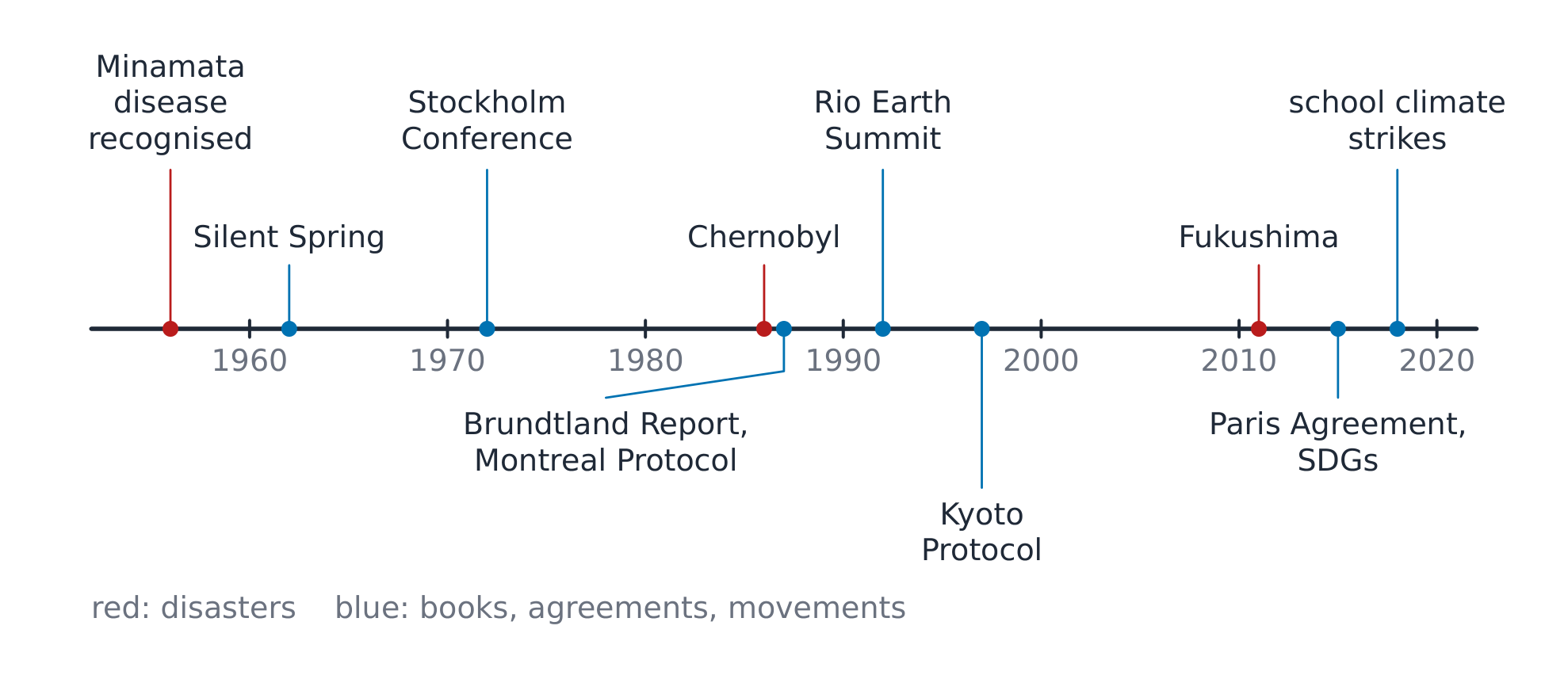
- Disasters, scientific discoveries, books, campaigns, media and technologies can alter which risks people notice and which responses seem possible. Rachel Carson's Silent Spring appeared in 1962 and helped bring pesticide effects into public debate. A historical sequence is evidence of timing; explaining influence also needs a mechanism, such as wider reporting, changed public concern or institutional response.
- The timeline marks selected events rather than a complete history or proof that one event caused every later policy. Indigenous perspectives also vary across communities and time. The 2017 Te Awa Tupua settlement in New Zealand is a specific example of legal recognition of a river, linked to Whanganui iwi relationships with it; it does not establish that every Indigenous community has the same beliefs or legal arrangements.
Set the boundary before balancing a system
- A system contains interacting parts. Its boundary is chosen for a question, not necessarily a fence visible on the ground. A lake-only boundary treats inflowing river water as an input; a catchment boundary may place that river transfer inside the system. Changing the boundary changes which arrows cross it without changing the underlying water movement.
- Represent stores as boxes and flows as directed arrows. A stock is an amount at a time, such as cubic metres of stored water; a flow is a rate, such as cubic metres per day. Label the quantity, unit and interval. Arrow widths or box sizes may show magnitude only if that visual scale is stated; otherwise the diagram is a qualitative model.
Which pair distinguishes a stock and a rate correctly?
Difficulté 1/5 · 100 pièces + un petit bonus lors de la première réussite aujourd'hui
A stock is an amount at a time; a rate needs a time denominator. Convert to interval amounts before balancing.
Convert flow rates to interval amounts
- In an invented reservoir, initial storage is $800\ \mathrm{m^3}$ and average input and output rates are 120 and $90\ \dfrac{\mathrm{m^3}}{\mathrm{day}}$ for three days. Net input is $30\ \dfrac{\mathrm{m^3}}{\mathrm{day}}$, so the change is $90\ \mathrm{m^3}$ and final storage is $890\ \mathrm{m^3}$. Adding a daily rate directly to the stock would mix unlike quantities.
- The calculation assumes these are period-average rates and all relevant exchanges are included. If measured final storage is $875\ \mathrm{m^3}$, the 15 cubic-metre discrepancy might reflect an omitted net loss, measurement uncertainty or changing rates. A balance fitted by adjusting an unknown term is not independent proof of that term's physical cause. Compare evidence and uncertainty before announcing a leak.
Initial stock is 800 m³; average input is 120 m³/day and output 90 m³/day for three days. Find final stock assuming no omitted terms.
Difficulté 2/5 · 140 pièces + un petit bonus lors de la première réussite aujourd'hui
Net rate = 120 − 90 = 30 m³/day. Interval gain = 30 × 3 = 90 m³. Final stock = 800 + 90 = 890 m³, assuming no omitted terms.
The same reservoir model predicts 890 m³, but measurement gives 875 m³. What is justified?
Difficulté 1/5 · 100 pièces + un petit bonus lors de la première réussite aujourd'hui
A residual alone does not identify the cause. Check unmeasured exchanges and measurement/model errors.
Distinguish transfer from transformation
- Transfer changes the location of matter or energy; transformation changes chemical form, physical state or energy form. Rain falling into a river transfers water. Evaporation transforms liquid water into vapour while conserving the water molecules. Photosynthesis includes chemical changes and conversion of radiant energy into chemical energy.
- Ingested biomass moving from a rabbit into a fox is a transfer in a simple food-flow diagram. Digestion and respiration within the fox also involve transformations. These are descriptions of specified processes, not mutually exclusive labels for the entire complex act of feeding. Identify which part the question asks you to classify and explain what changes.
How should ingested biomass and its later respiration be described?
Difficulté 1/5 · 100 pièces + un petit bonus lors de la première réussite aujourd'hui
Specify which process is being classified rather than treating the whole complex event as one indivisible category.
Classify exchanges rather than appearances
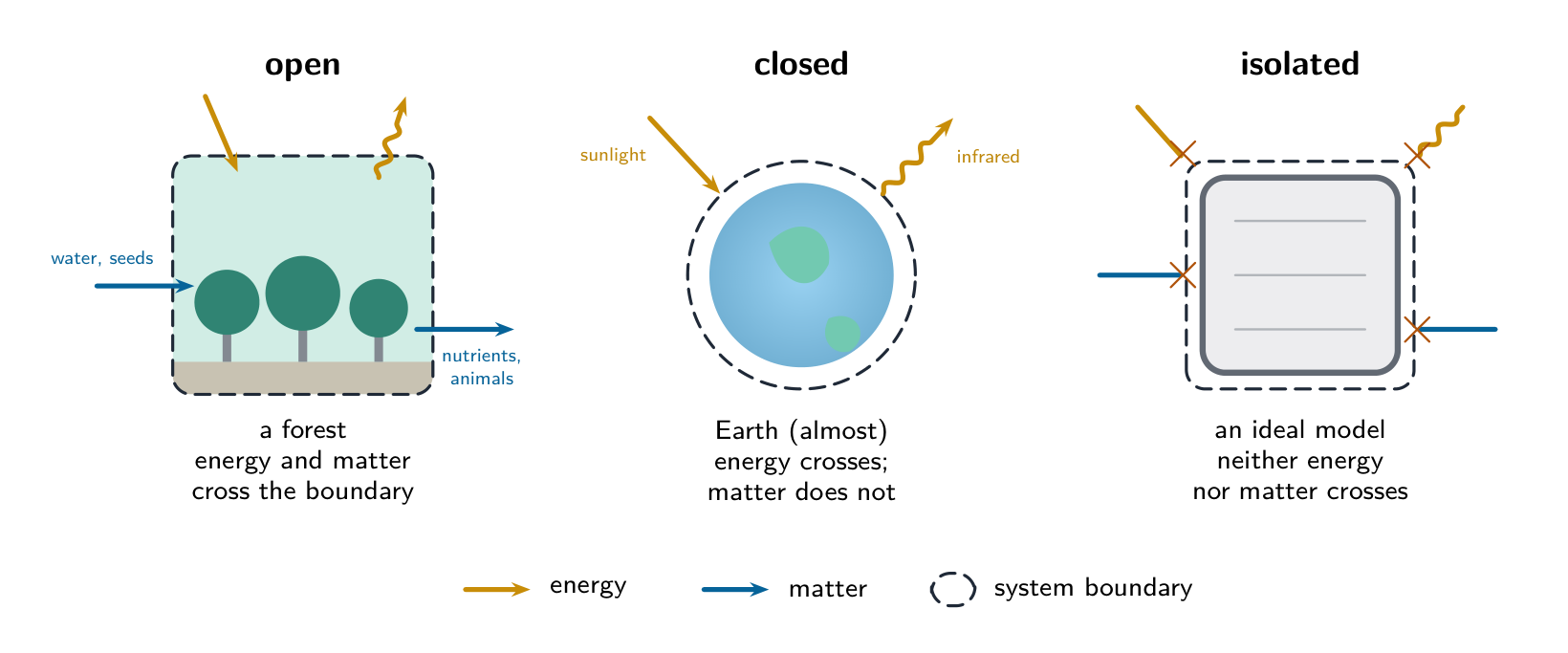
- Open systems exchange both matter and energy across the boundary. A forest receives sunlight, rainfall and organisms and releases radiation, water and materials. A closed system exchanges energy but not matter. A sealed terrarium approximates material closure while receiving light and releasing heat; being sealed does not make it isolated.
- An isolated system exchanges neither, an idealisation for practical environmental modelling. Earth is approximately closed to matter on many accounting scales, with small exchanges such as incoming meteorites and escaping gas, but it exchanges substantial radiation. Choose a timescale and purpose before deciding whether neglected exchanges are small enough for the approximation.
A sealed transparent terrarium receives light and releases heat while no matter crosses its boundary. It is best modelled as what?
Difficulté 1/5 · 100 pièces + un petit bonus lors de la première réussite aujourd'hui
A closed system exchanges energy but not matter. Sealed does not imply isolated.
Connect local and Earth-system models
- The biosphere, hydrosphere, cryosphere, geosphere, atmosphere and anthroposphere interact: life, water, ice, rocks/soils, air and human systems. A city's food imports connect its consumption to land and water use elsewhere. A local improvement can therefore export an impact beyond the measured boundary rather than remove it globally.
- Models simplify these links through diagrams, equations or simulations. They help expose assumptions and compare scenarios, but validation requires evidence independent of the model's own equations. A model can fit historical data yet give uncertain future predictions. State the purpose, omitted processes, parameter uncertainty and scale rather than dismissing every simplification as useless or treating a good fit as universal proof.
Conserve energy without confusing store and change
- Over a stated interval, energy input minus energy output equals the change in stored energy. If a model begins with 100 energy units, receives 50 and releases 40, the final store is 110 units. The input does not equal the total existing store plus output; it equals the store's change plus output. Matter budgets need equally consistent boundaries and units.
- Irreversible processes increase total entropy in an isolated system. In ecosystems, respiration disperses energy as thermal energy less available for further biological work. Not all lower-level biomass is eaten or assimilated; wastes and uneaten material also enter decomposer pathways. Energy is conserved, but less is available in higher-trophic-level biomass. There is no universal fixed transfer percentage or exact maximum number of trophic levels.
A system begins with 100 energy units, receives 50 and releases 40 over an interval. Find final stored energy.
Difficulté 2/5 · 140 pièces + un petit bonus lors de la première réussite aujourd'hui
The change is 50 − 40 = 10; final store is 110. Input equals change in store plus output, not total existing storage plus output.
Which explains reduced energy available in higher-trophic-level biomass?
Difficulté 1/5 · 100 pièces + un petit bonus lors de la première réussite aujourd'hui
Energy remains conserved, but dispersal and biomass pathways reduce its availability for higher-level production. Transfer efficiencies vary.
Trace a complete feedback loop
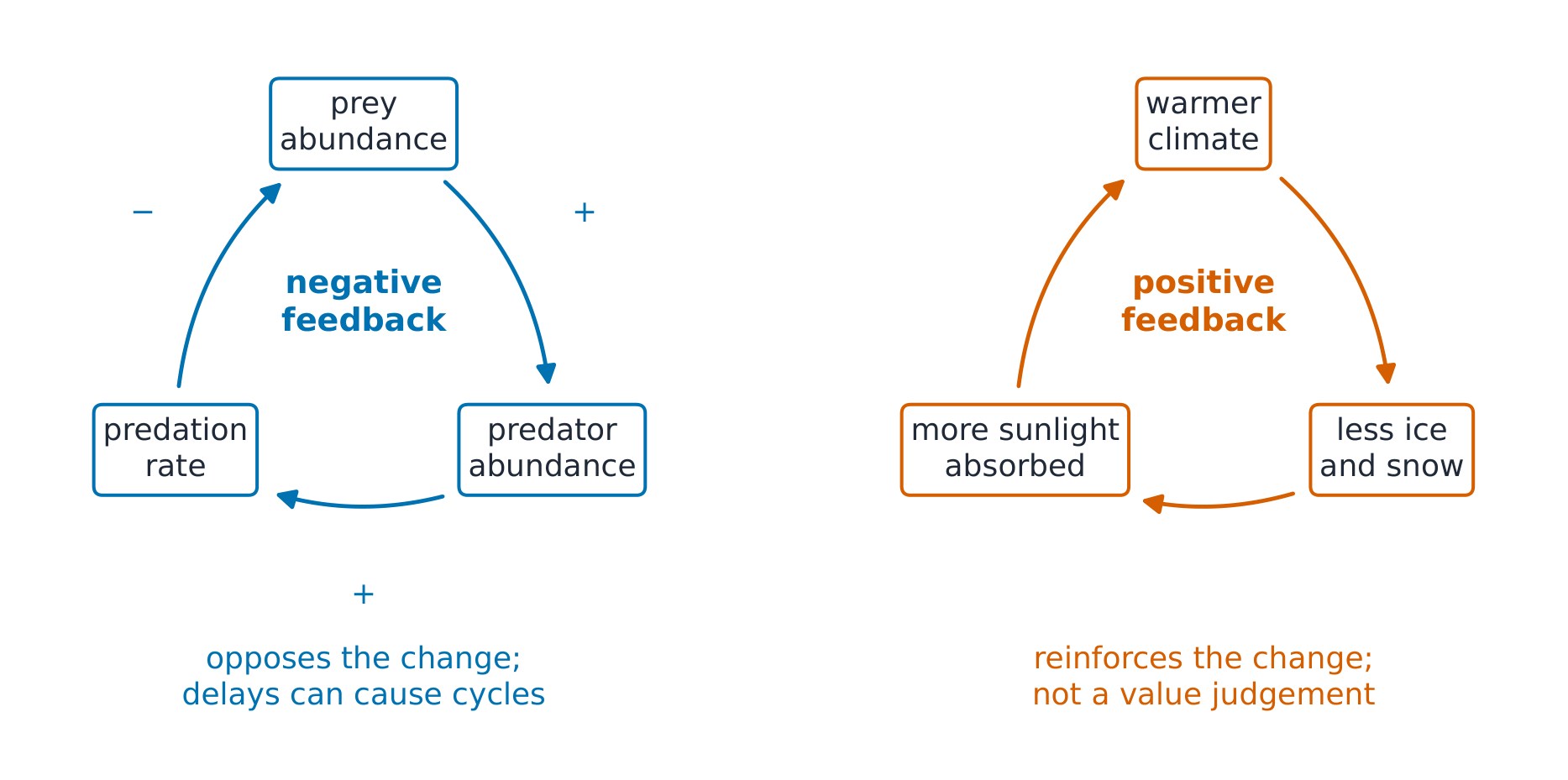
- Feedback exists when a process's effects influence that process again. Warming reduces reflective ice; darker exposed surfaces absorb more solar energy; that promotes further warming. This is positive feedback because it reinforces the original change. The word positive does not mean desirable, and an amplifying loop can reinforce a decrease as well as an increase.
- Increased prey can support more predators, whose feeding then reduces prey: a counteracting, negative feedback. Delays and other interactions can generate cycles rather than immediate stabilisation. Identify every causal link and return to the original variable. A single one-way cause and effect, with no return path, does not establish feedback. In the diagram, a + link means an increase tends to increase the next variable, and a − link tends to decrease it, other conditions held equal.
Warming reduces ice, darker surfaces absorb more sunlight, and further warming follows. Which statement is correct?
Difficulté 1/5 · 100 pièces + un petit bonus lors de la première réussite aujourd'hui
The causal path returns to warming and reinforces it. Sign describes reinforcement or opposition, not social benefit.
Test regulation with Daisyworld
- Watson and Lovelock's Daisyworld is an imaginary planet where dark and light daisies have temperature-dependent growth. Dark surfaces absorb more sunlight and warm locally; light surfaces reflect more and cool locally. Changing coverage can counter a change in solar input over a limited range. Regulation arises through interactions rather than organisms planning a planetary temperature.
- If solar input becomes unsuitable for either type, biological regulation fails. Compare the living-model temperature response with an otherwise specified lifeless model to identify what the feedback contributes. Daisyworld illustrates a mechanism; it does not independently demonstrate that real Earth has a guaranteed optimum climate. Gaia ideas connect organisms and environment through feedback, not conscious purpose or immunity to disruption.
What does Daisyworld demonstrate?
Difficulté 1/5 · 100 pièces + un petit bonus lors de la première réussite aujourd'hui
Biological and physical interactions can regulate the model without intent; regulation fails outside suitable conditions.
Distinguish equilibrium and resilience
- A steady state can have nearly constant stocks while inputs and outputs continue. Static equilibrium has no ongoing change of the relevant state in the model; a living ecosystem generally maintains active flows. Stability concerns response to a disturbance: a restoring tendency differs from a departure that grows. Constant appearance over a short interval does not alone reveal which mechanism maintains it.
- Resilience concerns the capacity to absorb disturbance and retain or recover important functions and organisation. Functional diversity, refuges, connectivity and suitable recovery traits can help under particular disturbances. Large stores or fast reproduction are not universal guarantees. Ask “resilient to what disturbance, over what timescale, and maintaining which functions?” before comparing two systems.
What is needed before claiming one ecosystem is more resilient?
Difficulté 1/5 · 100 pièces + un petit bonus lors de la première réussite aujourd'hui
Resilience is context-dependent. Steady stocks can coexist with continuing flows.
Interpret a tipping-point model cautiously
- The ball-and-valley landscape represents alternative stable states and a transition between them. Small disturbances can leave the system in its original basin; a sufficiently large disturbance or a changing landscape can lead to another state. The drawing is a generic model, not measured rainforest topography or an exact numerical forecast.
- Returning the driver to its old value may not immediately restore the old ecosystem because feedbacks and recovery conditions can differ: this is a possible form of hysteresis. A threshold may have uncertainty and depend on other drivers. Rainforest drying and clearing can interact, but a schematic valley does not prove one universal clearing percentage or an inevitable uniform switch of the entire Amazon.

Does a generic two-valley drawing establish the exact forest-clearing percentage at which all Amazon forest must change state?
Difficulté 1/5 · 100 pièces + un petit bonus lors de la première réussite aujourd'hui
The schematic is not an empirical threshold measurement. Hysteresis and uncertain context can matter.
Connect the three sustainability dimensions
- Sustainability concerns the long-term viability of linked human and environmental systems, including conditions available to future generations. Environmental aims include ecosystem functioning, regeneration, pollution limits and biodiversity. Social aims include health, education, rights and cultural continuity; economic aims concern structures supporting livelihoods and future needs. One favourable indicator cannot establish success in all dimensions.
- Strong sustainability treats critical natural functions as limits not always replaceable by other capital; represent economy inside society inside environment. A weaker-substitution view allows more replacement between capital types. A larger bank balance cannot necessarily replace a wetland's flood-storage function or an irreplaceable habitat. State the assumption instead of treating either label as an automatic verdict on a policy.
Manage natural capital with a defensible budget
- Natural capital is the resource stock and associated ecological functions; natural income is the yield or regeneration it supplies over time. An invented forest holds $500\,000\ \mathrm{m^3}$ and has net growth 2% per year under stated conditions: $10\,000\ \dfrac{\mathrm{m^3}}{\mathrm{year}}$. Harvesting $15\,000\ \dfrac{\mathrm{m^3}}{\mathrm{year}}$ reduces its timber stock by $5000\ \mathrm{m^3}$ in that one-year model.
- Growth may depend on stock size, weather, age structure and mortality. A harvest equal to a simple growth estimate is not proof of sustainability if biodiversity, soil or regeneration is impaired. Minerals do not regenerate on human timescales. Evaluate substitution, reduced demand and recovery as well as extraction; calling a resource renewable does not mean every extraction rate or method is sustainable.
An invented forest holds 500000 m³ with net growth 2% per year. Harvest is 15000 m³ in one year. Find the magnitude of timber-stock decline under this model.
Difficulté 2/5 · 140 pièces + un petit bonus lors de la première réussite aujourd'hui
Net annual growth = 500000 × 2/100 = 10000 m³. Stock change = 10000 − 15000 = −5000 m³, so decline magnitude = 5000 m³. Habitat and other losses require separate checks.
Explain services without double counting
- Provisioning services include food, water and timber; regulating services include flood regulation, carbon storage and pollination; cultural services include recreation, learning and spiritual relationships. In the common four-group framework, supporting processes such as nutrient cycling and soil formation underpin other services. A wetland can provide several benefits at once.
- A service without a market price is not without value. Monetary estimates can inform decisions but may omit cultural or intrinsic values and can double count supporting processes already represented in final benefits. Ask who benefits, which functions are replaceable, and which would be lost. A large total monetary value does not establish that harms and gains are distributed fairly.
Include justice and limits of economic indicators
- GDP records the value of production over a period; it is not a complete environmental or well-being account. Pollution cleanup can raise recorded spending while damage remains. A green-GDP estimate adjusts for environmental costs, but depends on valuation and missing information. Report social and ecological indicators alongside economic totals, and distinguish an average from distribution across households.
- Environmental justice concerns fair access, exposure, participation and recognition. An invented city's lower average air pollution could conceal an increase beside a low-income neighbourhood's waste facility. Across borders, waste exports can shift risks away from consumers. Income, cultural identity, gender and unequal influence can affect access to water, food and energy. Identify both who benefits and who bears costs at a stated scale.
A pollution cleanup raises measured spending. What follows about GDP and environmental well-being?
Difficulté 1/5 · 100 pièces + un petit bonus lors de la première réussite aujourd'hui
Measure ecological and social outcomes separately and examine which groups bear harms and receive benefits.
Calculate and qualify an ecological deficit
- Ecological-footprint accounts express demand on biologically productive area in global hectares; biocapacity expresses regeneration capacity on a comparable basis. In an invented country of 50 million people, footprint $2.0\times10^8$ gha and biocapacity $1.2\times10^8$ gha give 4.0 and 2.4 gha per person. The deficit is 1.6 gha per person and the demand/capacity ratio is about 1.67.
- This regional deficit can be met through imports, depletion or net carbon accumulation, requiring evidence to distinguish them. It is not a literal measurement of all pollution or a statement that multiplying physical land area alone solves every impact. Globally, trade cannot supply another planet's biocapacity. The Global Footprint Network method has a defined scope; use consistent accounting years and methods for comparisons.
A population of 50 million has footprint 2.0 × 10⁸ gha and biocapacity 1.2 × 10⁸ gha. Find deficit per person.
Difficulté 2/5 · 140 pièces + un petit bonus lors de la première réussite aujourd'hui
Demand per person = 200000000/50000000 = 4.0 gha; capacity per person = 120000000/50000000 = 2.4 gha. Deficit = 4.0 − 2.4 = 1.6 gha per person. This regional accounting deficit does not alone identify trade, depletion or emissions contributions.
Use several indicators and check the sample
- Carbon footprints report greenhouse-gas emissions in carbon-dioxide-equivalent units, with the boundary and period stated. Water footprints include direct and supply-chain use; methods distinguish surface/groundwater consumption, rainwater use and a pollution-related dilution-volume indicator. These are different metrics: they cannot all be added as though tonnes, cubic metres and hectares were the same quantity.
- Citizen science can widen monitoring, such as repeated bird counts with a shared protocol. Record site, season, effort and identification confidence; accessible sites and keen volunteers can bias coverage. More records may mean more observers rather than more birds. A named indicator such as species richness is useful only with a comparable area, effort and season; combine it with abundance and habitat evidence when assessing change.
Twice as many volunteers submit bird observations this year, and twice as many records appear. Is increased bird abundance established?
Difficulté 1/5 · 100 pièces + un petit bonus lors de la première réussite aujourd'hui
Compare effort, sites, season and identification quality before inferring abundance trends.
Compare global frameworks with their limits
- The SDGs link social, environmental and economic aims through shared goals and targets. They can support coordination and comparison, while trade-offs, uneven data and local differences complicate implementation. Clean-energy expansion, for example, needs evaluation of affordability, materials and land use rather than an assumption that one goal automatically satisfies every other goal.
- Planetary boundaries address nine interacting Earth-system processes and rising risk beyond proposed limits. The 2023 assessment reported six crossed boundaries, and the 2025 update seven. Date the assessment; these are not a countdown to one catastrophe or a direct local pollution allowance. The framework does not alone allocate responsibility or determine a fair policy.
Read the doughnut as a decision framework
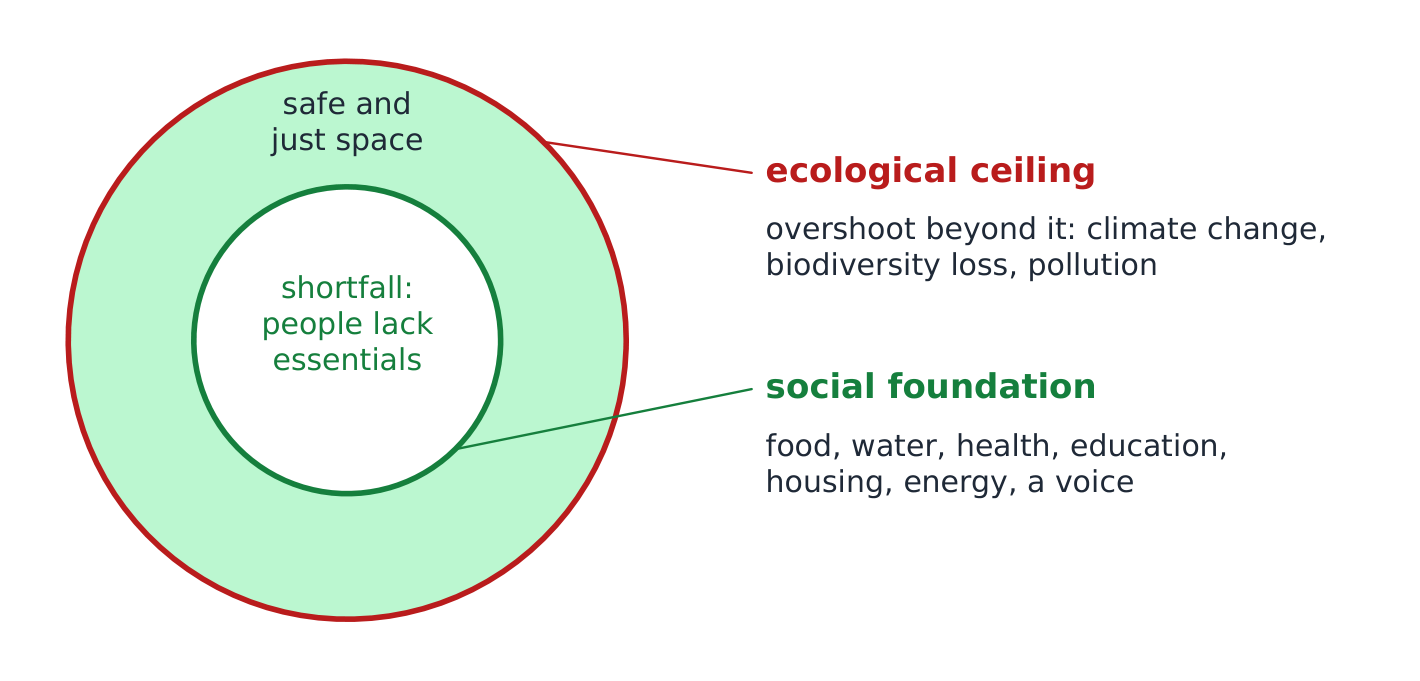
- The doughnut combines an inner social foundation with an outer ecological ceiling. The aim is to meet essential needs while remaining within ecological limits. Regenerative design restores ecological functions; distributive design shares benefits, opportunities and influence. The safe-and-just ring represents these joint aims rather than a measured guarantee that a particular city already meets them.
- A circular economy favours eliminating waste and pollution, keeping products and materials in use, and regenerating nature. Repair and reuse can reduce demand before recycling. Contamination, losses, degradation and energy needs limit recycling; increased total consumption can offset a lower impact per item. The framework needs practical measures and indicators to assess its outcomes.
Which joins the two limits of the doughnut model?
Difficulté 1/5 · 100 pièces + un petit bonus lors de la première réussite aujourd'hui
The framework requires regenerative and distributive practice plus indicators; it does not select a unique policy by itself.
Evaluate an intervention with the full evidence chain
- For a proposed development, establish a baseline, predict impacts and alternatives, plan avoidance or mitigation, and specify monitoring and responsibility. An environmental impact assessment can expose concerns before approval, but its quality depends on baseline evidence, independence, public access and follow-up. A report itself does not guarantee that predicted damage is prevented.
- Conclude at the scale the evidence supports. Combine system budgets with ecological functioning, distributional impacts and stated values; compare short- and long-term effects. If two options trade habitat protection against affordability, explain the criteria and remaining uncertainty. A strong evaluation makes a reasoned conditional judgement, rather than listing advantages and disadvantages without deciding what they imply.
Evaluate a proposal to replace a wetland with development, connecting evidence, system boundaries, sustainability and justice.
An evaluation links evidence to criteria and a judgement; it does not end at an unweighted advantages list.
AHL: Quantify a threshold comparison
- Use a named control variable, date, unit and direction of risk. In an invented index, an upper acceptable reference is 0.80 and a later observation is $0.92\pm0.03$. Its interval 0.89–0.95 lies wholly above that fixed reference. The central value exceeds it by $100(0.92-0.80)/0.80=15\%$, which is a relative exceedance, not 15 percentage points or 15% of the planet destroyed.
- If the reference itself spans 0.70–0.95, the observation overlaps that range, so a clear crossing against the whole reference interval is not established. For actual planetary-boundary comparisons use the published variable and uncertainty zone, not this invented index. Different boundaries can have different scales and indicators; a count of crossed boundaries cannot replace variable-specific quantitative analysis.
An invented upper reference is .80 and observed central index .92. Find percentage exceedance relative to the reference.
Difficulté 2/5 · 140 pièces + un petit bonus lors de la première réussite aujourd'hui
100(.92−.80)/.80 = 15%. This is an invented ratio example, not actual planetary-boundary observations.
Observed index .92 ± .03 overlaps a reference interval .70–.95. What follows?
Difficulté 1/5 · 100 pièces + un petit bonus lors de la première réussite aujourd'hui
The intervals overlap. Use named variables, assessment dates and uncertainty zones for real comparisons.
AHL: Apply the lenses without confusing them with the measurement
- Environmental law asks about duties, jurisdiction, recognition and enforcement; environmental and ecological economics examine incentives, costs and limits to substitution; environmental ethics examines responsibilities, values and distribution. An index crossing is evidence of an environmental condition, while the lenses help assess what should be done and who should act.
- For an invented wetland plan, compare enforceable protection and monitoring, the costs borne by residents and developers, and the treatment of non-human life and future generations. A monetary benefit does not automatically override a legal duty or ethical concern; equally, an asserted value does not establish a disputed scientific measurement. Keep the distinct questions connected in a reasoned decision.
Does a quantified environmental threshold decide by itself who has a legal duty to pay for a remedy?
Difficulté 1/5 · 100 pièces + un petit bonus lors de la première réussite aujourd'hui
Keep the physical evidence connected with, and distinguished from, legal obligations, incentives and ethical responsibilities.