Global economy and development
Introduit| English | Sens |
|---|---|
| exchange rate/eksˈtʃeɪndʒ reɪt/ | The price of one currency expressed in units of another currency. |
| comparative advantage/kəmˈpærətɪv ədˈvæntɪdʒ/ | avantage comparatif |
| tariffs/ˈtærɪfs/ | Taxes imposed on goods imported into a country. |
| depreciation/dɪˌpriːʃɪˈeɪʃn/ | A fall in the value of an asset or currency over time. |
| balance of payments/ˈbæləns ɒv ˈpeɪmənts/ | A record of economic transactions between an economy's residents and the rest of the world over a period. |
| economic development/ˌiːkəˈnɒmɪk dɪˈveləpmənt/ | An improvement in living standards and economic opportunities, including health, education and material welfare. |
The yuan's surprise, 11 August 2015
- On 11 August 2015 China's central bank cut the yuan's reference rate by 1.9 %, its biggest one-day fall in two decades. Stock markets around the world fell over the following weeks.
- A small change in one price — the exchange rate 汇率 — affects exporters, importers, debtors and whole economies. This lesson is about trade, exchange rates and development.
Why countries trade
- A country has a comparative advantage 比较优势 in a good if it can make it at a lower opportunity cost than others. Specialising and trading lets everyone consume beyond their own PPC.
- Countries still restrict trade: tariffs 关税 (taxes on imports), quotas and subsidies protect jobs or infant industries, but raise prices for consumers and invite retaliation.
Country A gives up 2 cloths to make 1 tonne of rice; Country B gives up 4 cloths. Who has the comparative advantage in rice?
Difficulté 1/5 · 100 pièces + un petit bonus lors de la première réussite aujourd'hui
Comparative advantage goes to the lower opportunity cost.
Which are likely effects of a tariff on imported steel?
Difficulté 2/5 · 140 pièces + un petit bonus lors de la première réussite aujourd'hui
Tariffs raise domestic prices, protecting producers and raising revenue at buyers' expense.
Exchange rates
- The exchange rate is the price of one currency in another. A depreciation 贬值 makes exports cheaper abroad and imports dearer at home; an appreciation does the opposite.
- Rates float with demand and supply of the currency, or a central bank can fix or manage them. China managed the yuan within a band.
The rate is 7.2 yuan per dollar. How many yuan does an export worth 250 dollars earn?
Difficulté 2/5 · 140 pièces + un petit bonus lors de la première réussite aujourd'hui
$250 \times 7.2 = 1800$ yuan.
The yuan depreciates against the dollar. Match each group to the effect.
Difficulté 2/5 · 140 pièces + un petit bonus lors de la première réussite aujourd'hui
A weaker yuan buys fewer dollars.
Worked example: an exporter's depreciation
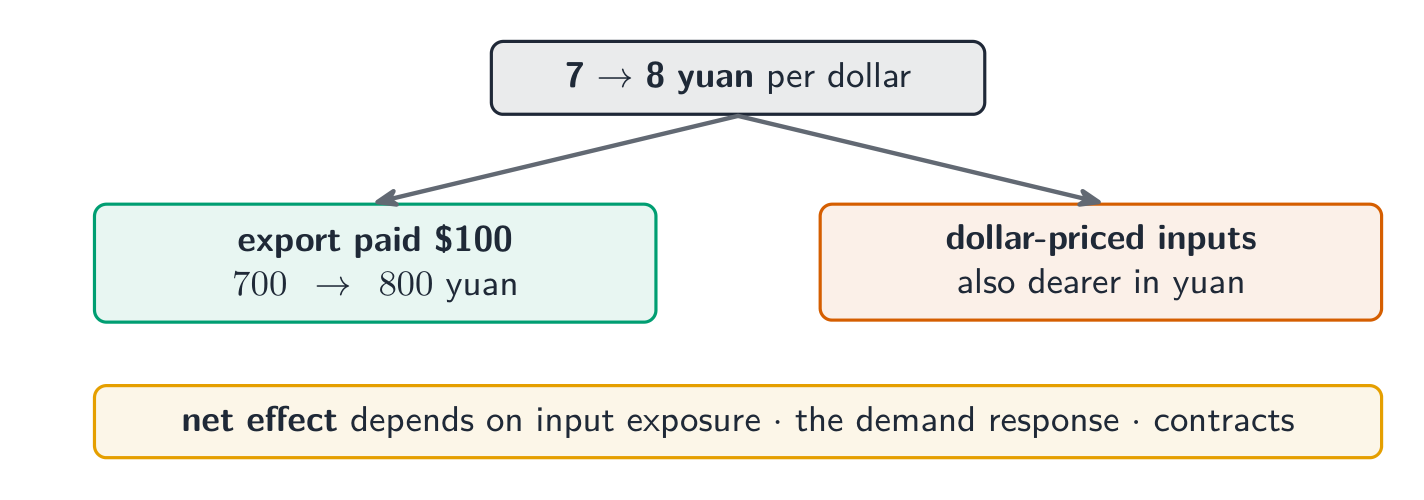
A Chinese toy firm sells a toy for 100 dollars in the USA. Its inputs include 30 dollars of imported parts. The yuan falls from 7 to 8 per dollar. What happens to its revenue and costs in yuan?
- Revenue: $100 \times 7 = 700$ yuan before; $100 \times 8 = 800$ yuan after — 100 yuan more per toy.
- Imported parts: $30 \times 7 = 210$ yuan before; $30 \times 8 = 240$ yuan after — 30 yuan more.
- Net effect: the firm gains about 70 yuan per toy at the same dollar price, or it can cut its dollar price and sell more. The gain depends on how much of its cost is imported and how strongly US demand responds.
A firm sells a product for 50 dollars and uses 20 dollars of imported inputs. The rate moves from 6 to 7 yuan per dollar. By how many yuan does its profit per unit rise, at the same dollar price?
Difficulté 2/5 · 140 pièces + un petit bonus lors de la première réussite aujourd'hui
Revenue rises by $50 \times 1 = 50$ yuan; input costs by $20 \times 1 = 20$ yuan; net +30 yuan.
The balance of payments
- The balance of payments 国际收支 records all money flows with the rest of the world. The current account includes trade in goods and services and income; the financial account records investment and loans.
- A persistent current account deficit must be financed by borrowing or selling assets. China ran large surpluses after 2001; the USA has run deficits since the 1980s.
A current account deficit means a country has no exports.
Difficulté 1/5 · 100 pièces + un petit bonus lors de la première réussite aujourd'hui
It means the country pays more abroad (for imports and income) than it receives, not that exports are zero.
Economic development
- Economic development 经济发展 is broader than growth: health, education, freedom and living standards. The Human Development Index combines life expectancy, schooling and income per head.
- Barriers include poor infrastructure, weak institutions, debt and dependence on one commodity. Strategies include trade, foreign investment, aid, microfinance and investment in education and health.
Which three measures make up the Human Development Index?
Difficulté 1/5 · 100 pièces + un petit bonus lors de la première réussite aujourd'hui
The HDI combines health, education and living standards.
Development in practice
- From 1981 to 2015 the share of the world living in extreme poverty fell from about 44 % to 10 %, with China alone lifting over 800 million people out.
- Export-led growth worked for East Asia, but depends on open markets abroad; commodity exporters risk the "resource curse" when prices fall.
"A depreciation always helps a country" is wrong. Exports become cheaper, but imported food, fuel and parts cost more, which can raise inflation and hurt firms with foreign-currency debts. The net effect depends on how responsive trade is and what the country imports.
Countries gain from trading by comparative advantage, but use tariffs and quotas to protect some industries. The exchange rate links prices across borders: a depreciation helps exporters and raises import costs. The balance of payments records these flows, and development means better lives, not just higher GDP.
Evaluate export-led growth as a development strategy for a low-income country.
Balance the case and use an example.