HL challenges and interventions
Introduit| English | Sens |
|---|---|
| intervention/ˌɪntəˈvenʃn/ | intervention |
| effectiveness/ɪˈfektɪvnəs/ | How well an intervention achieves its aim. |
| equity/ˈekwɪti/ | Fairness in who is reached and who benefits. |
A billion fingerprints, 2009 onwards
- In 2009 India began Aadhaar, a digital ID that links a 12-digit number to each person's fingerprints and iris scans. By 2023 over 1.3 billion people had one, and it helped send welfare payments straight to bank accounts.
- But when fingerprint readers failed — worn hands, weak signal — some poor families could not collect food rations. HL asks you to judge interventions 干预措施 like this: who gains, who is left out, and what would work better.
HL challenges
- HL adds two challenge areas: global well-being (health, environment, inclusion) and governance and human rights (privacy, surveillance, free expression, participation).
- Each challenge has many stakeholders and no perfect answer. Your job is to evaluate interventions with evidence, not just describe problems.
Which pair names the HL challenge areas in Digital Society?
Difficulté 1/5 · 100 pièces + un petit bonus lors de la première réussite aujourd'hui
HL extension focuses on these two areas.
Criteria for judging an intervention
- Effectiveness 有效性: does it achieve its aim, and how do we know? Equity 公平性: who is reached and who is excluded? Cost and sustainability: who pays now and later?
- Rights: does it protect privacy, consent and appeal? A good evaluation weighs these against each other, using data.
Match each question to the criterion it tests.
Difficulté 2/5 · 140 pièces + un petit bonus lors de la première réussite aujourd'hui
A full evaluation uses all four.
Worked example: digital-only clinic booking
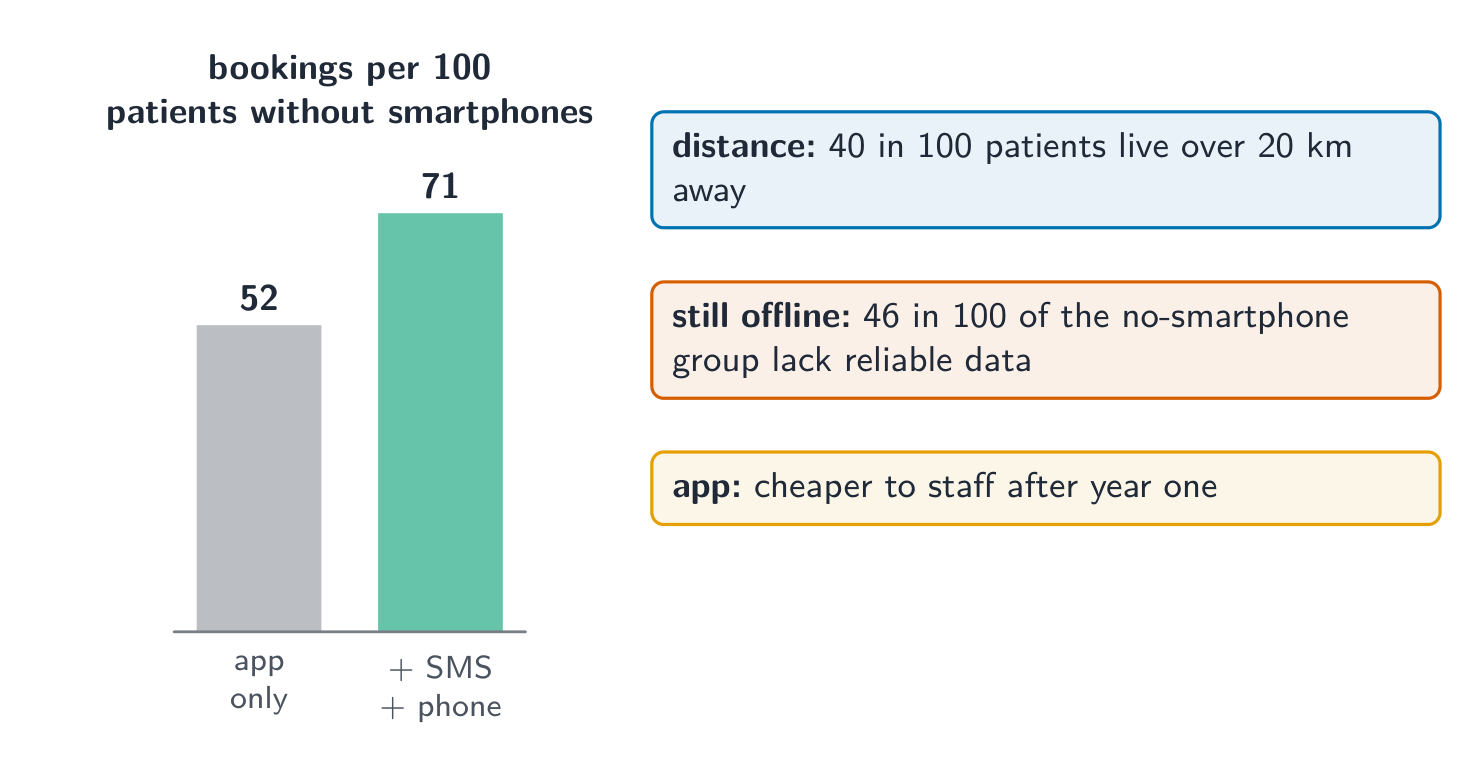
A health service plans to accept appointments only through an app. The evidence pack: 40 in 100 patients live over 20 km away; in a pilot for patients without smartphones, adding SMS and a phone line raised bookings from 52 to 71 in 100; 46 in 100 of that group lack reliable data; the app is cheaper to staff after year one. Recommend a policy.
- Effectiveness: the pilot raised bookings by $71 - 52 = 19$ per 100, an increase of $\dfrac{19}{52} \approx 37\,\%$ — strong evidence that other channels matter.
- Equity: with 46 in 100 of that group lacking data, an app-only system would exclude many of the people who live far away and most need easy booking.
- Recommendation: keep the app for most users to save staff costs, but keep SMS and a phone line for those without smartphones or data. Review booking rates by group each year.
Bookings rose from 52 to 71 per 100 patients. What is the percentage increase, to the nearest whole number?
Difficulté 2/5 · 140 pièces + un petit bonus lors de la première réussite aujourd'hui
$\dfrac{71 - 52}{52} \times 100 \approx 36.5\,\%$, about 37 %.
A group has 400 patients and 46 in 100 lack reliable data. How many lack reliable data?
Difficulté 2/5 · 140 pièces + un petit bonus lors de la première réussite aujourd'hui
$400 \times 0.46 = 184$.
Which policy best fits the clinic evidence?
Difficulté 1/5 · 100 pièces + un petit bonus lors de la première réussite aujourd'hui
It keeps the savings while protecting excluded patients.
Governance and rights
- Digital ID, facial recognition and data sharing can make services efficient but also enable surveillance. Safeguards include data-protection law, limits on purpose, independent oversight and a right to appeal.
- In 2018 India's Supreme Court upheld Aadhaar for welfare but ruled that private companies could not demand it — balancing usefulness and privacy.
Which safeguards limit misuse of a national digital ID?
Difficulté 2/5 · 140 pièces + un petit bonus lors de la première réussite aujourd'hui
Open sharing increases the risk of misuse.
Stakeholders and voices
- List the stakeholders: users, excluded groups, governments, companies, workers. Ask whose voices are in the evidence and whose are missing.
- The people most affected by exclusion — elderly, rural, disabled or poor users — are often the least visible in app data.
"The cheapest digital option is the most efficient" is wrong. If an app-only system saves staff time but patients miss appointments, the costs move to illness, emergency care and lost trust. Efficiency must count the whole system and everyone in it.
The cheapest digital system is always the most efficient for society.
Difficulté 1/5 · 100 pièces + un petit bonus lors de la première réussite aujourd'hui
Costs can shift to excluded users, illness and lost trust.
HL evaluates interventions in global well-being and in governance and human rights. Judge each by effectiveness, equity, cost and rights, using evidence such as pilot data. Look for who is excluded, and recommend policies that keep the benefits while protecting the people most at risk.
Evaluate using fingerprint ID to distribute food rations.
Weigh criteria and recommend.