Latin close reading and literary effect
Introduit| English | Sens |
|---|---|
| rhetorical device | a technique of language used to persuade or create an effect, such as repetition or a rhetorical question |
| anaphora/əˈnæfərə/ | anaphore |
| tricolon | a series of three parallel words, phrases or clauses |
| chiasmus | an ABBA pattern in which the second half reverses the order of the first |
"How long, Catiline?", 63 BC
- On 8 November 63 BC the consul Cicero rose in the Roman Senate to attack Catiline, who was plotting to seize power. He began: Quo usque tandem abutere, Catilina, patientia nostra? — "How long, Catiline, will you abuse our patience?"
- Then came a hammering list: Nihilne te nocturnum praesidium Palati, nihil urbis vigiliae, nihil timor populi… moverunt? — "Has the night guard on the Palatine, has the watch of the city, has the fear of the people… not moved you at all?" The repeated nihil is a rhetorical device 修辞手法 called anaphora 首语重复.
Whom did Cicero attack in his speech of 8 November 63 BC?
Difficulté 1/5 · 100 pièces + un petit bonus lors de la première réussite aujourd'hui
Catiline was plotting to seize power.
Which word does Cicero repeat as anaphora in the list of things that should have moved Catiline?
Difficulté 1/5 · 100 pièces + un petit bonus lors de la première réussite aujourd'hui
Nihil opens each item.
Device, effect, link
- Close reading of Latin follows the same steps as in any literature: name the device, explain its effect, and link it to the meaning of the passage.
- The effect must come from the Latin itself — its word order, sound and structure — not only from the translation.
Order the steps of close reading.
Difficulté 3/5 · 200 pièces + un petit bonus lors de la première réussite aujourd'hui
Device, effect, link.
Common Latin devices
- Anaphora: repeating a word at the start of clauses. Tricolon 三连句: three parallel items, often growing longer. Chiasmus 交错配列: an ABBA pattern.
- Hyperbaton: separating words that belong together, to delay or stress. Alliteration: repeated opening sounds.
Match each device to its description.
Difficulté 2/5 · 140 pièces + un petit bonus lors de la première réussite aujourd'hui
These are common Latin devices.
Worked example: analysing a short line
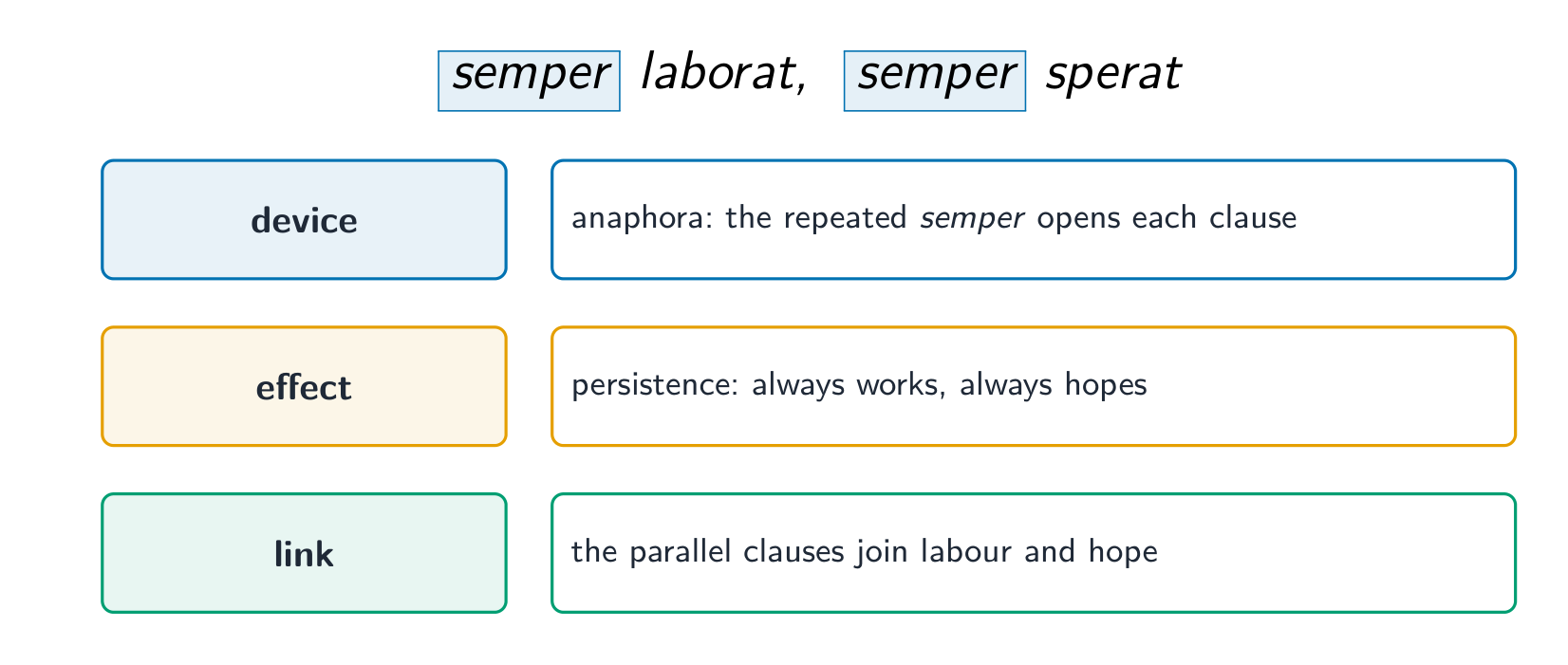
Line (an original teaching example): semper laborat, semper sperat — "always he works, always he hopes".
- Device: anaphora — semper opens both clauses; the two clauses are also parallel in length and structure (adverb + verb).
- Effect: the repetition stresses persistence; the matching endings -borat / sperat make the two actions sound alike.
- Link: labour and hope are joined as equals — the person's hope depends on their constant work. In Cicero, the same device turns a question into an accusation that will not stop.
What effect does semper laborat, semper sperat create?
Difficulté 1/5 · 100 pièces + un petit bonus lors de la première réussite aujourd'hui
Repetition and parallel structure.
Sound and position
- Latin was heard aloud. Read the line out: where is the stress, which sounds repeat?
- The first and last positions in a Latin sentence carry weight. Cicero puts Catilina in the middle of the first question, surrounded by his accusation.
The first and last positions in a Latin sentence often carry emphasis.
Difficulté 1/5 · 100 pièces + un petit bonus lors de la première réussite aujourd'hui
Position is part of meaning.
Writing the analysis
- Quote the Latin, translate it closely, then analyse: "the anaphora of nihil (…) piles up the forces Catiline has ignored, making his guilt seem obvious".
- Analyse a few features deeply rather than listing many.
Do not analyse the English translation. A device must exist in the Latin. "The word 'abuse' sounds harsh" is about the translator; abutere and its position are what Cicero chose.
Analysing the sound of an English translation shows Cicero's technique.
Difficulté 1/5 · 100 pièces + un petit bonus lors de la première réussite aujourd'hui
Devices must exist in the Latin.
Close reading of Latin names a device — anaphora, tricolon, chiasmus, hyperbaton — explains its effect from the Latin's structure, sound and word position, and links it to meaning. Quote the Latin, translate closely, and analyse a few features in depth.
Analyse Veni, vidi, vici ("I came, I saw, I conquered"), attributed to Julius Caesar.
Device, effect, link.