Atmosphere, resources and life-cycle decisions
Introduit| English | Sens |
|---|---|
| life-cycle assessment/laɪf ˈsaɪkl əˈsesmənt/ | analyse du cycle de vie |
| functional unit/ˈfʌŋkʃənl ˈjuːnɪt/ | unité fonctionnelle |
What would explain this observation?
- A reusable container can require more energy to manufacture than a single-use one. Its impact depends on how often it is used and what happens at disposal.
Build the model
- A life-cycle assessment 生命周期评价 considers raw materials, manufacture, transport, use and end-of-life processes.
- Greenhouse gases absorb and emit infrared radiation; pollution and climate effects are related but distinct questions.
- life-cycle assessment: Assessment across production, use and disposal.
- functional unit 功能单位: The common service used for a fair comparison.

Which comparison uses a consistent functional unit?
Difficulté 1/5 · 100 pièces + un petit bonus lors de la première réussite aujourd'hui
A fair life-cycle comparison keeps the functional unit constant - the same service, such as one litre delivered one thousand times. Comparing one bottle against an arbitrary number of bags or matching colours measures nothing useful.
Match each technical term to its precise meaning.
Difficulté 2/5 · 140 pièces + un petit bonus lors de la première réussite aujourd'hui
Use the definitions to distinguish related quantities and processes.
Choose evidence that can test it
- Define the functional unit before comparing products.
- The same delivered service, such as carrying one litre of water a hundred times, is fairer than comparing one object with another regardless of lifetime.
In the lab: List system boundaries, energy sources and assumptions. Compare water demand, emissions and waste separately before making a judgement. Explain whose priorities affect the decision and where the data are uncertain.
Which two habits make the investigation or model in this case more defensible?
Difficulté 2/5 · 140 pièces + un petit bonus lors de la première réussite aujourd'hui
Stating the conditions and assumptions lets others repeat the work exactly, and recording the supporting evidence lets them check the conclusion. Hiding disagreeing results removes the evidence that could challenge a wrong conclusion, and one measurement can never establish a wider claim.
Work from known quantities
- Known: a reusable item requires 1,000 energy units to make and 10 per use; a disposable item requires 60 per use.
- Equality occurs when 1,000 + 10n = 60n.
- Rearranging gives 1,000 = 50n, so n = 20 uses under this simplified model.
Your turn: A reusable item costs 600 energy units initially and 5 per use; disposables cost 35 per use. Find break-even uses.
Equal service, different energy totals
1,000 + 10n and 60n are equal at 20 uses. Change the manufacture and per-use energy assumptions to see when reuse has lower energy for the same completed service.
A reusable item costs 600 energy units initially and 5 per use; disposables cost 35 per use. Find break-even uses.
Difficulté 2/5 · 140 pièces + un petit bonus lors de la première réussite aujourd'hui
The result is 20 uses. Known: reusable item 600 units initially plus 5 per use; disposable 35 per use. Break-even: 600 + 5n = 35n. Rearranging: 600 = 30n, so n = 20 uses. Above 20 uses the reusable item is ahead under this simplified model.
Check the conclusion and its limits
- A break-even model is sensitive to cleaning, transport and disposal assumptions.
- Recyclable does not guarantee that an item is actually collected and recycled.
Not true: A recyclable product is always recycled after use. Recyclable means the material CAN be recycled with the right collection and processing; actual recycling depends on local systems and behaviour. Many recyclable items are never collected.
- A life-cycle assessment considers raw materials, manufacture, transport, use and end-of-life processes.
- Define the functional unit before comparing products.
- Watch for: A break-even model is sensitive to cleaning, transport and disposal assumptions.
A recyclable product is always recycled after use.
Difficulté 1/5 · 100 pièces + un petit bonus lors de la première réussite aujourd'hui
Recyclable means the material CAN be recycled with the right collection and processing; actual recycling depends on local systems and behaviour. Many recyclable items are never collected.
Assessment across production, use and disposal: write the technical term.
Difficulté 1/5 · 100 pièces + un petit bonus lors de la première réussite aujourd'hui
life-cycle assessment means Assessment across production, use and disposal.
A reusable item costs 900 energy units to make and 6 per use. A disposable item costs 36 per use. At how many uses are the totals equal, and what does recyclable not guarantee?
Set total energies equal: 900 + 6n = 36n. Rearrange to 900 = (36 − 6)n = 30n, giving n = 900/30 = 30 uses. Reuse is lower only above 30 uses in this model. Recyclability still needs collection and processing to become actual recycling.
A reusable item requires 900 energy units to make and 6 per use. A disposable requires 36 per use. At how many uses are their total energy requirements equal?
Difficulté 1/5 · 100 pièces + un petit bonus lors de la première réussite aujourd'hui
900 + 6n = 36n, so n = 900/30 = 30 uses. Equality is at 30; reuse is lower only after 30 under this energy model.
Write from a fuel decision with a stated boundary
- The original written case gives a reusable item 900 energy units of manufacture and 6 per use; a disposable uses 36 per use. Equality is $900+6n=36n$, so $n=30$. At 30 uses neither wins on energy; the first whole number for which reuse uses less is 31. Recyclable still does not mean collected and recycled.
- Energy from fuels involves both chemical changes and decisions about resources. The following original comparison scenarios develop Reactivity 1.3, shared by SL and HL. Distinguish energy released, useful energy delivered, direct emissions and life-cycle impacts. A favourable number on one measure need not settle the whole decision.
Balance complete combustion from the atoms
- Complete combustion of a hydrocarbon or alcohol forms carbon dioxide and water. For propane, balance carbon and hydrogen before oxygen: $\mathrm{C_3H_8+5O_2\rightarrow3CO_2+4H_2O}$. The products contain ten oxygen atoms, supplied by five oxygen molecules. For ethanol, $\mathrm{C_2H_5OH+3O_2\rightarrow2CO_2+3H_2O}$: its own oxygen atom reduces the external oxygen requirement.
- Combustion releases energy overall when forming product bonds releases more energy than breaking reactant bonds requires. Ignition overcomes an activation barrier; exothermic does not mean spontaneous ignition at room temperature. Match the physical states to the enthalpy value used: forming liquid water releases additional heat compared with leaving that water as vapour.
In complete ethanol combustion, C₂H₅OH + x O₂ → 2 CO₂ + 3 H₂O. Find x.
Difficulté 2/5 · 140 pièces + un petit bonus lors de la première réussite aujourd'hui
The products contain seven oxygen atoms. Ethanol already supplies one, so the remaining six come from three O₂ molecules.
Limited oxygen changes the products and the evidence
- Idealized methane reactions include $\mathrm{2CH_4+3O_2\rightarrow2CO+4H_2O}$ and $\mathrm{CH_4+O_2\rightarrow C+2H_2O}$. A real flame may produce mixtures of carbon dioxide, carbon monoxide and carbon-rich particles. Mixing, oxygen supply and vaporization matter; a clean-looking flame does not establish that carbon monoxide is absent.
- Carbon monoxide binds strongly to haemoglobin and impairs oxygen transport; particles also harm health. More chemical energy remains in CO or carbon than in fully oxidized products, so incomplete combustion releases less heat per mole of fuel to the same final water state. This reasoning supports proper oxygen supply and ventilation; do not create oxygen-starved flames as a classroom comparison.
Change the denominator before ranking fuels
- An invented fuel A releases 900 kJ per mole and has molar mass $18\ \dfrac{\mathrm{g}}{\mathrm{mol}}$; fuel B releases 1400 kJ per mole with molar mass $50\ \dfrac{\mathrm{g}}{\mathrm{mol}}$. Their specific energies are $900/18=50$ and $1400/50=28\ \dfrac{\mathrm{kJ}}{\mathrm{g}}$. B wins per mole, A per gram. Use positive released-energy magnitudes for this comparison, although their combustion enthalpies are negative.
- Specific energy compares energy per mass; energy density compares energy per volume. An invented liquid releasing $30\ \dfrac{\mathrm{kJ}}{\mathrm{g}}$ with density $0.80\ \dfrac{\mathrm{g}}{\mathrm{cm}^3}$ stores $24\ \dfrac{\mathrm{kJ}}{\mathrm{cm}^3}$. A gas needs a specified pressure, temperature and storage system before a volume comparison is meaningful. Tank mass and safety constraints can matter too.
Invented fuel A releases 900 kJ/mol and has molar mass 18 g/mol. Fuel B releases 1400 kJ/mol and has molar mass 50 g/mol. Find A’s energy released per gram and compare the fuels on this mass basis.
Difficulté 2/5 · 140 pièces + un petit bonus lors de la première réussite aujourd'hui
Specific energy = released-energy magnitude/molar mass. For A, 900/18 = 50 kJ/g; for B, 1400/50 = 28 kJ/g. A releases more energy per gram even though B releases more per mole. Both comparisons use positive released-energy magnitudes.
Compare the same useful service
- Suppose an invented fuel produces 48 g direct CO₂ for each megajoule released and a heater delivers 80% of that energy usefully. One useful megajoule needs $1/0.80=1.25$ released megajoules, so direct emissions are $48/0.80=60$ g per useful megajoule. Multiplying by 0.80 would incorrectly make inefficiency reduce the fuel needed.
- For 10 MJ of useful heat, the heater requires $10/0.80=12.5$ MJ input. If its fuel releases $50\ \dfrac{\mathrm{MJ}}{\mathrm{kg}}$, fuel mass is $12.5/50=0.25$ kg. Another device's emissions per released MJ cannot be compared directly with this device's emissions per useful MJ. The functional unit must describe the same service on both sides.
A fuel produces 48 g direct CO₂ per released MJ; its heater delivers 80% as useful heat. Find direct CO₂ per useful MJ.
Difficulté 2/5 · 140 pièces + un petit bonus lors de la première réussite aujourd'hui
One useful MJ requires 1/0.80 released MJ. Therefore emissions are 48/0.80 = 60 g per useful MJ. Multiplying by 0.80 would incorrectly reward losses.
Distinguish a climate effect from other pollution
- Fossil fuels derive from ancient biological material and are non-renewable on human timescales. Coal is a carbon-rich solid with impurities; crude oil is a mixture refined into fractions; natural gas is methane-rich. Lower direct combustion CO₂ for one fuel does not account for extraction, refining or methane leaking during supply.
- Greenhouse gases absorb and emit infrared radiation. Increasing their concentration changes the Earth's energy balance; the enhanced greenhouse effect is different from ozone depletion. Carbon monoxide toxicity, soot exposure and climate warming are different effects, even when one activity contributes to several. A CO₂-only comparison is therefore an explicitly limited assessment.
Renewable feedstock does not guarantee carbon neutrality
- Photosynthesis transfers solar energy into chemical stores: $\mathrm{6CO_2+6H_2O\rightarrow C_6H_{12}O_6+6O_2}$. Fermentation can produce ethanol: $\mathrm{C_6H_{12}O_6\rightarrow2C_2H_5OH+2CO_2}$. Burning that ethanol returns carbon to the atmosphere; the carbon source and timing matter when comparing it with fossil carbon.
- Regrowth can remove atmospheric carbon, but fertilizer manufacture, processing, transport and land-use change can add emissions or reduce carbon stocks. A renewable feedstock is not automatically impact-free or sustainably supplied. Count uptake and later release consistently, without crediting the same uptake twice. Waste-derived fuels and dedicated crops may have different boundaries and competing uses.
Add life-cycle contributions on a common basis
- In an invented comparison per useful megajoule, A produces 60 g direct emissions plus 15 g upstream emissions, totalling 75 g CO₂-equivalent. B produces 72 g direct emissions, receives an explicitly assumed 50 g uptake credit and adds 20 g upstream: $72-50+20=42$ g CO₂-equivalent. B's higher exhaust value alone would give the wrong ranking under this accounting.
- If B's upstream contribution becomes 70 g and its credit falls to 40 g, its total becomes $72-40+70=102$ g, exceeding A. A conclusion depends on justified data and boundaries. CO₂-equivalent combines greenhouse gases using a stated accounting basis; it is not a claim that every gram is CO₂ in the exhaust. Consider land, water, toxicity and waste separately.
Per useful MJ, B has 72 g direct emissions, a 40 g uptake credit and 70 g upstream emissions on a common CO₂-equivalent basis. A totals 75 g on the same basis. Find B’s net total and compare it with A.
Difficulté 2/5 · 140 pièces + un petit bonus lors de la première réussite aujourd'hui
Net emissions = direct emissions + upstream emissions − uptake credit = 72 + 70 − 40 = 102 g CO₂- equivalent per useful MJ. This is 102 − 75 = 27 g more than A on the same service basis.
Test when the break-even conclusion exists
- For manufacture cost $M$, reusable cost per use $r$ and single-use cost per service $d$, equality is $M+rn=dn$, giving $n=M/(d-r)$ when $d>r$. With $M=840$, $r=7$ and $d=35$, equality is 30 uses. At 31, reuse needs 1057 units and single-use 1085, a saving of 28 units.
- If cleaning rises to 14 units, equality moves to $840/(35-14)=40$ uses. If the reusable cost per use equals or exceeds 35, a positive manufacturing cost never pays back in this energy model. Breakage before the crossover also defeats the expected saving. Energy equality does not establish equality for water use or emissions.
A hydrogen fuel cell separates electron and ion paths
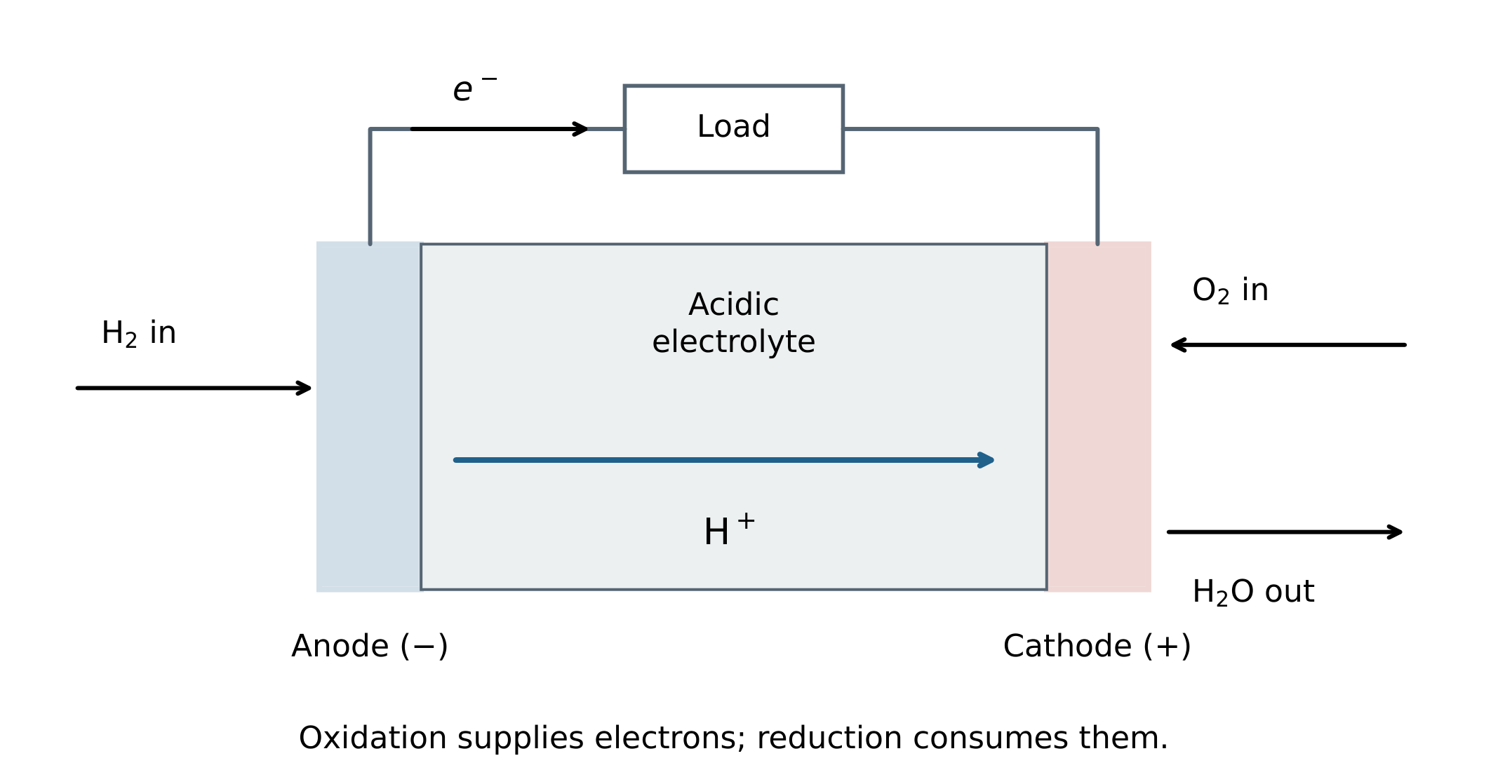
- In an acidic hydrogen cell, anode oxidation is $\mathrm{H_2\rightarrow2H^++2e^-}$ and cathode reduction is $\mathrm{\tfrac12O_2+2H^++2e^-\rightarrow H_2O}$. Adding and cancelling gives $\mathrm{H_2+\tfrac12O_2\rightarrow H_2O}$. Check atoms and charge as well as cancelling the electrons. Oxidation defines the anode; reduction defines the cathode.
- Electrons pass through an external load from anode to cathode; ions carry charge through the electrolyte. The electrolyte should not short-circuit the electron route. Fuel and oxidant are supplied continuously, unlike a primary cell with finite stored reactants. In this operating fuel cell the anode is negative and cathode positive; those signs are not the definitions of the electrode names.
Keep half-equations in the same medium
- In alkaline conditions, hydrogen oxidation is $\mathrm{H_2+2OH^-\rightarrow2H_2O+2e^-}$; oxygen reduction is $\mathrm{\tfrac12O_2+H_2O+2e^-\rightarrow2OH^-}$. The same overall hydrogen–oxygen reaction results. Combining an acidic half-equation with an alkaline one without further balancing leaves a different and usually incorrect account of ions and water.
- Methanol oxidation releases six electrons per molecule in this acidic model. Add its half-equation to three times the acidic oxygen-reduction half-equation, then cancel electrons, hydrogen ions and water. The result includes carbon dioxide: not all fuel cells produce only water. Methanol also requires appropriate handling because it is toxic.
Finish with efficiency and the limits of the claim
- An invented cell receives 100 kJ chemical energy and delivers 58 kJ electricity plus 30 kJ useful heat. Electrical efficiency is 58%; total useful-energy efficiency is 88%, provided that the heat really serves a useful demand. The remaining 12 kJ is not destroyed; it is transferred in forms not counted as useful in this definition.
- Hydrogen is an energy carrier. Making, compressing, transporting and storing it require energy and resources. A hydrogen–oxygen cell has no direct CO₂ from its cell reaction, but that does not establish zero life-cycle emissions or 100% efficiency. Support a fuel decision with a balanced chemical account, a common functional unit, stated boundaries and an evaluation of the evidence.
A hydrogen cell produces water and converts 58 kJ of a 100 kJ chemical input into electricity; another 30 kJ warms a building usefully. Evaluate the claim that it has 100% efficiency and no environmental impact.
Specify the energy output counted and the system boundary before evaluating an environmental claim.