Sexual reproduction: meiosis and fertilization have different roles
Introduit| English | Sens |
|---|---|
| fertilization/ˌfɜːtɪlaɪˈzeɪʃn/ | fécondation |
| haploid/ˈhæplɔɪd/ | haploïde |
What would explain this observation?
- Gametes normally contain one set of chromosomes, while fertilization 受精 joins two sets. Maintaining chromosome number across generations requires both processes.
Build the model
- Meiosis reduces chromosome number when producing haploid 单倍体 cells from a diploid starting cell.
- Homologous chromosomes separate in meiosis I, while sister chromatids separate in meiosis II.
- Fertilization combines haploid gamete nuclei to form a diploid zygote.
- Sexual reproduction can create new combinations of existing alleles.
- haploid: Having one chromosome set in the stated life cycle.
- fertilization: Fusion of gamete nuclei to form a zygote.

Which process restores diploid chromosome number in this model?
Difficulté 1/5 · 100 pièces + un petit bonus lors de la première réussite aujourd'hui
Meiosis halves the chromosome number to make haploid gametes; fertilization fuses two gametes and restores the diploid number. Neither meiosis II alone nor DNA replication adds a second set.
Match each technical term to its precise meaning.
Difficulté 2/5 · 140 pièces + un petit bonus lors de la première réussite aujourd'hui
Use the definitions to distinguish related quantities and processes.
Choose evidence that can test it
- Distinguish homologous chromosomes from sister chromatids, and chromosome number from DNA quantity.
- Replication before meiosis copies DNA without doubling the number of chromosome sets.
- Crossing over and independent assortment contribute to genetic variation, while random fertilization further changes combinations.
- These processes do not make every offspring genetically distinct under every conceivable condition.
In the lab: Use a labelled model organism with a stated chromosome number. Track chromosome sets through replication, meiosis I, meiosis II and fertilization. Use anonymous model data rather than personal family or reproductive-health information. Compare organism life cycles carefully; flowering-plant and animal reproductive structures require their own additional teaching.
Which two habits make the investigation or model in this case more defensible?
Difficulté 2/5 · 140 pièces + un petit bonus lors de la première réussite aujourd'hui
Stating the conditions and assumptions lets others repeat the work exactly, and recording the supporting evidence lets them check the conclusion. Hiding disagreeing results removes the evidence that could challenge a wrong conclusion, and one measurement can never establish a wider claim.
Work from known quantities
- Known: a model organism has diploid chromosome number 2n=12.
- A gamete has n=6.
- After fertilization, the zygote has 12 chromosomes.
- With six independently assorting chromosome pairs and ignoring crossing over, there are 2⁶=64 possible maternal/paternal chromosome combinations in a gamete.
- This is a model count, not a probability of an individual phenotype.
Your turn: A model organism has diploid chromosome number 20. How many chromosomes are normally in a gamete?
Replication copies DNA; meiosis separates chromosome sets
Track the lesson's 2n=12 model through stable endpoints. Compare chromosome counts with DNA molecules, restore 12 chromosomes at fertilization, and explore the 64 possible origin combinations across many meioses without crossing over.
A model organism has diploid chromosome number 20. How many chromosomes are normally in a gamete?
Difficulté 2/5 · 140 pièces + un petit bonus lors de la première réussite aujourd'hui
The result is 10 chromosomes. Known: diploid number 2n = 20. A gamete carries one set: n = 20/2 = 10 chromosomes. Fertilization of two such gametes restores 20.
Check the conclusion and its limits
- A gamete is not made by halving the size of an ordinary cell.
- Independent assortment counts assume distinct homologous alternatives and do not include crossing-over outcomes.
- Human and plant reproduction cannot be fully replaced by a monohybrid Punnett grid.
Not true: DNA replication alone changes a diploid cell into a tetraploid cell. Replication doubles the DNA content but the chromosomes still count as one each (two sister chromatids); the cell remains diploid. Tetraploidy is a change in chromosome sets; one ordinary DNA-replication phase does not produce it.
- Meiosis reduces chromosome number when producing haploid cells from a diploid starting cell.
- Distinguish homologous chromosomes from sister chromatids, and chromosome number from DNA quantity.
- Watch for: A gamete is not made by halving the size of an ordinary cell.
DNA replication alone changes a diploid cell into a tetraploid cell.
Difficulté 1/5 · 100 pièces + un petit bonus lors de la première réussite aujourd'hui
Replication doubles the DNA content but the chromosomes still count as one each (two sister chromatids); the cell remains diploid. Tetraploidy is a change in chromosome sets; one ordinary DNA-replication phase does not produce it.
Having one chromosome set in the stated life cycle: write the technical term.
Difficulté 1/5 · 100 pièces + un petit bonus lors de la première réussite aujourd'hui
haploid means Having one chromosome set in the stated life cycle.
Write from the data given
- A model organism has diploid chromosome number 46.
- A gamete normally has half that number. Replication alone does not turn a diploid cell into a tetraploid cell.
A model organism has diploid chromosome number 46. How many chromosomes are normally in a gamete, and why does DNA replication alone not make the cell tetraploid?
Gamete chromosome number = diploid number/2 = 46/2 = 23. Replication copies DNA into attached sister chromatids without adding a chromosome set, so the cell remains diploid. Fertilization joins two haploid contributions and restores 46 chromosomes.
The SL written model organism has diploid chromosome number 46. How many chromosomes are normally in a gamete?
Difficulté 1/5 · 100 pièces + un petit bonus lors de la première réussite aujourd'hui
46 divided by 2 is 23. Other options — 10 (the lesson gamete from a diploid number of 20); 46 (the diploid number).
Compare reproduction by mechanism and conditions
- A strawberry runner produces another plant without gamete fusion. This is asexual reproduction: one successful genotype can spread without finding a mate. Similar inherited susceptibility can become a disadvantage after disease or environmental change. Mutation can still create variation in an asexual lineage.
- Sexual reproduction combines gametes and reshuffles inherited alleles. Some combinations may suit changed conditions, but no process guarantees improvement in every offspring. Transfer costs, time and energy matter. Self-fertilization is sexual even when one organism supplies both gametes; count gamete fusion, not simply the number of parents nearby.
A flower supplies both gametes, which fuse. Which description follows from the mechanism?
Difficulté 1/5 · 100 pièces + un petit bonus lors de la première réussite aujourd'hui
Gamete fusion defines sexual reproduction. Selfing changes parentage, not that mechanism; pollen transfer and fusion remain different events.
Connect chromosome sets with gamete strategies
- In an invented species with 2n = 12, normal gametes carry six chromosomes and a zygote twelve. Ignoring crossing over, six independently orienting pairs permit 64 whole-chromosome combinations across possible gametes. One meiosis still produces four haploid nuclei, rather than 64 offspring. DNA replication copies each chromosome before division without supplying another homologous set.
- Male and female reproductive roles are defined by smaller and larger gametes. Animal sperm typically have little reserve and are produced in large numbers; larger eggs retain more cytoplasm and resources. Number alone does not determine reproductive success: transfer, fertilization and offspring survival intervene. A flower with both reproductive structures can provide both gamete types.
Trace sperm production and transfer through connected structures
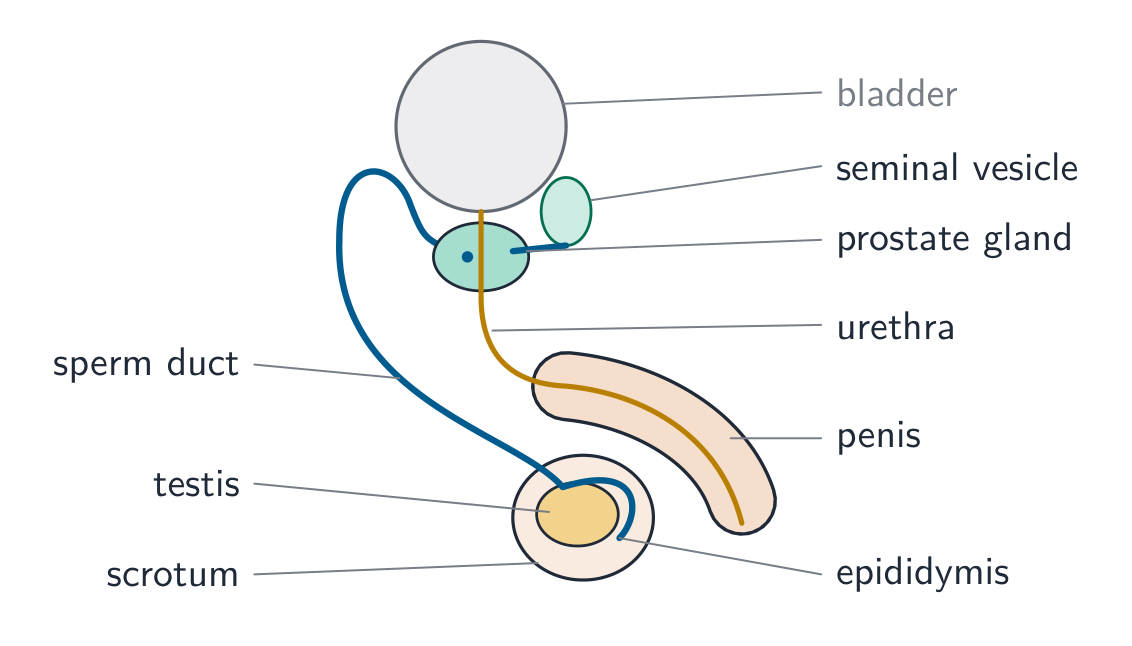
- Testes contain sperm-producing tubules and also produce testosterone. The scrotum supports a temperature suitable for sperm production. Sperm mature further in the epididymis, then travel along the sperm duct, or vas deferens, towards the urethra. Follow the connected route rather than memorizing isolated labels.
- Seminal vesicles and the prostate add secretions contributing to semen. Semen is not pure sperm; the bladder stores urine, not sperm. The urethra carries semen through the penis during ejaculation and urine at other times. The diagram is a simplified typical arrangement, showing one representative testis and duct.
Separate oocyte release, fertilization and implantation sites
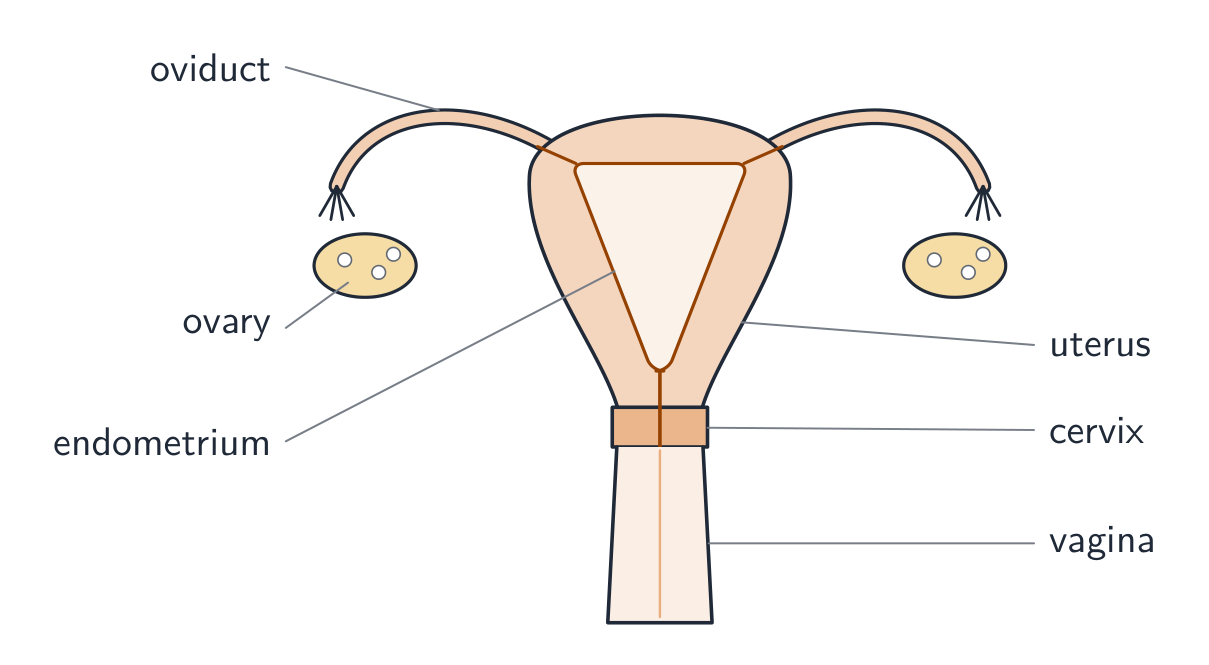
- Ovaries contain developing oocytes and produce ovarian hormones. A released oocyte can enter an oviduct, where fertilization usually occurs. The tube has an open funnel near the ovary, rather than forming a sealed continuation of it. Cilia and muscle help move the oocyte and early embryo.
- The uterine endometrium supports implantation after embryo development and transport. The muscular uterus connects through its cervix to the vagina, which receives semen and forms part of the birth canal. The urinary outlet is separate. Do not put fertilization in the uterus simply because later pregnancy develops there.
Which sequence correctly distinguishes the usual human fertilization site from later implantation?
Difficulté 1/5 · 100 pièces + un petit bonus lors de la première réussite aujourd'hui
Oocytes are released from ovaries; fertilization normally occurs in an oviduct. Development and transport precede implantation in the endometrium.
Link ovarian events with the changing uterine lining
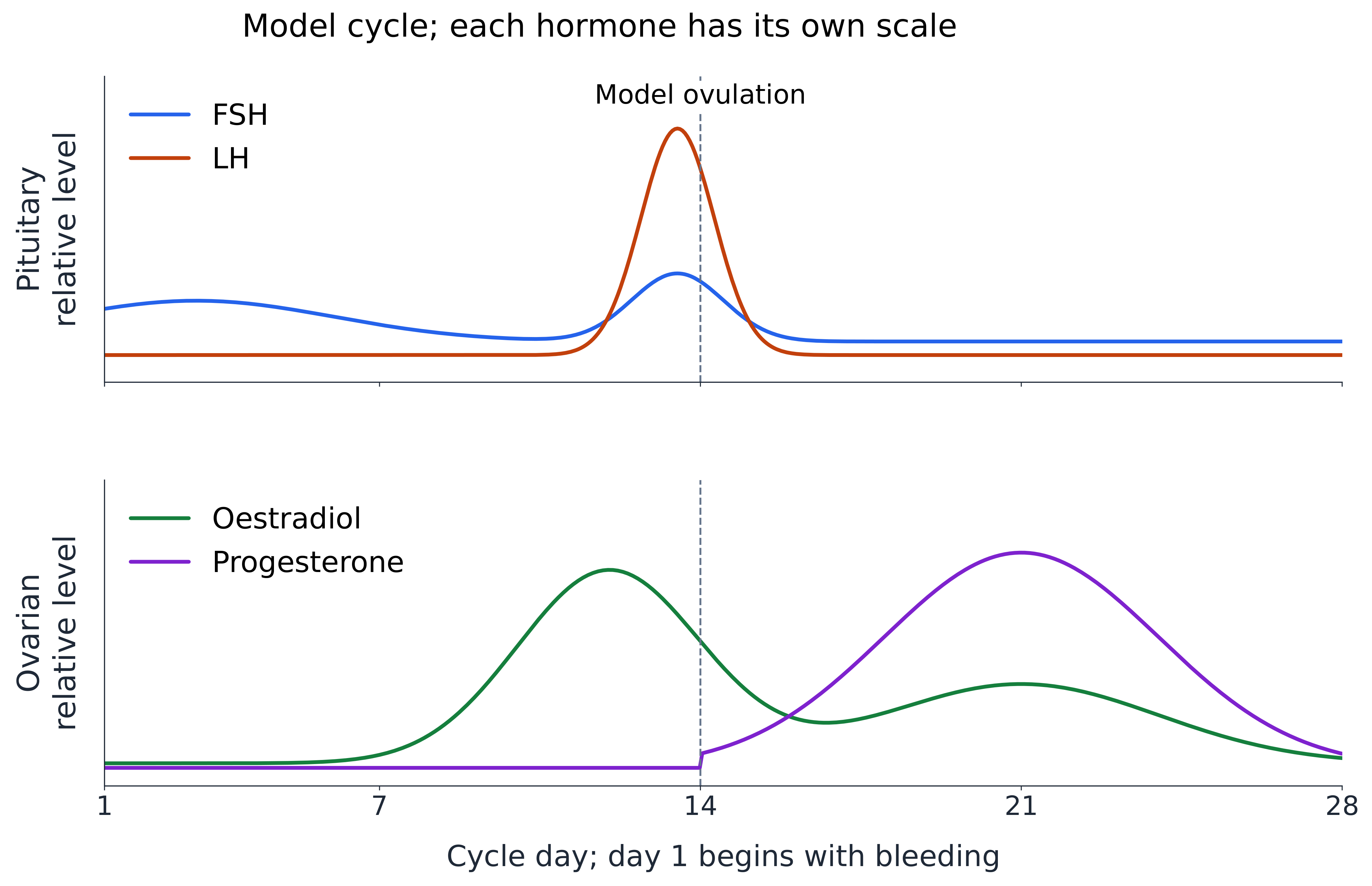
- Day 1 marks the start of menstrual bleeding. FSH from the anterior pituitary supports developing ovarian follicles; their oestradiol supports rebuilding of the endometrium. Ovarian hormones usually limit further hypothalamic/pituitary stimulation through negative feedback, opposing excessive stimulation rather than physically blocking a duct.
- Sustained high pre-ovulatory oestradiol can instead produce positive feedback in the appropriate context. The LH surge triggers ovulation and formation of the corpus luteum. Progesterone from the corpus luteum supports a secretory endometrium, with negative feedback on further gonadotropin release. Without continued pregnancy support, corpus-luteum decline lowers ovarian hormones and permits shedding.
Read hormone timing without comparing unrelated scales
- In this invented model, the LH surge precedes ovulation, while the progesterone maximum follows it. Trace cause → ovarian event → uterine response. Each hormone has its own relative scale, so an LH peak drawn higher than progesterone does not establish a higher absolute concentration or greater biological importance.
- A 28-day cycle and day-14 ovulation are teaching examples, not fixed rules for everyone or personal fertility predictions. A short oestradiol rise is not automatically the sustained high signal producing positive feedback. Identify the hormone, phase and target before describing feedback as positive or negative.
Which causal statement fits the taught menstrual-cycle model?
Difficulté 1/5 · 100 pièces + un petit bonus lors de la première réussite aujourd'hui
Identify timing and physiological context. A relative hormone scale does not compare absolute concentrations, and illustrative cycle dates are not universal.
Distinguish fertilization from later pregnancy establishment
- A sperm interacts with the oocyte's surrounding layers and its membrane fuses with the oocyte membrane. The paternal nuclear contribution joins the maternal chromosome contribution; paternal tail and mitochondria are normally broken down. Do not draw an intact sperm growing permanently inside the embryo.
- The pronuclear envelopes break down and both chromosome complements participate in the first joint mitosis, producing diploid nuclei. This is more precise than imagining two intact envelopes simply merging. Fertilization is distinct from implantation: development, transport and attachment to the uterine lining are additional stages, and early division alone does not guarantee a birth.
Connect IVF hormones with the stage they control
- IVF carries out fertilization outside the body before embryo transfer. A common approach controls the natural ovarian cycle, uses gonadotropins to stimulate several follicles, monitors maturation, collects oocytes and fertilizes them in the laboratory. Embryos are cultured before a selected embryo is transferred to the uterus, with appropriate endometrial support.
- Regimens vary; hormones coordinate physiology rather than guaranteeing successful fertilization or implantation. Transfer into the uterus is not fertilization there, and the treatment does not move a fertilized embryo into an ovary. The NHS account of IVF stages provides a real clinical sequence; the numerical classroom cases here are invented.
State the denominator behind every development percentage
- An invented laboratory sequence collects 12 oocytes, records nine fertilized and observes three reaching a defined later embryo stage. Fertilization per collected oocyte is 9/12 = 75%. Later-stage development is 3/9, about 33.3%, per fertilized oocyte, but 3/12 = 25% per collected oocyte.
- These percentages describe different transitions. No birth outcome is given, so none is a live-birth rate. For a second invented sequence of 20 collected, 15 fertilized and six at the stated later stage, the corresponding values are 75%, 40% and 30%. Label the outcome, starting group and observation period before comparing results.
An invented IVF laboratory sequence collects 20 oocytes, records 15 fertilized and six reaching a defined later embryo stage. What percentage of fertilized oocytes reaches that stage?
Difficulté 2/5 · 140 pièces + un petit bonus lors de la première réussite aujourd'hui
Six divided by fifteen × 100 = 40%. Relative to all collected oocytes it is 30%, while fertilization per collected oocyte is 75%. No live-birth outcome is supplied.
Locate pollen and ovules within the flower
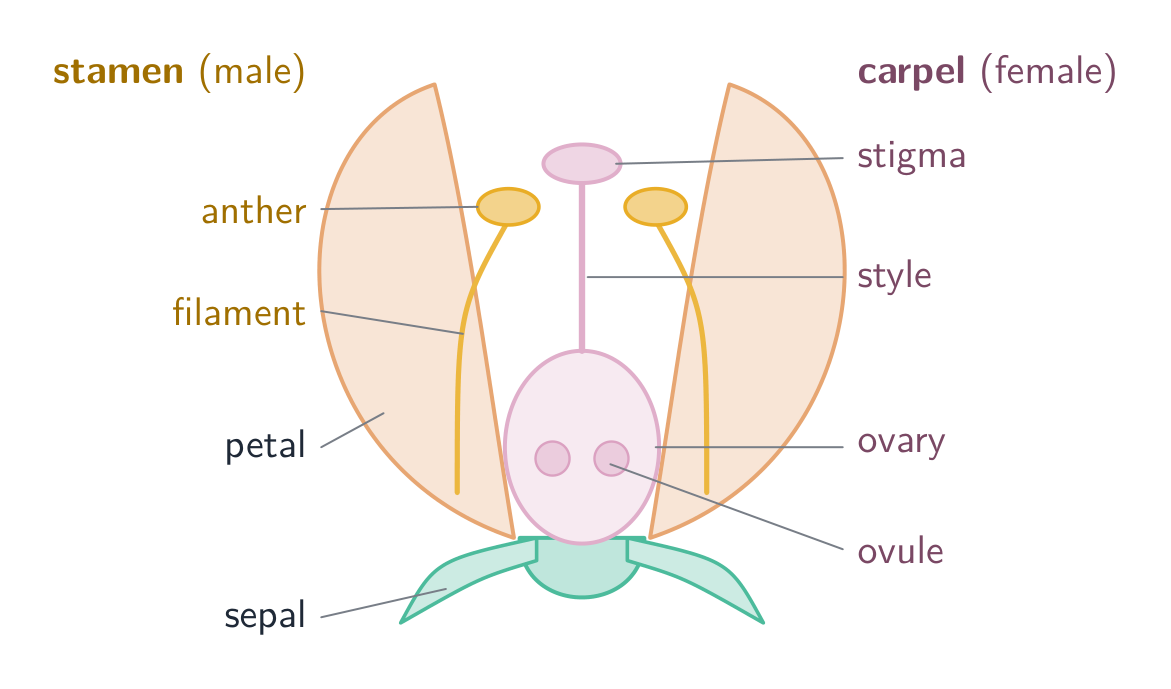
- A stamen comprises an anther producing pollen and its supporting filament. The carpel includes stigma, style and ovary; ovules within the ovary contain the female gametophyte and egg. Petals, scent and nectar can attract insects, while sepals protect a developing bud. Different flowers need not share one shape or pollinator.
- Meiosis contributes to haploid spores, which develop into haploid stages that produce gametes by mitosis. A whole pollen grain is not one naked male gamete, and an ovule is not simply a single egg cell. Use the structure and its contents separately when explaining how an insect visit can eventually contribute to an embryo.
Follow pollen transfer through fertilization and seed dispersal
- Pollination transfers pollen from anther to stigma. Compatible pollen can germinate and produce a pollen tube through the style towards an ovule. A male gamete fuses with the egg, forming the diploid zygote that develops into an embryo. Flowering plants also have a second fertilization producing endosperm, a supporting tissue rather than a second embryo.
- A fertilized ovule develops into a seed; the ovary commonly develops into a fruit. Seed dispersal later moves seeds away from the parent. An insect transferring pollen is not carrying a formed embryo to fertilize a stigma. Match each transfer to its structure, destination and life-cycle stage.
Which transfer is pollination in flowering plants?
Difficulté 1/5 · 100 pièces + un petit bonus lors de la première réussite aujourd'hui
Pollination is pollen transfer. Fertilization is gamete fusion; dispersal moves seeds at a later stage. Pollen arrival alone does not establish compatibility or fertilization.
Explain how crossing can be promoted or prevented
- Cross-pollination transfers pollen between different plants of the same species. Self-pollination stays within one plant, including transfer between its flowers. Different maturation times for pollen and stigma, separate male/female structures and especially separate male/female plants can reduce selfing. An insect visiting several flowers on one plant has not necessarily crossed between plants.
- Genetically controlled self-incompatibility can reject self or otherwise incompatible pollen, so pollen arrival does not prove fertilization. Repeated selfing often increases homozygosity, exposing harmful recessive variants and contributing to inbreeding depression. This is conditional: some species regularly self, and outcrossing recombines existing alleles rather than creating every new allele.
Connect germination conditions with reserve mobilization
- A viable seed may remain dormant until suitable conditions and any dormancy requirements are met. Water supports rehydration and metabolism, oxygen supports aerobic respiration, and suitable temperature supports enzyme activity. Light requirements vary by species; darkness is not automatically a universal barrier to germination.
- Enzymes mobilize stored reserves into soluble products used for respiration and growth. The radicle establishes a root and the shoot develops; reserves support the seedling before sufficient photosynthesis. Germination does not require a seed already to contain functioning green leaves or to acquire all its early organic carbon from the soil.
Design a seed comparison with an explicit outcome
- Use comparable viable seeds, independent replicate groups, controlled temperature and water availability, a defined criterion such as radicle emergence, and a fixed observation period. Change one intended factor while controlling others. Twenty seeds in one dish share conditions; they do not automatically provide twenty independent dishes.
- An invented group with 18 of 24 seeds meeting the criterion gives 75% germination. A group with 21 of 28 also gives 75%, despite having more germinated seeds. A low proportion alone cannot distinguish unsuitable conditions from poor viability or unmet dormancy requirements. Retain group-level results and report the denominator instead of comparing raw counts only.
In an invented seed group, 16 of 20 seeds meet the stated germination criterion by day 7. Calculate percentage germination.
Difficulté 2/5 · 140 pièces + un petit bonus lors de la première réussite aujourd'hui
16/20 × 100 = 80%. The conclusion refers to that criterion, group and observation time; independent replicate groups and viability/dormancy controls support comparison.
Explain a complete reproductive pathway from evidence
- Trace gamete production and transfer, fertilization, embryo development and the relevant later event. For humans, connect hormonal sources to follicles, ovulation and the endometrium, while separating fertilization from implantation. For plants, distinguish pollen, male gametes, ovules, eggs, seeds and dispersal. Label arrows with the process they represent.
- When interpreting invented data, state the biological outcome and denominator, then calculate before making a claim. Explain one experimental limitation, one possible alternative explanation and how an added observation would distinguish them. A plausible diagram or percentage is evidence for the stated stage, not proof that every later stage succeeded.
Compare a human reproductive pathway with a flowering-plant pathway. Distinguish transfer, fertilization and later development. In an invented laboratory sequence, 20 oocytes are collected, 15 fertilize and six reach a defined later embryo stage. Calculate the later-stage percentage using each starting group and explain one possible misinterpretation.
Follow processes between structures and state which stage was observed. Later-stage embryos/fertilized oocytes × 100 = 6/15 × 100 = 40%; later-stage embryos/collected oocytes × 100 = 6/20 × 100 = 30%. Neither percentage measures live births.