Respiration, ATP and energy transfers
Introduit| English | Sens |
|---|---|
| respiration/ˌrespɪˈreɪʃn/ | respiration |
| ATP/ˌeɪ tiː ˈpiː/ | ATP |
What would explain this observation?
- A muscle can use oxygen while you exercise without producing a flame. Respiration 呼吸作用 transfers energy through a controlled series of reactions.
Build the model
- Aerobic respiration uses oxygen and releases carbon dioxide and water from organic substrates.
- Energy released can support ATP 三磷酸腺苷 formation.
- ATP hydrolysis can be coupled to processes such as active transport and muscle contraction.
- respiration: Cell reactions that transfer energy from substrates.
- ATP: A molecule that couples energy transfers in cells.

Why use a temperature-controlled water bath for respirometry?
Difficulté 1/5 · 100 pièces + un petit bonus lors de la première réussite aujourd'hui
A water bath holds temperature constant, so gas expansion or contraction from temperature change does not move the marker; the remaining volume change reflects respiration. It cannot equalise organism mass and is not meant to stop oxygen uptake.
Match each technical term to its precise meaning.
Difficulté 2/5 · 140 pièces + un petit bonus lors de la première réussite aujourd'hui
Use the definitions to distinguish related quantities and processes.
Choose evidence that can test it
- Anaerobic processes allow ATP production when oxygen supply cannot support the required aerobic rate, but give less ATP per glucose.
- In humans lactate can accumulate; yeast can produce ethanol and carbon dioxide.
In the lab: A respirometer can measure oxygen uptake when carbon dioxide is absorbed. Control temperature with a water bath and use a comparison containing inert material. Keep absorbent separated from organisms and follow the school risk assessment.
Which two habits make the investigation or model in this case more defensible?
Difficulté 2/5 · 140 pièces + un petit bonus lors de la première réussite aujourd'hui
Stating the conditions and assumptions lets others repeat the work exactly, and recording the supporting evidence lets them check the conclusion. Hiding disagreeing results removes the evidence that could challenge a wrong conclusion, and one measurement can never establish a wider claim.
Work from known quantities
- Known: oxygen uptake is 0.80 cubic centimetres in 4.0 minutes for 2.0 g of tissue.
- Rate per mass = volume / (time × mass).
- Rate = 0.80/(4.0 × 2.0) = 0.10 cubic centimetres per minute per gram.
- Normalizing allows a fairer comparison of samples of different mass.
Your turn: 0.60 cubic centimetres are used in 3.0 minutes by 2.0 g of tissue. Find the mass-specific rate.
More oxygen uptake, or a higher rate per gram?
Sample A uses 0.80 cm³ in 4 minutes for 2 g: 0.10 cm³ per minute per gram. Compare a second sample after accounting for both measurement time and tissue mass.
0.60 cubic centimetres are used in 3.0 minutes by 2.0 g of tissue. Find the mass-specific rate.
Difficulté 2/5 · 140 pièces + un petit bonus lors de la première réussite aujourd'hui
The result is 0.1 cm³/min/g. Known: 0.60 cubic centimetres used in 3.0 minutes by 2.0 g of tissue. Use mass-specific rate = volume / (time x mass). Rate = 0.60/(3.0 x 2.0) = 0.10 cubic centimetres per minute per gram. Dividing by mass makes samples of different sizes comparable.
Check the conclusion and its limits
- Breathing ventilates the lungs; respiration consists of chemical reactions in cells.
- A moving respirometer marker can also reflect temperature or pressure changes.
Not true: Breathing and cellular respiration are the same process. Breathing is ventilation - moving air in and out of the lungs. Cellular respiration is the set of chemical reactions in cells that transfers energy from glucose. The names overlap but the processes are different.
- Aerobic respiration uses oxygen and releases carbon dioxide and water from organic substrates.
- Anaerobic processes allow ATP production when oxygen supply cannot support the required aerobic rate, but give less ATP per glucose.
- Watch for: breathing ventilates the lungs; respiration consists of chemical reactions in cells.
Breathing is ventilation - moving air in and out of the lungs.
Difficulté 1/5 · 100 pièces + un petit bonus lors de la première réussite aujourd'hui
True. Breathing is ventilation - moving air in and out of the lungs. Cellular respiration is the set of chemical reactions in cells that transfers energy from glucose. The names overlap but the processes are different.
Cell reactions that transfer energy from substrates: write the technical term.
Difficulté 1/5 · 100 pièces + un petit bonus lors de la première réussite aujourd'hui
respiration means Cell reactions that transfer energy from substrates.
Write from the data given
- 0.84 cubic centimetres are used in 3.0 minutes by 2.0 g of tissue.
- Find the mass-specific rate. Breathing is not cellular respiration.
0.84 cubic centimetres are used in 3.0 minutes by 2.0 g of tissue. What is the mass-specific rate, and why is breathing not cellular respiration?
Mass-specific rate = volume / (time × mass) = 0.84/(3.0 × 2.0) = 0.84/6.0 = 0.14 cubic centimetres per minute per gram. Breathing ventilates the lungs; respiration is the energy-transferring chemistry in cells.
The SL written case uses 0.84 cubic centimetres in 3.0 minutes for 2.0 g tissue. Find rate per minute per gram.
Difficulté 1/5 · 100 pièces + un petit bonus lors de la première réussite aujourd'hui
3.0 times 2.0 is 6.0, and 0.84 divided by 6.0 is 0.14. Other options — 0.10 (the lesson example's result for 0.60 cubic centimetres in 3.0 minutes by 2.0 g); 0.84 cubic centimetres (the volume used).
Identify ATP without making it the long-term food store
- Adenosine triphosphate contains adenine, ribose and three phosphate groups. Adenosine is adenine plus ribose, while ADP has two phosphates. ATP is a transferable short-term energy currency, not the main long-term energy reserve of an organism or a molecule used just once before all its atoms disappear.
- ATP hydrolysis to ADP and inorganic phosphate releases energy overall under cellular conditions. Isolated bond breaking requires energy; the favourable net change also involves product formation and interactions. Avoid explaining the entire process as energy escaping from one broken bond.
Explain ATP cycling through coupled processes
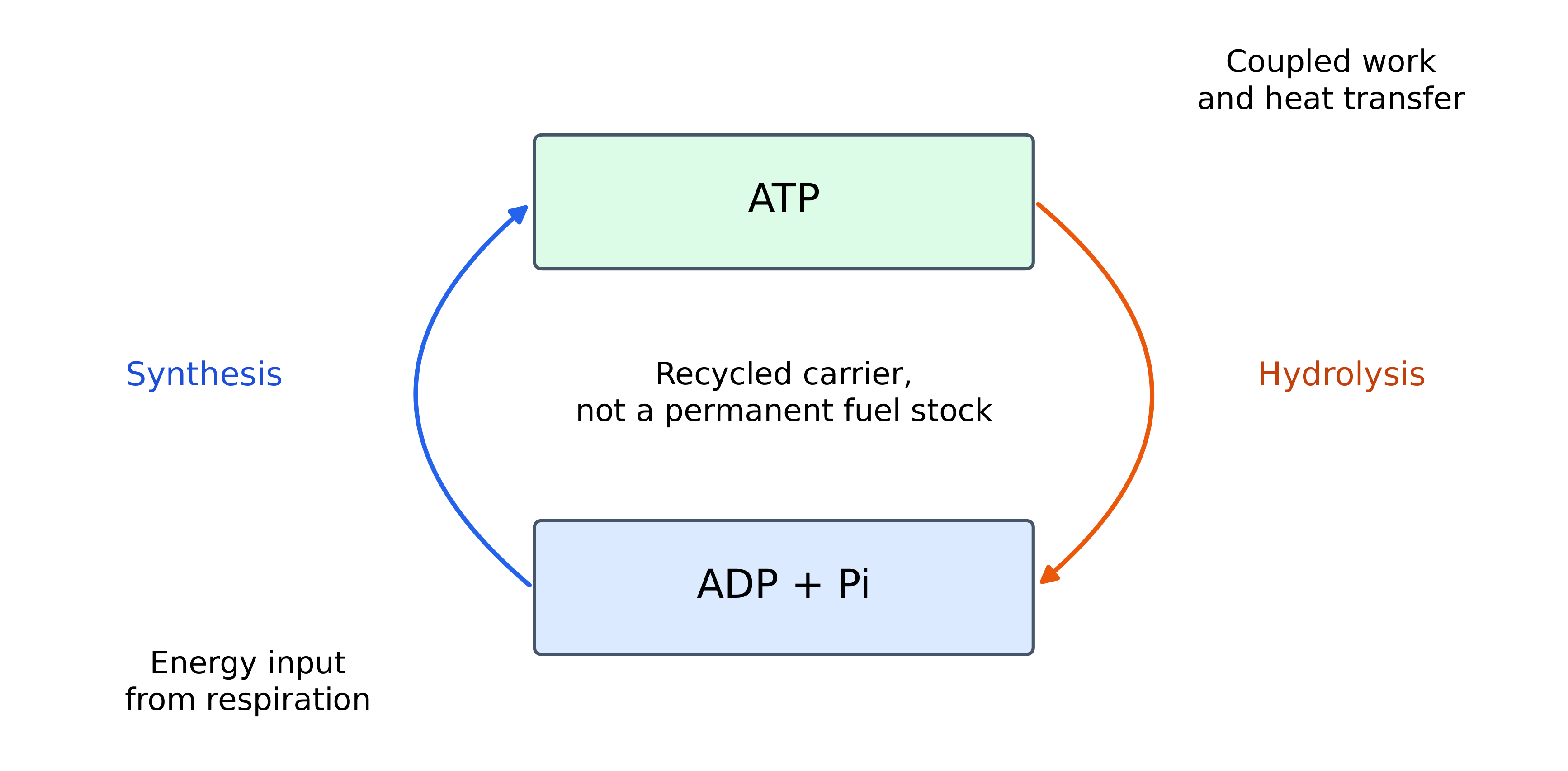
- Energy from respiration can drive phosphorylation of ADP using inorganic phosphate, rebuilding ATP. Specific proteins couple ATP use to active transport, macromolecule synthesis, muscle movement or chromosome movement. ATP is not a free energy packet acting at a distance without a mechanism.
- Synthesis needs energy and hydrolysis can support a coupled process, with energy also dissipated as heat. Different processes have different costs. Follow the transfers and regenerated molecules rather than describing energy as matter created from nothing or counting ATP as a carbon-containing waste product.
Distinguish a steady ATP pool from turnover
- An invented cell makes and uses 600 ATP molecules each second while maintaining an average pool of 120. Turnover is $600/120=5$ pool-equivalents per second. Individual molecules can cycle rapidly even though their average concentration remains steady.
- If synthesis falls while use remains high, the pool can decline and ATP-dependent work becomes harder to sustain. Equal concentrations at two observations do not reveal all synthesis and use between them. State whether a measurement concerns pool size, rate of production or rate of consumption.
An invented cell synthesizes and uses 600 ATP molecules each second while its average pool remains 120 molecules. Find pool-equivalents used per second.
Difficulté 2/5 · 140 pièces + un petit bonus lors de la première réussite aujourd'hui
600/120 = 5 pool-equivalents per second. Equal synthesis and use can maintain a steady pool with rapid turnover; a concentration is not a consumption rate.
Separate cellular chemistry from moving air
- Cellular respiration transfers energy from organic substrates through enzyme-controlled reactions and supports ATP production. Ventilation moves air; gas exchange transfers gases across a surface. A living seed can respire without lungs, and photosynthetic cells also respire in darkness using available substrates.
- The overall aerobic glucose summary is glucose + oxygen → carbon dioxide + water, with energy transferred to usable forms and heat. It represents many reactions, not a single explosive event. Oxygen delivery alone cannot supply a cell with functioning mitochondrial machinery it does not possess.
Compare human aerobic and anaerobic routes precisely
- Human aerobic glucose metabolism begins with cytosolic glycolysis and continues through mitochondrial stages, requiring oxygen for sustained operation and giving a much greater ATP yield. The human lactate-producing route occurs in cytosol without requiring mitochondria and has a small net yield: two ATP per glucose in the complete pathway.
- Both routes can operate at the same time rather than switching instantaneously between all-or-nothing states. Lactate retains substantial chemical energy and can be transported and used later; it is not permanently useless poison. Fatty acids support aerobic respiration but cannot replace glucose in the human lactate-producing route.
Explain why oxygen uptake is not an ATP counter
- Glucose and fatty acids are important respiratory substrates; other organics can enter after suitable conversions. Respiration transfers chemical energy rather than creating it. Complete aerobic oxidation has greater ATP yield than the lactate route because more substrate energy can be transferred through the aerobic system.
- Oxygen uptake measures one gas flux. Substrate choice, coupling, transport and maintenance costs affect useful ATP yield, so the same oxygen measurement does not guarantee the same ATP production. Distinguish the gas measured, the chemical pathway inferred and the energetic quantity claimed.
Connect respirometer movement to its gas model
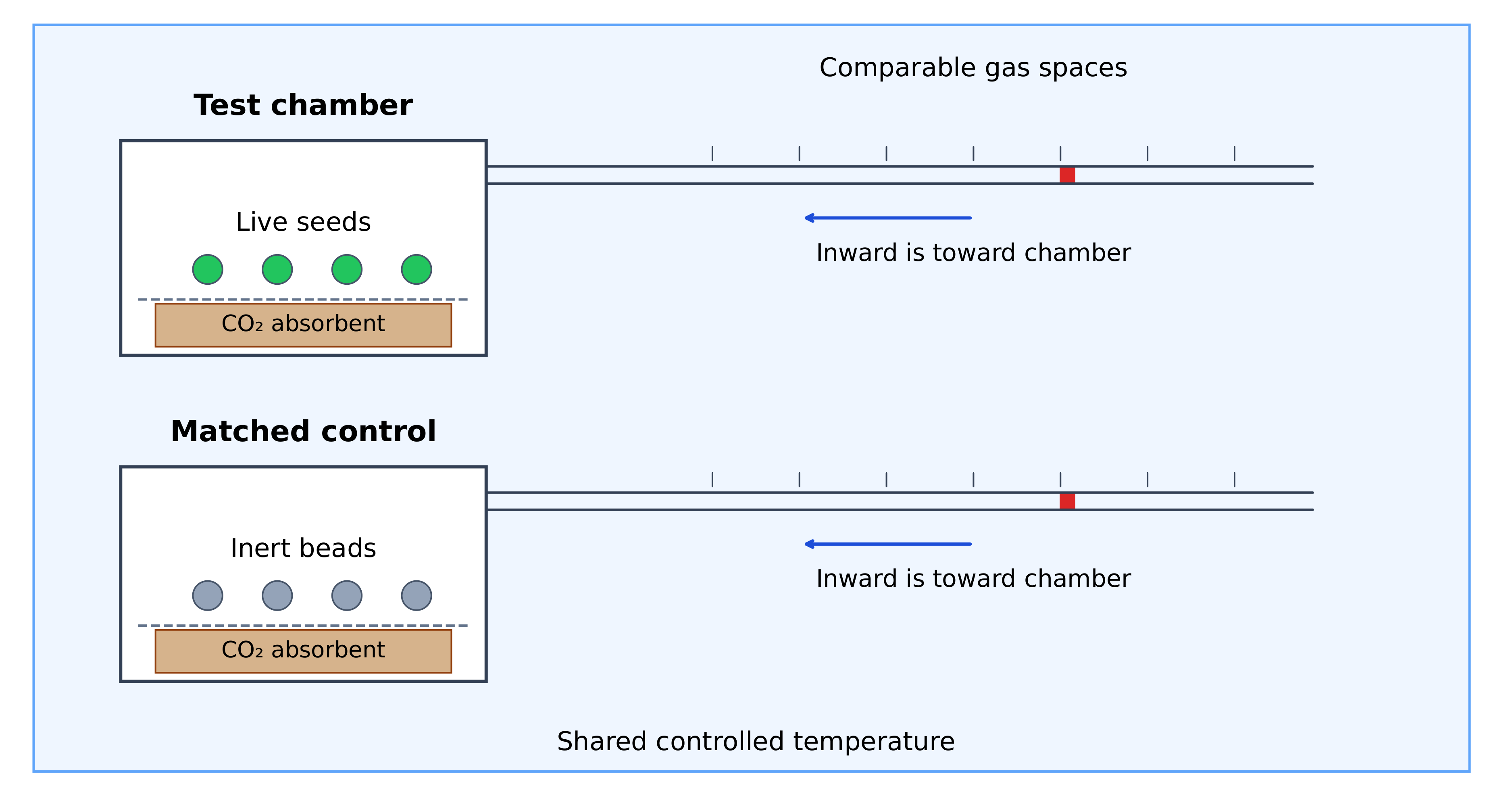
- A sealed respirometer can estimate oxygen uptake when a suitable absorbent removes carbon dioxide produced by the sample. Under controlled conditions, loss of oxygen from the gas phase changes pressure or volume and moves a capillary marker. It does not count ATP or measure every anaerobic process directly.
- Temperature, external pressure, leaks, unequal gas spaces or poor equilibration can also move the marker. Use an approved living sample and keep corrosive absorbent physically separate under the school protocol. Equilibrate before setting the start, check seals and record a fixed interval rather than attributing every movement automatically to respiration.
Normalize a corrected volume by both mass and time
- A suitable non-respiring control estimates shared background drift. Match occupied volume, gas space, temperature and absorbent arrangement; equal bead and seed mass alone need not give equal gas spaces. State why the control represents the particular drift being corrected.
- In an invented calibrated apparatus, uptake is 0.80 cubic centimetres in 4.0 minutes for 2.0 g of tissue. Rate is $0.80/(4.0\times2.0)=0.10$ cubic centimetres per minute per gram. Normalization helps comparison but does not remove differences in species, developmental stage, tissue condition or water content.
An invented calibrated apparatus estimates 0.80 cubic centimetres oxygen uptake over 4.0 minutes for 2.0 g tissue. Find rate per minute per gram.
Difficulté 2/5 · 140 pièces + un petit bonus lors de la première réussite aujourd'hui
0.80/(4.0 × 2.0) = 0.10 cubic centimetres per minute per gram. Divide by both time and mass; the estimate depends on apparatus correction and comparable biological samples.
Convert displacement to volume using the capillary radius
- For a uniform capillary, volume equals area times distance: $V=\pi r^2d$. An invented radius of 1.0 mm and corrected distance 24.0 mm give about 75.4 cubic millimetres, or 0.0754 cubic centimetres. Millimetres of travel are not millilitres of gas, and diameter must be halved before using it as radius.
- Over 4.0 minutes with 1.5 g of sample, the unrounded volume gives about 0.0126 cubic centimetres per minute per gram, or 0.013 to two significant figures. Using diameter as radius would multiply area, volume and rate by four. Record the calibration and keep all length units consistent before converting cubic units.
An invented uniform capillary has radius 1.0 mm and corrected displacement 24.0 mm. Use volume = πr²d and 1,000 cubic millimetres = 1 cubic centimetre. Find gas-volume change in cubic centimetres.
Difficulté 2/5 · 140 pièces + un petit bonus lors de la première réussite aujourd'hui
π × 1.0² × 24.0 = 75.398… cubic millimetres = 0.075398… cubic centimetres, about 0.0754. Using diameter as radius would multiply the result by four.
Correct control drift with its sign
- Taking inward as positive, test movement +30 mm and control +6 mm give corrected distance +24 mm. If instead test is +10 mm and control is −2 mm, correction gives $10-(-2)=12$ mm, not 8. Direction must be recorded before subtracting.
- This assumes the control estimates the shared non-respiratory movement. Large or unstable drift can indicate leaks or poor equilibration; subtraction cannot guarantee a valid result from a faulty apparatus. Report the raw and corrected quantities, not just a final number that hides the control's behaviour.
Taking inward as positive, an invented test marker moves +10 mm and its matched control moves −2 mm. Under the stated subtraction model, find corrected inward displacement.
Difficulté 2/5 · 140 pièces + un petit bonus lors de la première réussite aujourd'hui
Test minus control = 10 − (−2) = 12 mm. Record direction before correcting. Large or unstable background drift still undermines the assumptions; subtraction does not repair a leaking apparatus.
Separate repeat readings from biological replicates
- For a temperature comparison, use equivalent independent seed groups, control the mass basis, species, germination stage, gas space, oxygen supply and interval, and equilibrate at each temperature. Plot rates with variation. A change can reflect enzyme activity and wider physiology; high temperature can damage living tissue.
- Repeated readings on one group estimate repeatability, while independent groups reveal between-sample variation. Invented rates 0.09, 0.11 and 0.10 have mean 0.10 and range 0.02 in their stated units. The range is observed spread, not automatically a confidence interval or proof of absolute accuracy.
Report exactly what the respiration evidence establishes
- State the volume correction, time interval, mass basis and units, then connect uptake to the apparatus assumptions. A negative or erratic corrected result may call for checking controls and conditions rather than declaring that the sample synthesized oxygen. Do not infer an exact temperature optimum from just two treatments.
- Use respiration, ventilation, gas exchange and ATP synthesis as separate terms. A clear answer can explain lower anaerobic yield while recognizing simultaneous pathways and the limits of oxygen measurement. The strongest inference combines controlled gas data with relevant biochemical evidence, rather than treating one marker displacement as the whole metabolic mechanism.
Plan a temperature comparison of seed oxygen uptake and explain why marker displacement alone is not a direct ATP measurement.
The biological inference is only as strong as the gas-volume model, control validity and sample comparison.