DNA replication: retain one strand in each daughter molecule
Introduit| English | Sens |
|---|---|
| DNA polymerase/ˌdiː en ˈeɪ ˌpɒlɪməˈreɪz/ | ADN polymérase |
| semi-conservative replication/ˈsemi kənˈsɜːvətɪv ˌreplɪˈkeɪʃn/ | réplication semi-conservative |
What would explain this observation?
- After DNA replication, each daughter double helix contains one pre-existing strand and one newly synthesized strand. Copying a molecule is different from expressing its information.
Build the model
- DNA replication is semi-conservative.
- Complementary base pairing supports copying of the base sequence: adenine pairs with thymine and cytosine with guanine.
- The strands have opposite orientations.
- Helicase separates paired strands, while DNA polymerase DNA聚合酶 builds new DNA using a template and available nucleotides.
- semi-conservative replication 半保留复制: DNA copying in which each daughter double helix retains one parental strand.
- DNA polymerase: An enzyme that synthesizes DNA using a template.

What does each daughter double helix retain after one ideal replication round?
Difficulté 1/5 · 100 pièces + un petit bonus lors de la première réussite aujourd'hui
Replication is semi-conservative: each daughter double helix keeps one parental strand paired with one new strand. Keeping both parental strands together in every molecule, or none, contradicts the labelling evidence.
Match each technical term to its precise meaning.
Difficulté 2/5 · 140 pièces + un petit bonus lors de la première réussite aujourd'hui
Use the definitions to distinguish related quantities and processes.
Choose evidence that can test it
- New DNA is synthesized in the 5′ to 3′ direction.
- In a simplified fork model, one new strand can be synthesized continuously while the other is produced in fragments that are joined.
- Distinguish these molecular mechanisms from the later separation of chromosomes during cell division.
- Copying errors can occur despite proofreading and repair.
In the lab: Use labelled strand models or an attributed experimental diagram. Mark old and new material with both labels and colours so the meaning survives monochrome viewing. Track successive rounds using a stated starting population and assumptions. A classroom model illustrates predictions; it is not direct evidence about enzyme activity or a substitute for experimental results.
Which two habits make the investigation or model in this case more defensible?
Difficulté 2/5 · 140 pièces + un petit bonus lors de la première réussite aujourd'hui
Stating the conditions and assumptions lets others repeat the work exactly, and recording the supporting evidence lets them check the conclusion. Hiding disagreeing results removes the evidence that could challenge a wrong conclusion, and one measurement can never establish a wider claim.
Work from known quantities
- Known: one double-stranded molecule contains two labelled original strands.
- After one complete round in unlabelled nucleotides, two molecules each contain one labelled strand.
- After two rounds, four molecules exist: two retain one labelled original strand and two contain only unlabelled strands.
- The fraction containing an original strand is 2/4=50%.
Your turn: One labelled double helix replicates for three complete rounds in unlabelled nucleotides. What percentage of the eight molecules contain an original strand?
Two original strands, more DNA molecules
After two complete rounds, 2 of 4 molecules retain an original labelled strand: 50%. Track each original strand across rounds and distinguish the fraction of molecules from the fraction of strands.
One labelled double helix replicates for three complete rounds in unlabelled nucleotides. What percentage of the eight molecules contain an original strand?
Difficulté 2/5 · 140 pièces + un petit bonus lors de la première réussite aujourd'hui
The result is 25 %. Known: one labelled double helix; three complete rounds in unlabelled nucleotides; 2^3 = 8 molecules. Only the two original strands persist, each in one molecule, so 2 of 8 molecules contain an original strand. Percentage = 2/8 x 100 = 25%.
Check the conclusion and its limits
- Replication uses DNA as a template to make DNA; transcription uses a DNA template to make RNA.
- A predicted label distribution assumes complete rounds and no degradation or exchange of the labelled material.
Not true: DNA replication and transcription both produce the same type of nucleic-acid product. Replication copies DNA into DNA; transcription copies a DNA template into RNA. The products are different nucleic acids with different roles.
- DNA replication is semi-conservative.
- New DNA is synthesized in the 5′ to 3′ direction.
- Watch for: replication uses DNA as a template to make DNA; transcription uses a DNA template to make RNA.
Write from 2 labelled molecules out of 32
- One labelled double helix replicates for 5 complete rounds in unlabelled nucleotides.
- Say how many of the 32 molecules still contain an original strand.
Replication copies DNA into DNA; transcription copies a DNA template into RNA.
Difficulté 1/5 · 100 pièces + un petit bonus lors de la première réussite aujourd'hui
True. Replication copies DNA into DNA; transcription copies a DNA template into RNA. The products are different nucleic acids with different roles.
DNA copying in which each daughter double helix retains one parental strand: write the technical term.
Difficulté 1/5 · 100 pièces + un petit bonus lors de la première réussite aujourd'hui
semi-conservative replication means DNA copying in which each daughter double helix retains one parental strand.
One labelled double helix replicates for 5 complete rounds in unlabelled nucleotides. How many molecules are there, and what fraction still contain an original strand?
2 to the power 5 is 32. Two original strands remain in two molecules, so the fraction is 2 out of 32.
One double helix with both original strands labelled undergoes five complete rounds of semi-conservative replication using only unlabelled nucleotides. Assume no strand degradation or label exchange. What fraction of the resulting molecules contain an original strand?
Difficulté 1/5 · 100 pièces + un petit bonus lors de la première réussite aujourd'hui
Each complete round doubles molecule number: 1 × 2⁵ = 32 molecules. The two original strands each remain in one molecule, so the fraction containing an original strand is 2/32 = 1/16.
D1.1: Connect replication to continuity rather than gene expression
- Growth and tissue replacement need new cells with the required DNA sequences. Reproduction also passes genetic information to descendants. Replication copies DNA before its distribution; chromosome separation later moves copies that already exist.
- Transcription instead uses a DNA template to make RNA for gene expression. Complementary pairing and correction allow high copying accuracy, but a copied genome is not guaranteed error-free. Replication does not deliberately invent an adaptive sequence because a cell needs one.
Which process produces new DNA from a DNA template?
Difficulté 1/5 · 100 pièces + un petit bonus lors de la première réussite aujourd'hui
Replication makes DNA; transcription makes RNA, and separation distributes existing copies.
D1.1: Use complementary pairing as a copying rule
- Each exposed parental strand provides an ordered template. A pairs with T and C with G in DNA. For an aligned template C–A–T–G–G–A, the complementary new segment is G–T–A–C–C–T. Do not substitute RNA uracil for DNA thymine.
- The paired sequences are complementary, not identical in the same left-to-right alignment. Copying the complementary strand can reconstruct the first sequence. DNA polymerase incorporates appropriate available DNA nucleotides into the new strand.
What is the aligned DNA complement of C–A–T–G–G–A?
Difficulté 1/5 · 100 pièces + un petit bonus lors de la première réussite aujourd'hui
Adenine pairs with thymine in DNA, not uracil.
D1.1: Track the two original strands through later rounds
- Semi-conservative replication gives each daughter double helix one strand from its parent molecule and one newly made strand. From one labelled original helix, round one gives two hybrid molecules; round two gives two hybrids and two entirely unlabelled molecules.
- Assume complete rounds, intact original strands, no label exchange and only unlabelled new nucleotides. A strand made in round one later becomes a template, but it does not become one of the two original labelled strands. The diagram uses line style as well as colour.
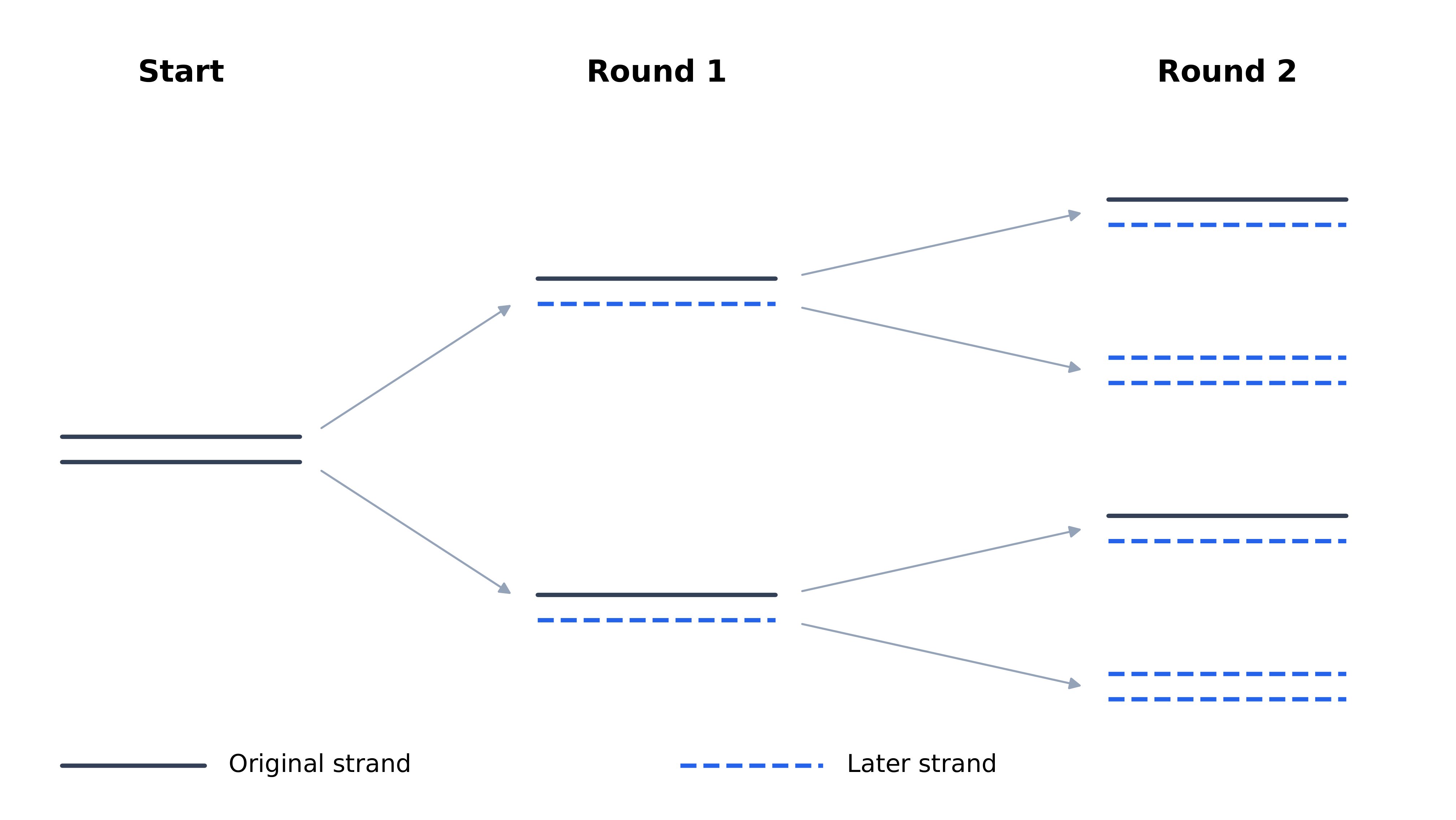
After two ideal rounds from one labelled helix, how many molecules contain an original strand?
Difficulté 1/5 · 100 pièces + un petit bonus lors de la première réussite aujourd'hui
Only the two labelled starting strands count as original material.
D1.1: Choose the correct denominator for a labelled percentage
- After five ideal rounds from one double helix there are 2⁵ = 32 DNA molecules. Two molecules each contain one original strand, giving 2/32 × 100 = 6.25% of molecules containing original material.
- Those 32 double helices contain 64 individual strands. Only two strands are original, giving 2/64 × 100 = 3.125% of individual strands. These percentages answer different questions. For n complete rounds after the first, original-containing molecule count remains two in this model.
Why are 6.25% and 3.125% both correct in this example?
Difficulté 1/5 · 100 pièces + un petit bonus lors de la première réussite aujourd'hui
Each double-stranded molecule contains two strands; specify what is being counted.
After five complete rounds from one labelled helix in unlabelled nucleotides, give the percentage of molecules containing an original strand.
Difficulté 2/5 · 140 pièces + un petit bonus lors de la première réussite aujourd'hui
Five complete rounds from one helix give 1 × 2⁵ = 32 double helices. The two original strands each remain in one molecule: 2/32 × 100 = 6.25% of molecules.
One double helix with two original strands undergoes five complete rounds of semi-conservative replication in unlabelled nucleotides. Assume no strand degradation or exchange. What percentage of all individual strands are original?
Difficulté 2/5 · 140 pièces + un petit bonus lors de la première réussite aujourd'hui
Five rounds give 1 × 2⁵ = 32 double helices. Each contains two strands, so there are 32 × 2 = 64 strands. The original two remain: 2/64 × 100 = 3.125% of individual strands.
D1.1: Separate helicase action from new backbone synthesis
- Helicase unwinds the helix and disrupts hydrogen bonds between complementary bases, exposing the templates. It does not normally chop the covalent sugar–phosphate backbones into free nucleotides. Their sequence order must remain available for copying.
- DNA polymerase catalyses new DNA synthesis using a template and available DNA nucleotides. Complementary pairing guides base choice; covalent bonds join nucleotides along the growing backbone. Bonds across the two strands and bonds along one strand have different roles.
Which correction repairs the claim that helicase cuts both backbones?
Difficulté 1/5 · 100 pièces + un petit bonus lors de la première réussite aujourd'hui
Opening paired strands is different from breaking their covalent backbones.
D1.1: Specify what PCR amplifies and what it needs
- PCR amplifies a selected DNA region outside living cells. A standard reaction needs template DNA, two suitable DNA primers, free DNA nucleotides, thermostable polymerase such as Taq, and appropriate buffer and required ions.
- Primers bind opposite template strands at sites flanking the selected region. Their sequences help define what is copied. Primers supply starting ends; nucleotides supply building material; polymerase catalyses synthesis. One primer pair does not automatically amplify the entire genome.
What helps determine which region is amplified?
Difficulté 1/5 · 100 pièces + un petit bonus lors de la première réussite aujourd'hui
Primers must bind suitable matching template sites flanking the chosen region.
D1.1: Explain the three PCR stages without universal temperatures
- In an illustrative Taq-based cycle, about 95°C separates paired templates, about 55°C permits primers to anneal, and about 72°C supports extension. The reaction then repeats the temperature cycle. These are protocol examples, not universal constants for every primer and enzyme.
- Heating replaces the strand-opening role of helicase in PCR. Taq tolerates repeated hot stages, so it need not be replaced after every cycle; its main extension step is not the highest-temperature denaturation step. Annealing and extension conditions depend on primer, enzyme and product properties.
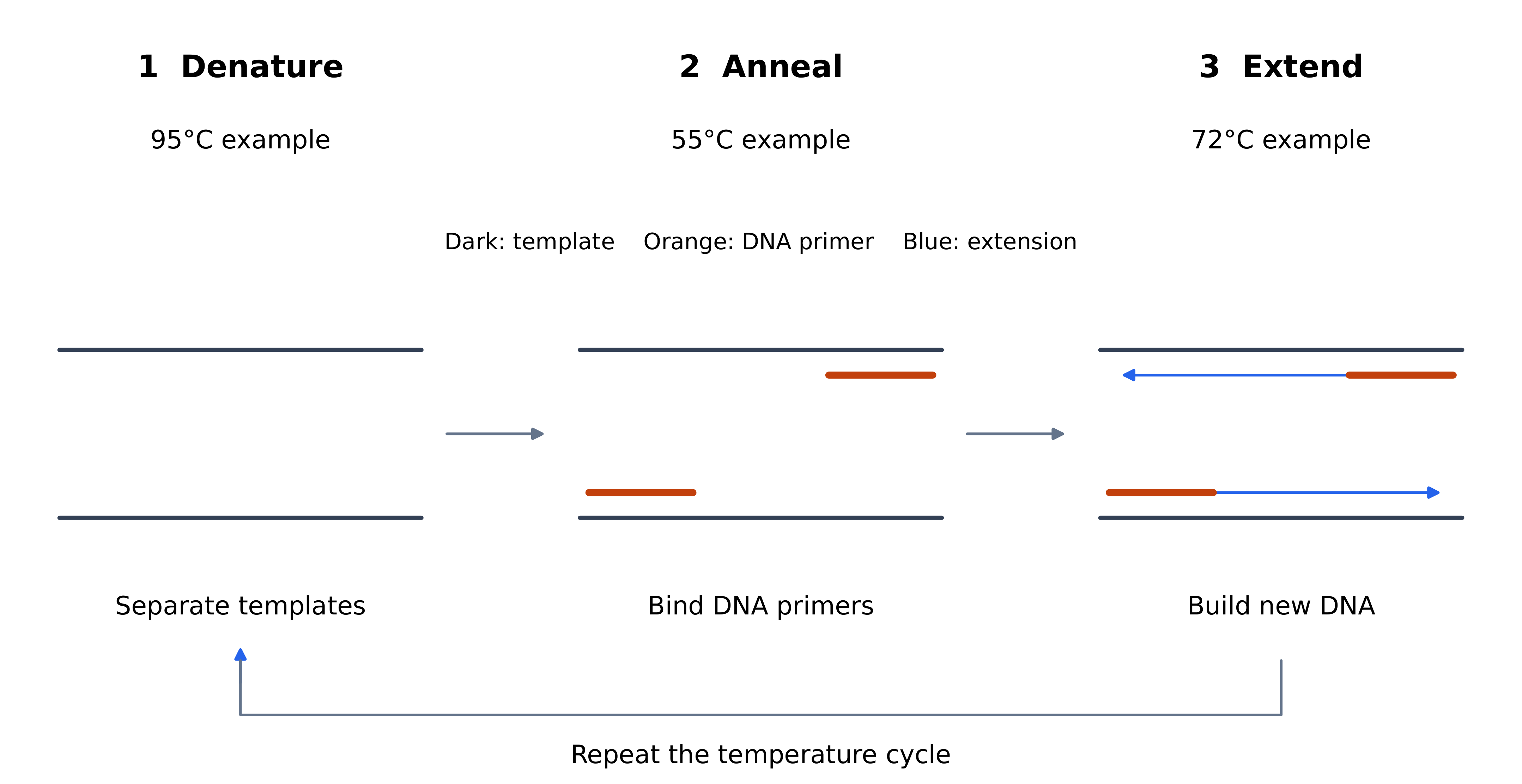
At which illustrative stage do primers bind matching templates?
Difficulté 1/5 · 100 pièces + un petit bonus lors de la première réussite aujourd'hui
Cooling allows complementary primer–template pairing after heating separates templates.
D1.1: Apply an ideal amplification model with stated assumptions
- For defined double-stranded target molecules copied once in every ideal cycle, N = N₀ × 2ⁿ. An invented starting population of three targets becomes 3 × 2⁸ = 768 targets after eight complete doubling cycles. Five further ideal cycles multiply the current amount by 32.
- Real PCR does not double indefinitely. Incomplete amplification, reagent limitation, interfering products and incorrect priming can alter yield. Early products from longer genomic templates also need not all have both primer-defined ends. The model is a stated ideal target-copy calculation, not an exact inventory of every early product.
What factor follows five additional ideal doubling cycles?
Difficulté 1/5 · 100 pièces + un petit bonus lors de la première réussite aujourd'hui
Repeated doubling multiplies by 2⁵, not by adding five.
An invented ideal target-copy model starts with 3 targets and doubles for 8 complete cycles. Give the target count.
Difficulté 2/5 · 140 pièces + un petit bonus lors de la première réussite aujourd'hui
N = 3 × 2⁸ = 768 defined target copies.
D1.1: Explain gel movement from charge and molecular sieving
- The DNA phosphate backbone is negatively charged. In a suitable agarose gel and buffer, DNA moves from wells near the negative electrode towards the positive electrode. Smaller comparable linear double-stranded fragments generally move farther in the same run.
- A size ladder gives known fragment lengths for comparison. A visible band contains many fragments of similar size, not one naked-eye DNA molecule or one base. Fragment conformation also matters; do not use this simple linear-fragment rule indiscriminately for supercoiled and nicked circular DNA.
Which fragment travels farther in the stated comparable linear-DNA model?
Difficulté 1/5 · 100 pièces + un petit bonus lors de la première réussite aujourd'hui
The gel retards larger comparable linear fragments more.
D1.1: Read the invented gel as evidence rather than identity proof
- The illustrated evidence lane has bands at approximately 800 and 300 base pairs. Comparison A has both corresponding bands; comparison B has 800 and 500. A matches this illustrated size pattern, whereas B does not match the full pattern.
- One shared 800-base-pair band does not establish a whole-pattern match. Equal fragment size also does not guarantee identical sequence throughout a fragment. Estimate size using the ladder and appropriate calibration; twice the distance is not a universal rule for half the base pairs.
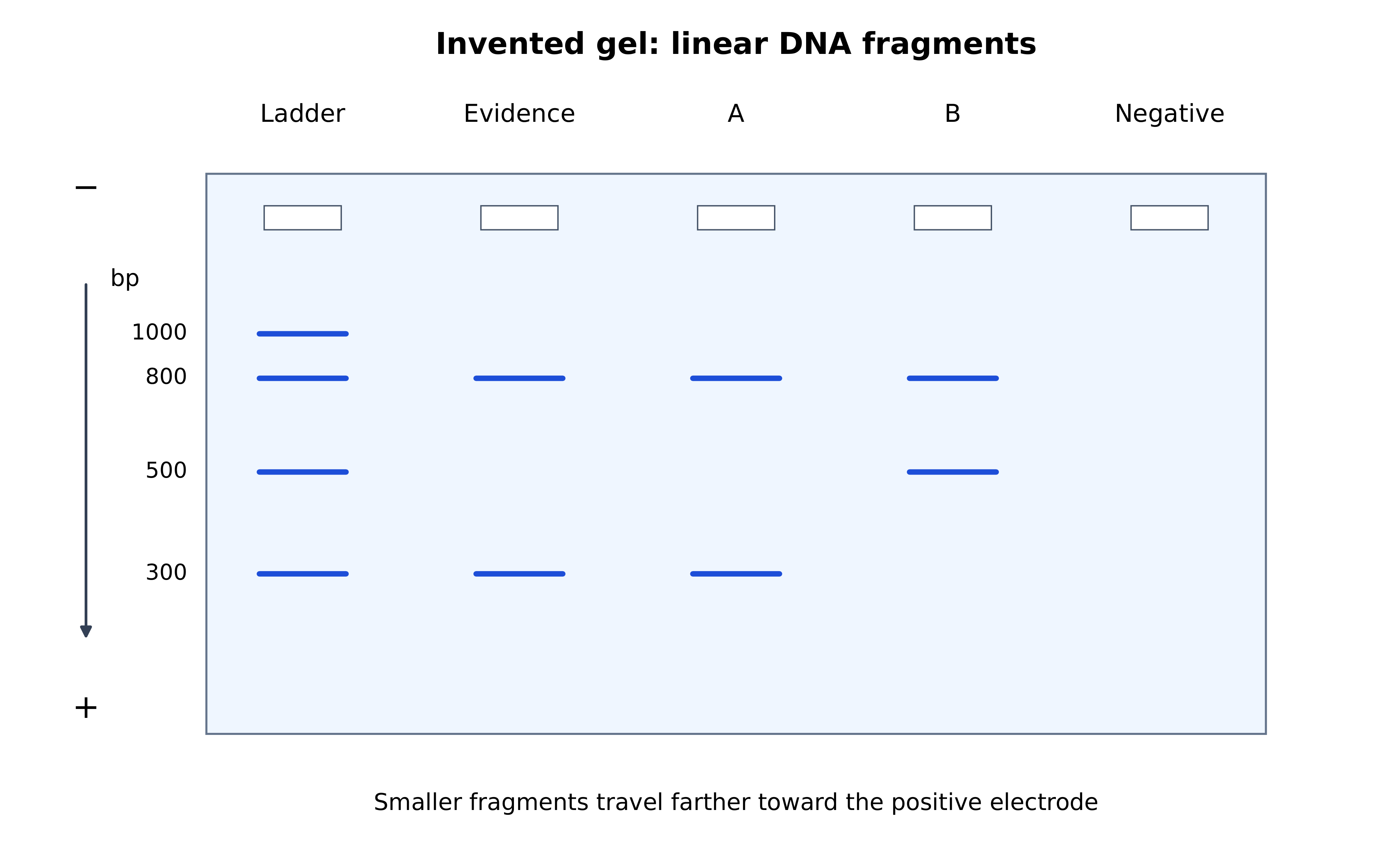
Which comparison matches the full illustrated evidence pattern?
Difficulté 1/5 · 100 pièces + un petit bonus lors de la première réussite aujourd'hui
Compare every supplied band, not just the first agreement.
D1.1: Use controls before interpreting a missing or extra band
- A negative amplification control contains reaction materials without the intended template. A target-sized band raises concern about contamination or unintended amplification. A positive control uses known suitable template to test whether the procedure can produce and detect the expected product.
- If a sample and positive control both lack bands, the sample is not established as a valid negative: amplification, loading or detection may have failed. A contaminated negative control also undermines interpretation. Investigate and repeat appropriately; clean controls improve confidence without eliminating every possible error.
What follows if the positive control also fails?
Difficulté 1/5 · 100 pièces + un petit bonus lors de la première réussite aujourd'hui
A failed control means the procedure has not demonstrated that it can give the expected result.
D1.1: Distinguish profiling markers from whole genomes
- DNA profiling compares selected variable markers. In a simple autosomal-marker model, a person normally inherits one allele from each biological parent. PCR supplies selected marker copies, separation reveals product sizes, and analysis compares the patterns.
- More appropriately chosen markers improve discrimination; one matching marker is weak evidence of source identity. The small teaching examples are not operational forensic protocols. Relatedness, identical twins, mixtures, contamination and handling errors can affect interpretation; a source association does not by itself establish guilt.
Why compare several variable markers rather than only one?
Difficulté 1/5 · 100 pièces + un petit bonus lors de la première réussite aujourd'hui
Additional informative markers improve discrimination but do not prove guilt.
D1.1: Test inheritance at each invented marker
- Invented data: mother has alleles 12/14 and 7/9 at markers one and two; child has 14/16 and 9/12. The required non-maternal contributions are 16 at marker one and 12 at marker two in the stated simple inheritance model.
- Candidate A has 16/18 and 10/12; candidate B has 20/22 and 10/12. B lacks required allele 16 and is inconsistent under an error-free, no-mutation model. A is not excluded by these markers, but two markers do not prove that A is the father.
Which required allele excludes candidate B in the stated example?
Difficulté 1/5 · 100 pièces + un petit bonus lors de la première réussite aujourd'hui
B lacks the required paternal allele 16 at the first marker.
D1.1: Keep copying amplification separation and inference distinct
- Cellular replication copies DNA using parental templates. PCR amplifies a selected region under temperature cycles. Gel electrophoresis separates comparable fragments mainly by size. Profiling then interprets selected inherited-marker patterns. These are linked tools, not interchangeable names for one process.
- A labelled-strand drawing tests a model prediction; it is not direct evidence of enzyme activity. A gel band is not a whole genome, a matching size is not complete sequence identity, and a source association is not proof of guilt. State the assumptions and what further evidence would be needed.
Which tool primarily separates fragments rather than making more DNA?
Difficulté 1/5 · 100 pièces + un petit bonus lors de la première réussite aujourd'hui
PCR amplifies; a gel separates; interpretation uses the resulting evidence.
AHL D1.1: Read strand ends before choosing a synthesis direction
- The 5′ and 3′ labels refer to deoxyribose carbon positions. Opposite strands are antiparallel. DNA polymerases extend an existing free 3′ end, incorporating the 5′ phosphate of an incoming nucleotide into the new backbone. New DNA grows 5′ → 3′.
- For a template aligned 3′–GACTTA–5′, the new strand is 5′–CTGAAT–3′. If that new strand must instead be written 3′ to 5′ from left to right, reverse the sequence as well: 3′–TAAGTC–5′. Do not swap labels while leaving the letters unchanged.
Where is the next DNA nucleotide added?
Difficulté 1/5 · 100 pièces + un petit bonus lors de la première réussite aujourd'hui
The incoming nucleotide joins to the existing 3′ end; synthesis remains 5′ to 3′.
AHL D1.1: Determine leading and lagging relative to one moving fork
- In the diagram, one fork moves right. Its upper parental template runs 3′ → 5′ towards the fork, so the new leading strand extends continuously rightwards. The lower template runs 5′ → 3′ towards the fork, so new lagging fragments extend leftwards.
- Every new fragment still grows 5′ → 3′. Leading and lagging describe synthesis relative to the chosen fork, not permanent top/bottom positions on every drawing. The fork-movement arrow and the DNA-synthesis arrows answer different questions.
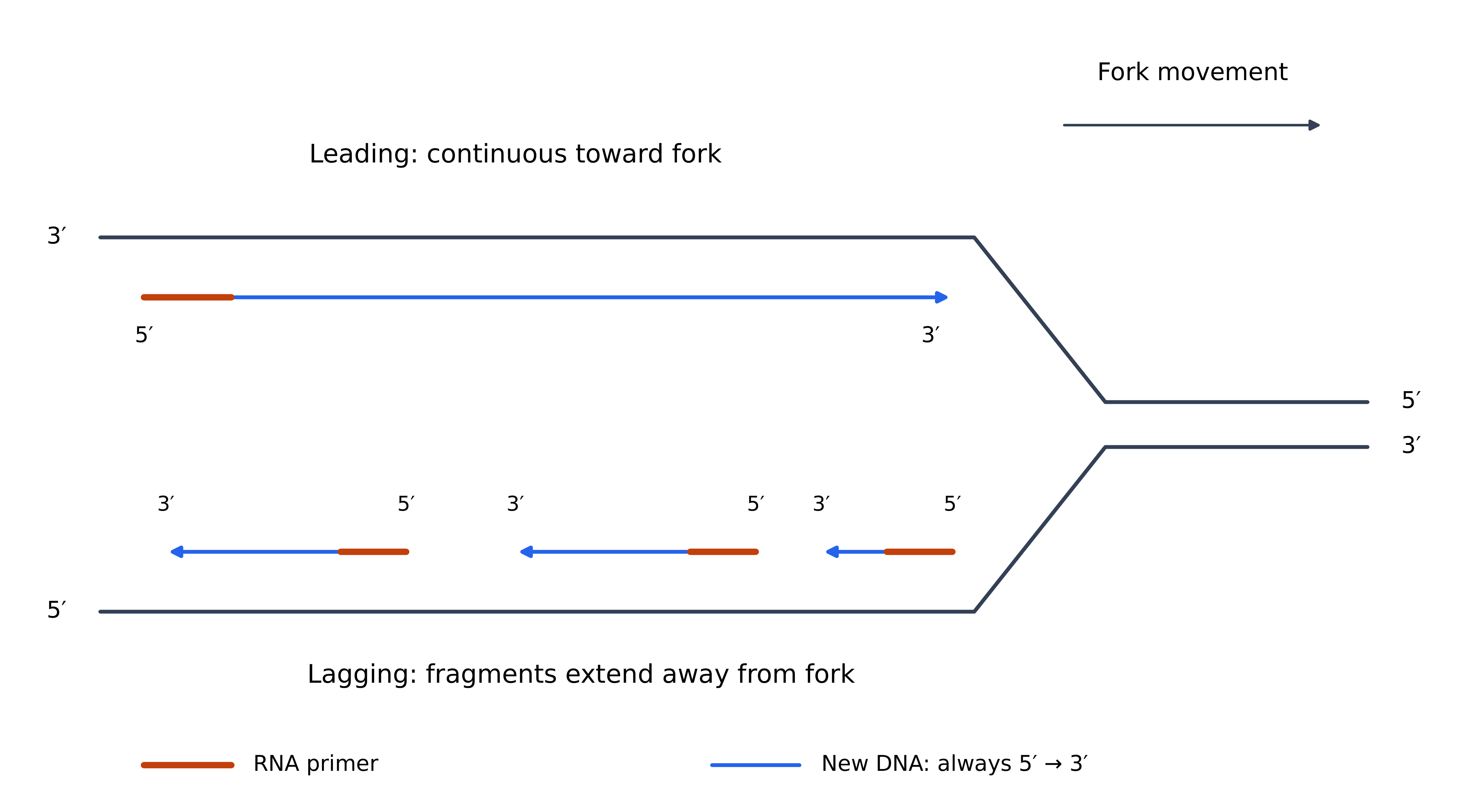
What is the synthesis direction of each lagging-strand fragment?
Difficulté 1/5 · 100 pièces + un petit bonus lors de la première réussite aujourd'hui
Fragment growth reverses its direction on the page, not its chemical synthesis polarity.
AHL D1.1: Explain repeated priming without leaving permanent gaps
- DNA polymerase needs an existing suitable starting end. Primase synthesizes short RNA primers. In this simplified one-fork model, the leading strand is primed once for continuous synthesis, while each new Okazaki fragment needs another RNA primer.
- As the fork exposes more lagging template, later fragments begin closer to the fork and extend away from it. Subsequent primer replacement and ligation make a continuous daughter backbone. The final lagging strand is not permanently disconnected. Standard PCR instead uses supplied DNA primers.
Why does the lagging side need repeated primers?
Difficulté 1/5 · 100 pièces + un petit bonus lors de la première réussite aujourd'hui
Primase provides new starts as more lagging-strand template is exposed.
In the stated one-fork model, one leading strand is initiated once and four Okazaki fragments are initiated. How many RNA primers are needed in total?
Difficulté 2/5 · 140 pièces + un petit bonus lors de la première réussite aujourd'hui
One leading start plus four fragment starts gives five primers.
AHL D1.1: Assign prokaryotic polymerase and ligase roles separately
- In the syllabus prokaryotic model, DNA polymerase III extends new DNA from a primer. DNA polymerase I removes RNA-primer material and replaces it with DNA. DNA ligase seals remaining nicks between adjacent DNA sections in the covalent backbone.
- Primase makes RNA starts; helicase separates paired templates. Ligase does not supply every replacement nucleotide or join the two parental templates back together. These named polymerase I/III roles are not universal enzyme names for every eukaryotic replication system.
Which enzyme fills the RNA-primer region with DNA in this stated model?
Difficulté 1/5 · 100 pièces + un petit bonus lors de la première réussite aujourd'hui
Polymerase I replaces primer material; ligase seals the remaining nick.
AHL D1.1: Correct a terminal mismatch while preserving the template
- If polymerase III has added terminal T opposite a template G, remove the mismatched terminal nucleotide at the growing strand’s 3′ end and replace it with C. Do not change the template G merely to fit the error.
- This proofreading action differs from helicase opening paired strands and ligase sealing a backbone nick. Subsequent DNA synthesis continues 5′ → 3′. Proofreading reduces error frequency; it does not guarantee that every possible mutation is eliminated.
What should replace the terminal T opposite template G?
Difficulté 1/5 · 100 pièces + un petit bonus lors de la première réussite aujourd'hui
C pairs with the unchanged template G; the error is in the newly added nucleotide.
AHL D1.1: Compare cellular and PCR ingredients at the right level
- Cellular replication uses helicase to open paired templates and, in the stated prokaryotic model, primase to make RNA primers. Standard PCR uses repeated heating to separate templates and supplied DNA primers to start thermostable-polymerase synthesis.
- Both use complementary templates and nucleotides to make DNA, but their opening methods, primer types and enzyme systems differ. Taq is not a substitute name for every cellular polymerase or for primase. Avoid importing every prokaryotic enzyme into a standard PCR ingredient list.
Which contrast is correct?
Difficulté 1/5 · 100 pièces + un petit bonus lors de la première réussite aujourd'hui
The systems share template copying but use different initiation and opening arrangements.