Enzyme rate and controlled measurements
Introduit| English | Sens |
|---|---|
| enzyme/ˈenzaɪm/ | enzyme |
| denaturation/ˌdenətʃəˈreɪʃn/ | dénaturation |
What would explain this observation?
- An enzyme 酶 works quickly at one temperature and slowly at another. Heating can increase successful collisions, but excessive heat can change the active site.
Build the model
- An enzyme is a biological catalyst.
- The substrate binds at an active site whose shape and chemical properties support the reaction.
- A catalyst increases rate without being used up overall.
- enzyme: A biological catalyst.
- denaturation 变性: A structural change that disrupts function.

Temperature changes enzyme activity
Activity depends on conditions; the curve is an illustrative model for one enzyme.
Which change best tests the effect of pH?
Difficulté 1/5 · 100 pièces + un petit bonus lors de la première réussite aujourd'hui
Testing pH means changing only pH. Buffers of different pH at one fixed temperature isolate pH as the variable; changing temperature or enzyme concentration at the same time would mix two variables and the result could not be attributed to pH.
Match each technical term to its precise meaning.
Difficulté 2/5 · 140 pièces + un petit bonus lors de la première réussite aujourd'hui
Use the definitions to distinguish related quantities and processes.
Choose evidence that can test it
- Measure rate using product formed per unit time or a fixed endpoint.
- For an endpoint test, 1/time is a rate proxy if the same amount of product or substrate change defines the endpoint each time.
In the lab: For starch digestion, equilibrate enzyme and starch in a water bath, control pH with buffer, mix measured volumes, and test samples with iodine at fixed intervals. Use a clean spot for each test. Do not put iodine into the reaction mixture.
Which two habits make the investigation or model in this case more defensible?
Difficulté 2/5 · 140 pièces + un petit bonus lors de la première réussite aujourd'hui
Stating the conditions and assumptions lets others repeat the work exactly, and recording the supporting evidence lets them check the conclusion. Hiding disagreeing results removes the evidence that could challenge a wrong conclusion, and one measurement can never establish a wider claim.
Work from known quantities
- Known: the endpoint is reached in 40 s.
- Use rate proxy = 1/time.
- Rate proxy = 1/40 = 0.025 per second.
- At 20 s the proxy is 0.050 per second, twice as large.
- This comparison is valid only if the same endpoint and starting concentrations are used.
Your turn: A fixed endpoint takes 50 s. Calculate the rate proxy 1/time.
A fixed endpoint takes 50 s. Calculate the rate proxy 1/time.
Difficulté 2/5 · 140 pièces + un petit bonus lors de la première réussite aujourd'hui
The result is 0.02 1/s. Known: the endpoint is reached in 50 s. Use rate proxy = 1/time. Rate proxy = 1/50 = 0.02 per second. This proxy is comparable with the 40 s worked case (0.025 per second) only because the same endpoint definition is used.
Check the conclusion and its limits
- An optimum is specific to the enzyme and conditions.
- Low temperature usually slows the reaction; it does not necessarily denature the enzyme.
- Endpoint intervals limit precision.
Not true: A low temperature always permanently denatures an enzyme. Low temperature usually only slows an enzyme because molecules collide less often; the active site is unchanged and warming restores activity. Denaturation is a structural change from excessive heat or extreme pH, not a guaranteed result of cooling.
- An enzyme is a biological catalyst.
- Measure rate using product formed per unit time or a fixed endpoint.
- Watch for: an optimum is specific to the enzyme and conditions.
Low temperature usually only slows an enzyme because molecules collide less often; the active site is unchanged and warming restores activity.
Difficulté 1/5 · 100 pièces + un petit bonus lors de la première réussite aujourd'hui
True. Low temperature usually only slows an enzyme because molecules collide less often; the active site is unchanged and warming restores activity. Denaturation is a structural change from excessive heat or extreme pH, not a guaranteed result of cooling.
A biological catalyst: write the technical term.
Difficulté 1/5 · 100 pièces + un petit bonus lors de la première réussite aujourd'hui
enzyme means A biological catalyst.
Write from the data given
- A fixed endpoint takes 80 s.
- Find the rate proxy 1 over time. The same endpoint must define every trial.
A fixed endpoint takes 80 s. What is the rate proxy 1 over time, and why must every trial use the same endpoint?
1 over 80 is 0.0125 per second. The proxy is not the amount of product.
The HL written case reaches a fixed endpoint in 80 s. What is the reciprocal-time rate proxy?
Difficulté 1/5 · 100 pièces + un petit bonus lors de la première réussite aujourd'hui
1 divided by 80 is 0.0125 per second. Other options — 0.020 per second (the earlier calculation's result for a 50 s endpoint); 0.025 per second (the lesson example's result for a 40 s endpoint).
Connect enzymes with a metabolic network
- Enzymes accelerate reactions and are regenerated overall, allowing repeated catalysis. Metabolism is an interacting network: products become other substrates, pathways branch and supplies must be regulated. Specificity requires many enzymes rather than one universal catalyst. Regeneration does not mean an enzyme stays rigid throughout every binding and release event.
- Anabolism builds larger or more complex molecules with an energy supply overall, as in protein synthesis, glycogen formation and photosynthesis. Catabolism breaks molecules down, as in digestion or substrate oxidation. Breaking a bond needs energy; the net balance of bonds broken, bonds formed and other changes determines the energy transfer. Photosynthesis is not merely one condensation reaction.
Explain specificity with chemistry and induced fit
- Folding positions side chains together in an active site even when they are far apart in the sequence. Complementary shape, charge and other chemical interactions help determine productive binding; a similar outline alone is insufficient. Binding can position groups, strain bonds or stabilize a transition state.
- Induced fit means enzyme and substrate shapes adjust during binding. Products leave and the enzyme can catalyse another cycle. Not every residue touches substrate, yet changes elsewhere can alter the site's structure. These protein-enzyme examples do not exclude catalytic RNA, which provides a different biological catalyst type.
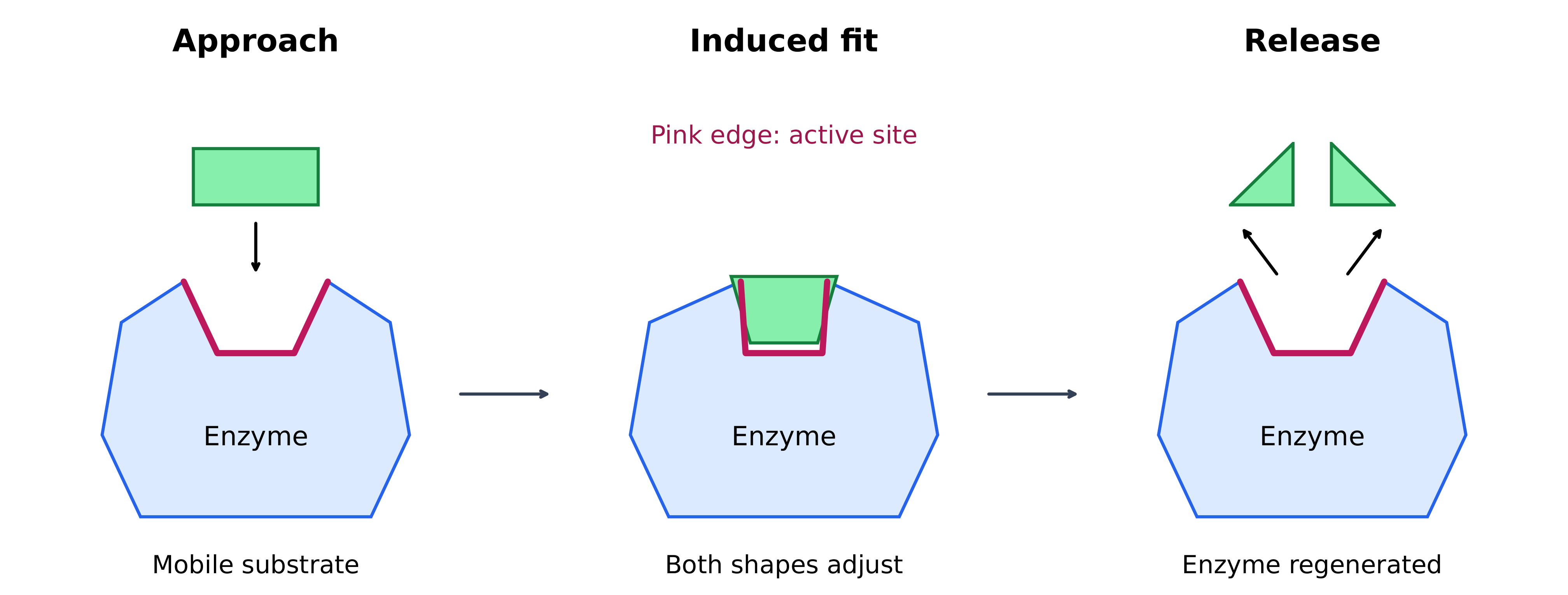
Explain productive encounters without requiring both partners to swim
- Random molecular motion brings substrate and enzyme sites together. Productive encounters need appropriate orientation and compatible chemistry; not every collision yields products. Higher movement over a suitable temperature range can increase encounter frequency without changing the enzyme into a source of heat for each substrate molecule.
- A membrane-bound enzyme can meet mobile substrate, while a mobile enzyme can reach an immobilized substrate. Fixed location does not automatically stop catalysis. Distinguish diffusion, productive binding and chemical turnover; changing one can alter observed rate even if the enzyme amount stays the same.
Compare activation barriers with the same starting level
- In an invented diagram, reactants are at 40 energy units and products at 20. Peaks are 100 without enzyme and 65 with enzyme, giving forward barriers 60 and 25 units. The overall change remains $20-40=-20$ in both cases. The horizontal axis shows reaction progress, not elapsed time.
- A lower barrier permits more encounters to proceed at a given temperature. It does not supply a net energy requirement, change the initial and final energy levels or move equilibrium. A net energy-releasing reaction can still be slow; catalysis accelerates forward and reverse reactions rather than making any impossible net process occur simply by adding enzyme.
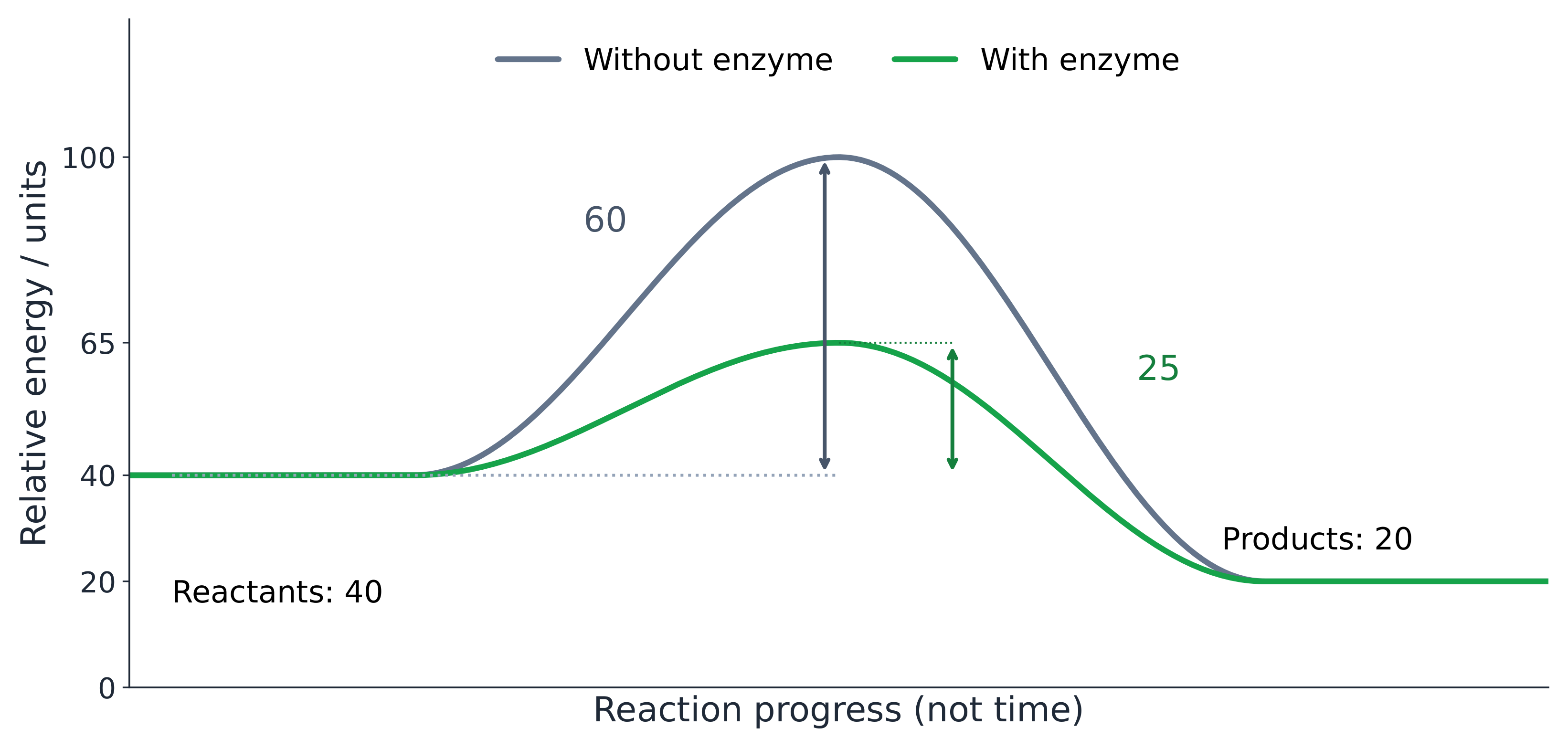
An invented energy diagram has reactants at 40 units, products at 20 and a catalysed peak at 65. What is the forward catalysed activation energy?
Difficulté 2/5 · 140 pièces + un petit bonus lors de la première réussite aujourd'hui
Forward barrier = 65 − 40 = 25 units. The overall change is 20 − 40 = −20 units, unchanged by the catalyst. The peak itself is not the barrier measured from reactants.
Separate a tested maximum from an exact optimum
- An invented temperature series has rates 2, 4, 7, 5 and 1 units at 10, 20, 30, 40 and 50°C. The greatest tested rate is 7 at 30°C, not proof that the exact optimum is 30. Increasing productive encounters explains the initial rise, while structural disruption can explain the high-temperature decline under this model.
- Use smaller intervals and repeats near the peak. Exposure duration and assay conditions matter, so there is no universal optimum for all enzymes. Cooling often slows a reaction reversibly. To test persistent heat damage, return treated and control samples to common suitable assay conditions rather than inferring denaturation from one low rate measured while cold.
Link pH to groups and interactions
- pH changes protonation of amino-acid groups, affecting charges, substrate binding and catalytic chemistry. Larger changes can disrupt the fold. Different enzymes have different suitable ranges; an acidic digestive-enzyme optimum does not mean every human enzyme works best in acid.
- A pH-induced rate change is not automatically irreversible denaturation. Restore common conditions and measure recovery, controlling substrate and enzyme amounts and exposure duration. Distinguish altered active-site chemistry from a completely hydrolysed peptide backbone, and use additional structural evidence if the exact molecular damage is being claimed.
Explain substrate saturation at fixed enzyme amount
- At low substrate, increasing concentration increases productive encounters. At high substrate, active sites spend most of their time occupied and turnover limits rate, so a plateau is approached. This does not mean every substrate molecule is bound or that added substrate has denatured the enzyme.
- Adding more active enzyme can raise that ceiling if substrate and other requirements remain sufficient. In an invented model, one enzyme dose approaches 8 rate units and double the dose approaches 16. Match temperature, pH, volume and the initial-rate method before attributing the difference to the number of working sites.
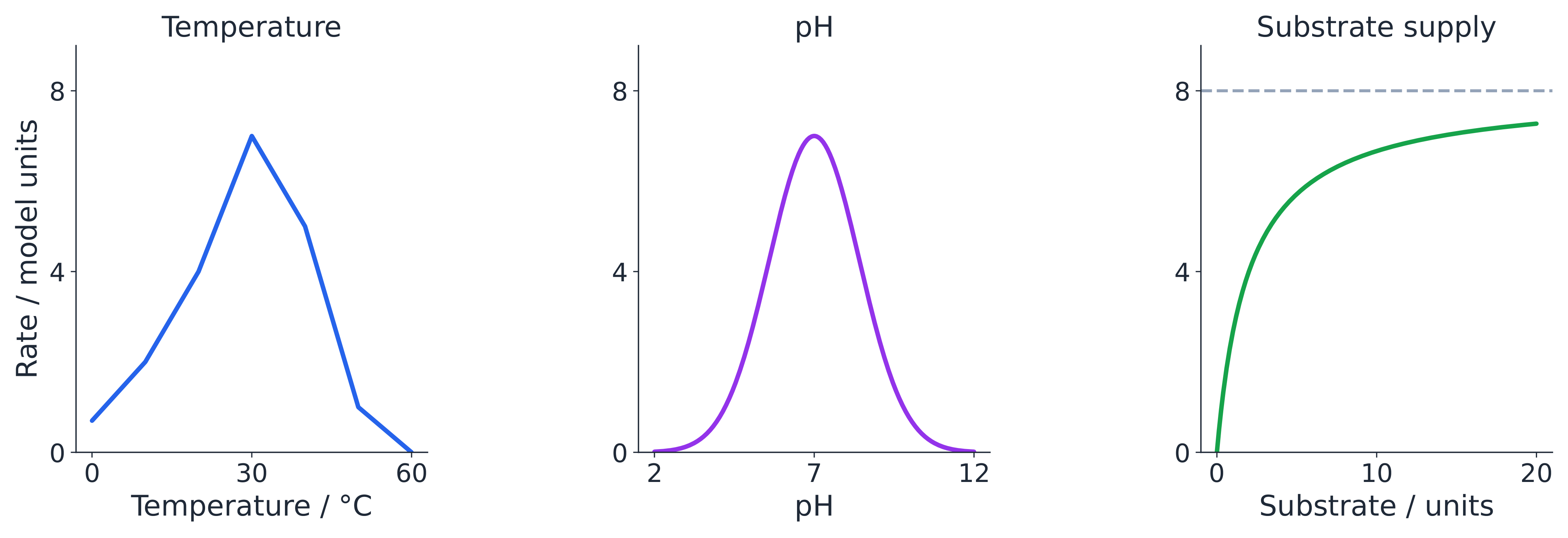
At fixed active-enzyme amount, an initial-rate curve approaches a plateau as substrate increases. Which explanation fits the model?
Difficulté 1/5 · 100 pièces + un petit bonus lors de la première réussite aujourd'hui
Saturation concerns enzyme-site availability and turnover, not necessarily structural damage. Match pH, temperature, volume and sufficient substrate when changing enzyme dose.
Measure a gradient rather than calling a volume a rate
- Invented gas volumes at 0, 20, 40, 60 and 80 seconds are 0, 12, 21, 27 and 30 mL. The first-interval mean rate is $12/20=0.60$ mL per second; the full-interval mean is $30/80=0.375$. Report which interval and units are used rather than calling 30 mL itself a rate.
- An initial tangent estimates rate at time zero, before major depletion and accumulation. A finite first-interval mean is not automatically that exact tangent. Product-time curves can flatten because conditions change during reaction; compare initial rates consistently when investigating a factor instead of mixing early and late averages.
An invented product-time series rises from 0 mL at 0 s to 30 mL at 80 s. Find the mean rate over that whole interval.
Difficulté 2/5 · 140 pièces + un petit bonus lors de la première réussite aujourd'hui
Mean gradient = (30 − 0)/(80 − 0) = 0.375 mL per second. It is not automatically the exact initial tangent; the first 20-second interval in the lesson gives a different mean of 0.60.
Use reciprocal time only for a common endpoint
- For the same fixed change, $1/t$ is a relative-rate proxy. Invented endpoint times 40 and 20 seconds give 0.025 and 0.050 per second: the second proxy is twice the first. Without a known endpoint amount, these units are not millilitres or grams of product per second.
- Match starting concentrations and endpoint detection. If the final positive iodine test is at 50 seconds and the first negative at 60, starch disappearance occurs after 50 and no later than 60 under that method, not exactly at 60. Shorter sampling intervals improve time resolution but can remove more mixture and alter conditions.
The final positive starch–iodine test is at 50 s and the first negative is at 60 s. Which endpoint statement is supported?
Difficulté 1/5 · 100 pièces + un petit bonus lors de la première réussite aujourd'hui
Sampling gives an interval, not an exact endpoint. Reciprocal time is a comparable rate proxy only when the same endpoint and starting conditions are used.
Keep the iodine assay separate from the enzyme reaction
- For a controlled amylase–starch temperature comparison, equilibrate measured enzyme and starch separately, maintain pH with a suitable buffer, then mix and time consistently. Transfer equal samples to separate iodine spots at fixed intervals. Do not add iodine to the reaction mixture because it changes what is being tested.
- Use fresh mixtures, the same colour criterion, matched volumes and starting concentrations, and a no-active-enzyme comparison. Obtain independent trials at each temperature. Minimize sampling losses or use parallel tubes. Follow the approved reagent and hot-water method; one disappearing colour is an endpoint observation, not a complete molecular mechanism.
Match the instrument to the quantity needed
- Counting bubbles does not measure gas volume unless each bubble's volume is known and consistent. A suitable gas syringe measures volume more directly, with leaks and dissolved gas still considered. A colorimeter needs a proper blank and calibration before absorbance can be converted to concentration.
- Measure change over time and distinguish instrument resolution, observer judgement and variation between trials. Randomizing treatment order can reduce systematic drift effects. Repeats improve an estimate of spread but do not repair a wrong calibration or a consistently different endpoint between treatments.
Connect the observed pattern to a qualified mechanism
- Describe the graph over the measured range, calculate an appropriate gradient or proxy, then explain productive encounters, active-site chemistry, saturation or structural disruption as relevant. State the manipulated factor and controls before assigning every difference to enzyme amount or permanent denaturation.
- A strong investigation separates treatment from measurement conditions, uses independent repeats and reports uncertainty. A tested peak is not an exact optimum; a plateau is not proof of denaturation; a low rate after one treatment does not identify every changed bond. Additional recovery or structural evidence can distinguish competing explanations.
Plan a comparison of amylase activity at different temperatures and explain how to distinguish a tested rate maximum from an exact optimum and persistent denaturation.
Rate interpretation requires both molecular reasoning and a measurement model that keeps competing explanations separate.
AHL: Separate reaction location from an organism's boundary
- Intracellular glycolysis occurs in cytosol and the eukaryotic Krebs cycle mainly in mitochondrial matrix. Digestive enzymes in the gut lumen act outside the cells that secreted them, although still inside the animal. Location of synthesis and location of enzyme action are different questions.
- Metabolic transfers also generate heat. With an invented 200 kJ input and 70 kJ retained in a specified useful output, efficiency is 35%; if every other output within this boundary is heat, heat is 130 kJ. This is not a universal ATP yield. Mammals and birds combine metabolic heat with regulated heat loss to maintain temperature.
AHL: An invented process receives 200 kJ and retains 70 kJ in the specified useful output. All other output within the stated boundary becomes heat. How much heat is produced?
Difficulté 2/5 · 140 pièces + un petit bonus lors de la première réussite aujourd'hui
Heat = 200 − 70 = 130 kJ. Useful efficiency is 70/200 × 100 = 35%. The stated boundary and omitted outputs are assumptions, not a universal ATP yield.
AHL: Distinguish a pathway cycle from a closed system
- A linear pathway such as A → B → C → D has successive enzyme-catalysed steps; glycolysis is a suitable example of this organization. Cyclical pathways such as Krebs and Calvin regenerate an acceptor while having net inputs and outputs. A cycle diagram does not imply no material enters or leaves.
- Pathways can branch and share intermediates. Regulating one step changes flux into linked processes, subject to substrate supplies and other controls. Do not count an inhibitory regulatory arrow as a matter-flow reaction or assume one enzyme catalyses every step because a diagram connects the arrows.
AHL: Explain reversible active-site competition
- In the simple competitive model, an inhibitor reversibly occupies the active site and reduces substrate access. Raising substrate can reduce its effect, with the original maximum approached at sufficiently high substrate. A small increase need not remove all inhibition immediately, and one reduced rate does not establish the binding location.
- Statins competitively inhibit HMG-CoA reductase, reducing a step toward mevalonate in cholesterol synthesis; they do not digest cholesterol already present. Structural research examines their occupation of the substrate-binding region. Connect the named target and mechanism rather than treating every enzyme inhibitor as interchangeable.
AHL: Qualify the simple non-competitive model
- An allosteric site is distinct from the active site; binding a regulator can alter conformation and function. In the simple reversible non-competitive model here, effective activity and maximum rate are reduced, and extra substrate cannot restore the original maximum. Allosteric binding can also activate, and not every allosteric system follows this simplest inhibition model.
- Invented rates without inhibitor, with competitive inhibitor and with simple non-competitive inhibitor are 4, 2 and 2 at substrate 2, then 7.2, 6 and 3.6 at substrate 18. One low-substrate comparison cannot distinguish mechanisms. A concentration series plus binding and recovery evidence is stronger than assigning sites and reversibility from two rates alone.
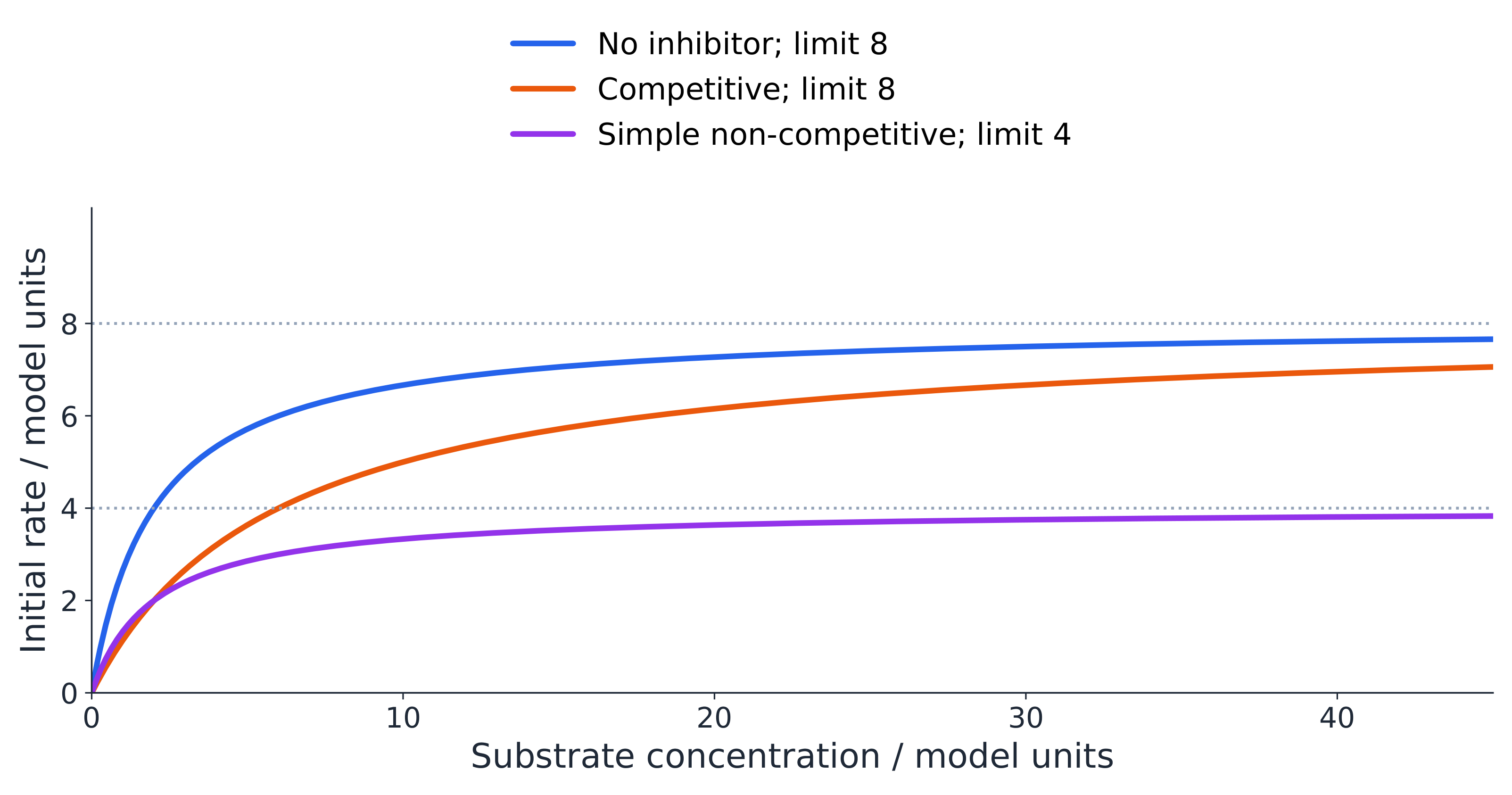
AHL: Which distinguishes the simple competitive and reversible non-competitive models used here?
Difficulté 1/5 · 100 pièces + un petit bonus lors de la première réussite aujourd'hui
Compare a substrate series, not one low-substrate point. Allosteric sites are distinct from the active site but binding may inhibit or activate; curve shape alone does not establish every molecular detail.
AHL: Trace end-product regulation without reversing matter flow
- In bacterial isoleucine synthesis, isoleucine binds a regulatory site on early threonine deaminase, reducing further pathway entry from threonine. When product is used and its concentration falls, inhibition can be relieved. This negative feedback limits unnecessary substrate and energy use rather than making isoleucine compete for threonine's active site.
- Draw forward intermediate arrows and a separate inhibitory connection back to the early enzyme. The regulation arrow does not convert product back into starting substrate. Branched-chain pathway research distinguishes catalytic and regulatory functions; this example does not mean every end product inhibits every enzyme or every pathway has just one control point.
AHL: Distinguish covalent inhibition from freely reversible binding
- Penicillin reacts with bacterial transpeptidases involved in peptidoglycan cross-linking, forming a stable covalent active-site modification on the relevant timescale. This mechanism-based inhibition weakens construction of a growing wall; it does not directly digest every membrane, and extra substrate does not promptly remove the modification.
- An altered transpeptidase can bind beta-lactam drugs less effectively while retaining useful wall-building activity, as examined in structural work on a resistant target. Target alteration differs from beta-lactamase destruction of drug. Genetic variants spread through selection or transfer; an individual enzyme does not learn avoidance during exposure.
AHL: Match each biochemical example to its stated mechanism.
Difficulté 2/5 · 140 pièces + un petit bonus lors de la première réussite aujourd'hui
Location, reversibility, regulation and chemical modification describe different mechanisms. An enzyme does not learn drug avoidance during exposure.