Water: a molecular cause for a biological property
Introduit| English | Sens |
|---|---|
| cohesion/kəʊˈhiːʒn/ | cohésion |
| adhesion/ədˈhiːʒn/ | adhésion |
What would explain this observation?
- A water droplet holds together on a leaf. Its behaviour comes from interactions between molecules, not a skin made of solid water.
Build the model
- Water molecules are polar.
- Attraction between the partially positive hydrogen of one molecule and a partially negative oxygen of another gives hydrogen bonding.
- Cohesion 内聚力 is attraction between water molecules; adhesion 黏附力 is attraction to another surface.
- cohesion: Attraction between molecules of the same substance.
- adhesion: Attraction between different substances.

What accounts for cohesion in liquid water?
Difficulté 1/5 · 100 pièces + un petit bonus lors de la première réussite aujourd'hui
Water molecules attract each other through hydrogen bonds between molecules, and that intermolecular attraction produces cohesion. The covalent O-H bonds sit INSIDE each molecule and are not what pulls molecules together.
Match each technical term to its precise meaning.
Difficulté 2/5 · 140 pièces + un petit bonus lors de la première réussite aujourd'hui
Use the definitions to distinguish related quantities and processes.
Choose evidence that can test it
- The same intermolecular interactions help explain surface tension and the energy needed to change temperature.
- Heating changes molecular motion and interactions; it does not normally break the covalent O–H bonds.
In the lab: Compare equal drops on clean surfaces under fixed temperature. Measure contact angle or spreading consistently. A detergent changes the system, so record concentration rather than treating all liquids as equivalent.
Which two habits make the investigation or model in this case more defensible?
Difficulté 2/5 · 140 pièces + un petit bonus lors de la première réussite aujourd'hui
Stating the conditions and assumptions lets others repeat the work exactly, and recording the supporting evidence lets them check the conclusion. Hiding disagreeing results removes the evidence that could challenge a wrong conclusion, and one measurement can never establish a wider claim.
Work from known quantities
- Known: 0.100 kg of water warms by 5.0 K; specific heat capacity is 4,180 J/(kg K).
- Q = mcΔT = 0.100 × 4,180 × 5.0 = 2,090 J.
- This calculation excludes energy absorbed by the container and lost to the surroundings.
Your turn: Use c = 4,180 J/(kg K). Calculate Q for 0.200 kg water heated through 5.0 K. Give the energy in joules to two significant figures.
Same heat, more water, smaller temperature rise
Start with 2,090 J heating 0.100 kg of water by 5 K. Change mass or heat loss to separate supplied energy from the heat actually gained by water.
Use c = 4,180 J/(kg K). Calculate Q for 0.200 kg water heated through 5.0 K. Give the energy in joules to two significant figures.
Difficulté 2/5 · 140 pièces + un petit bonus lors de la première réussite aujourd'hui
The result is 4200 J. Known: m = 0.200 kg; c = 4,180 J/(kg K); temperature rise 5.0 K. Use Q = m c delta T. Q = 0.200 x 4,180 x 5.0 = 4,180 J. This excludes heating of the container and losses. The unrounded 4180 J rounds to 4200 J (4.2 kJ) to two significant figures.
Check the conclusion and its limits
- Hydrogen bonds between molecules differ from covalent bonds within a water molecule.
- Polarity alone does not make every substance dissolve well in water.
Not true: Boiling water normally breaks its O–H covalent bonds. Boiling separates molecules from each other, overcoming intermolecular hydrogen bonds. The covalent O-H bonds inside each molecule survive - the steam is still H2O.
- Water molecules are polar.
- The same intermolecular interactions help explain surface tension and the energy needed to change temperature.
- Watch for: hydrogen bonds between molecules differ from covalent bonds within a water molecule.
Boiling separates molecules from each other, overcoming intermolecular hydrogen bonds.
Difficulté 1/5 · 100 pièces + un petit bonus lors de la première réussite aujourd'hui
True. Boiling separates molecules from each other, overcoming intermolecular hydrogen bonds. The covalent O-H bonds inside each molecule survive - the steam is still H2O.
Attraction between molecules of the same substance: write the technical term.
Difficulté 1/5 · 100 pièces + un petit bonus lors de la première réussite aujourd'hui
cohesion means Attraction between molecules of the same substance.
0.200 kg of water is heated through 3.0 K. Use 4180 J per kilogram per kelvin. What is Q, and what does boiling break?
0.200 times 4180 is 836, and 836 times 3 is 2508 J. Steam is still water.
The written case heats 0.200 kg water by 3.0 K. With specific heat capacity 4180 joules per kilogram per kelvin, how much heat does the water retain?
Difficulté 1/5 · 100 pièces + un petit bonus lors de la première réussite aujourd'hui
Q = 0.200 × 4180 × 3.0 = 2508 J before final rounding. The earlier 5.0 K example gives a different answer, 4180 J. Both exclude heating the container and losses to the wider surroundings.
Write from one water property to a biological consequence
- In the original written case, 0.200 kg water warms by 3.0 K with specific heat capacity 4180 joules per kilogram per kelvin. Retained heat is $Q=0.200\times4180\times3.0=2508$ J before final rounding. This is a different case from the earlier 5.0 K rise. The calculation excludes heating the container and exchanging heat with the room.
- This route develops A1.1 Water through molecular interactions, plant transport, solutions and animal habitats. All new numerical datasets are original and invented. Connect a molecular cause to a physical property, then explain the relevant biological consequence. A label such as “water is useful” does not yet explain how it supports life.
Explain a polar molecule that remains neutral overall
- In each O–H bond, oxygen attracts the shared electrons more strongly than hydrogen. Oxygen therefore has partial negative charge and hydrogen partial positive charge. The molecule is bent, so the bond polarities do not cancel. These partial charges describe unequal electron sharing; they do not mean that an ordinary water molecule is a collection of separate fully charged ions.
- A hydrogen bond commonly joins a partially positive hydrogen on one water molecule to oxygen on another. Distinguish the dashed intermolecular attraction from the covalent O–H bonds within each molecule. Ordinary boiling separates intact molecules by overcoming intermolecular attractions; it does not normally split them into hydrogen and oxygen by breaking those covalent bonds.
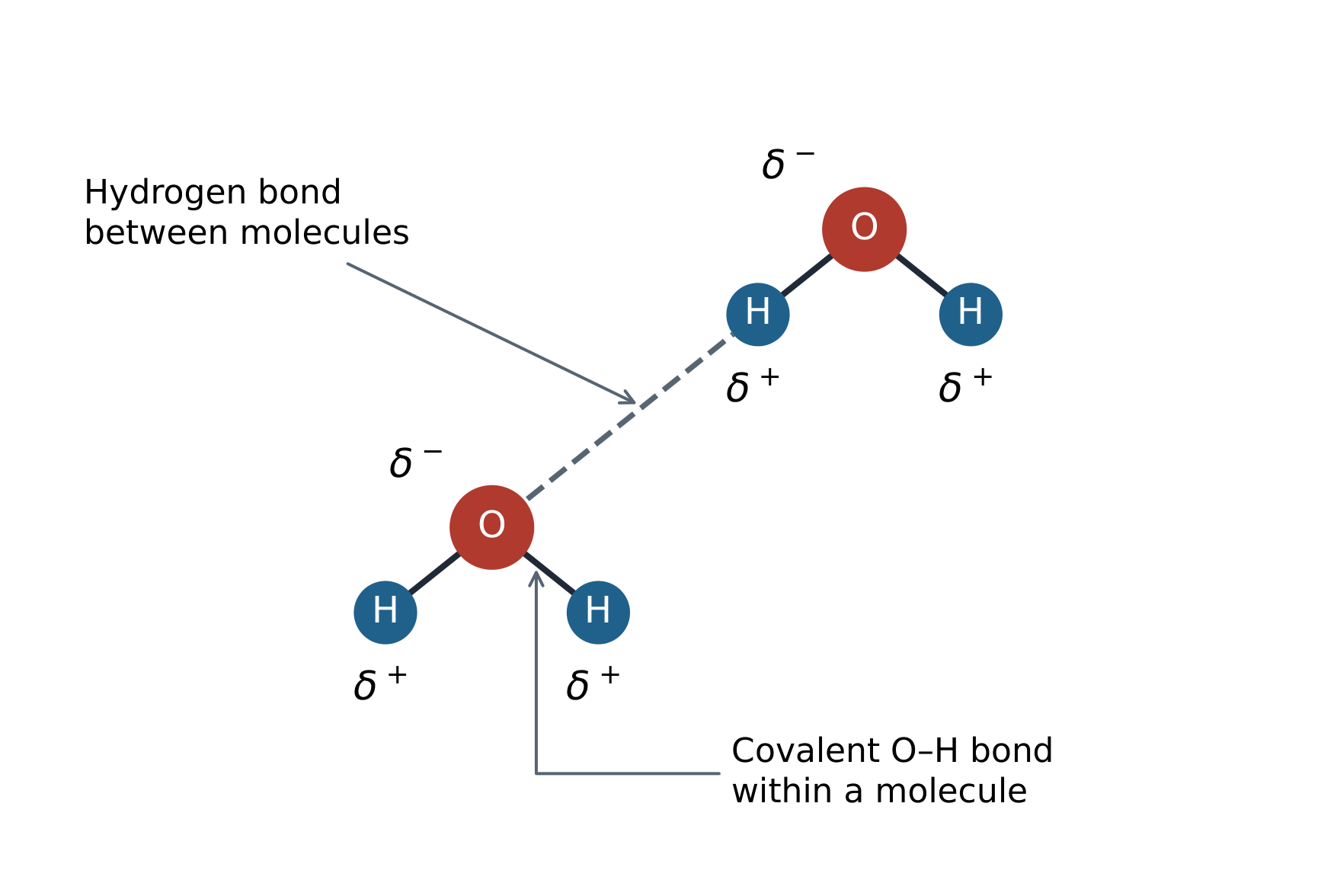
Which correctly distinguishes the bonds in the water diagram?
Difficulté 1/5 · 100 pièces + un petit bonus lors de la première réussite aujourd'hui
The solid O–H bonds join atoms within a molecule. The dashed attraction is between a partially positive hydrogen on one molecule and oxygen on another.
Link cohesion to a connected water column
- Cohesion is attraction between water molecules, supported by their hydrogen bonding. Many individually weaker interactions can together produce substantial effects. Creating additional water surface requires energy, so surface tension resists stretching. The pond surface remains liquid: a suitable small insect can deform it and receive supporting forces without standing on a solid skin.
- In xylem, evaporation from leaf surfaces helps generate tension, a pulling stress. Cohesion helps a connected water column transmit this pull through the plant. Water does not actively crawl upward or expend its own metabolic energy to climb. The column can fail if gas-filled breaks develop; cohesion is important but does not provide unlimited support under every condition.
Distinguish adhesion from the whole-tree explanation
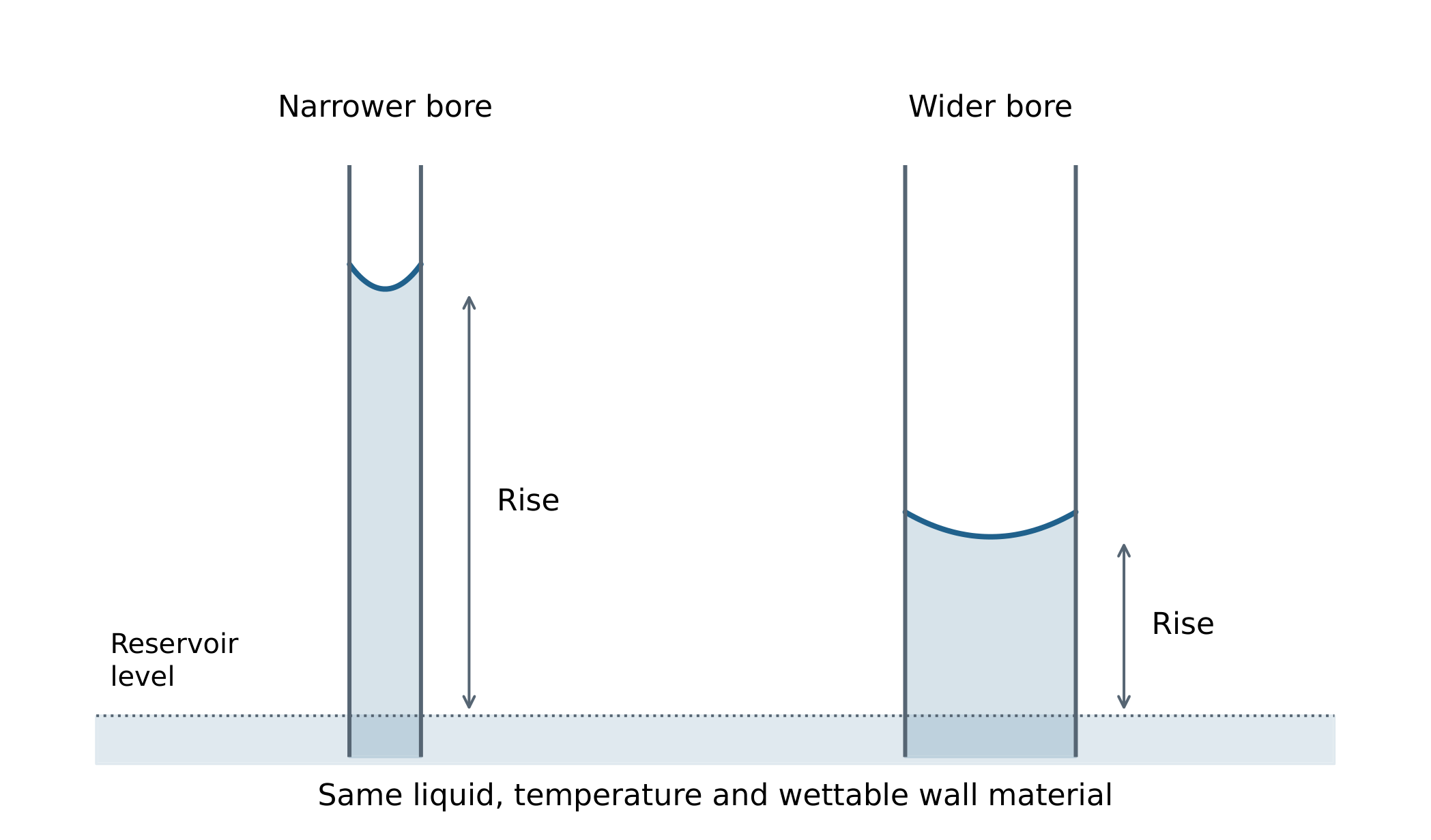
- Adhesion is attraction between water and another material, including suitable polar or charged groups in plant cell walls. In a narrow wettable tube, interactions at the wall together with cohesion can support capillary rise against gravity. The upward force is balanced by the raised water's weight at equilibrium. Surface chemistry matters: a narrow non-wettable space need not show the same rise.
- Under otherwise identical ideal wettable conditions, a narrower tube supports a greater equilibrium rise. Small spaces in soil and cell walls help retain and distribute water. A glass-tube demonstration does not explain every metre of ascent in a tall tree; transpiration-driven tension and the cohesive column remain central to long-distance water transport.
Explain solvent behaviour rather than saying everything dissolves
- Around a dissolved positive ion, nearby water molecules tend to orient their oxygen sides inward; around a negative ion, their hydrogen sides tend to face inward. Water also interacts with suitable polar molecular groups. Many ions and small polar molecules can therefore travel in aqueous fluids, such as mineral ions in xylem and glucose in blood plasma.
- Solubility depends on the substance, temperature and concentration: polarity does not guarantee unlimited dissolution. Nonpolar lipid regions interact poorly with water and tend to aggregate. This helps membrane lipids organize boundaries around aqueous interiors. A cloudy suspension of fine particles is not the same as molecular dissolution, and a clear solution need not be pure water.
Separate buoyant support from resistance to movement
- Buoyancy arises from pressure forces in the surrounding fluid. In a simple fully submerged model, upthrust equals the weight of displaced fluid. An invented object displacing 0.000500 cubic metres of water of density $1000\ \dfrac{\mathrm{kg}}{\mathrm{m}^3}$ displaces 0.500 kg. With $g=9.81\ \dfrac{\mathrm{N}}{\mathrm{kg}}$, the upward force is 4.905 N.
- An object of mass 0.600 kg weighs 5.886 N, so under this model its net force is 0.981 N downward before other forces. Upthrust has not removed its mass. Swimming also involves drag; viscosity contributes to resistance during movement, whereas buoyancy provides vertical support. Viscosity and density are different properties, and speed, shape and flow conditions also affect drag.
An invented submerged object displaces 0.000500 cubic metres of water of density 1000 kilograms per cubic metre. Use g = 9.81 newtons per kilogram. Find the upthrust.
Difficulté 2/5 · 140 pièces + un petit bonus lors de la première réussite aujourd'hui
Displaced mass is 1000 × 0.000500 = 0.500 kg; its weight is 0.500 × 9.81 = 4.905 N. This upward force does not remove the object’s own weight or drag.
Distinguish heat transfer from temperature buffering
- Thermal conductivity describes heat transfer down a temperature gradient through a material. Specific heat capacity describes energy needed to warm a mass by a given temperature difference. Water has greater thermal conductivity and specific heat capacity than air under ordinary comparable conditions. The two properties explain different consequences, so one should not be substituted for the other.
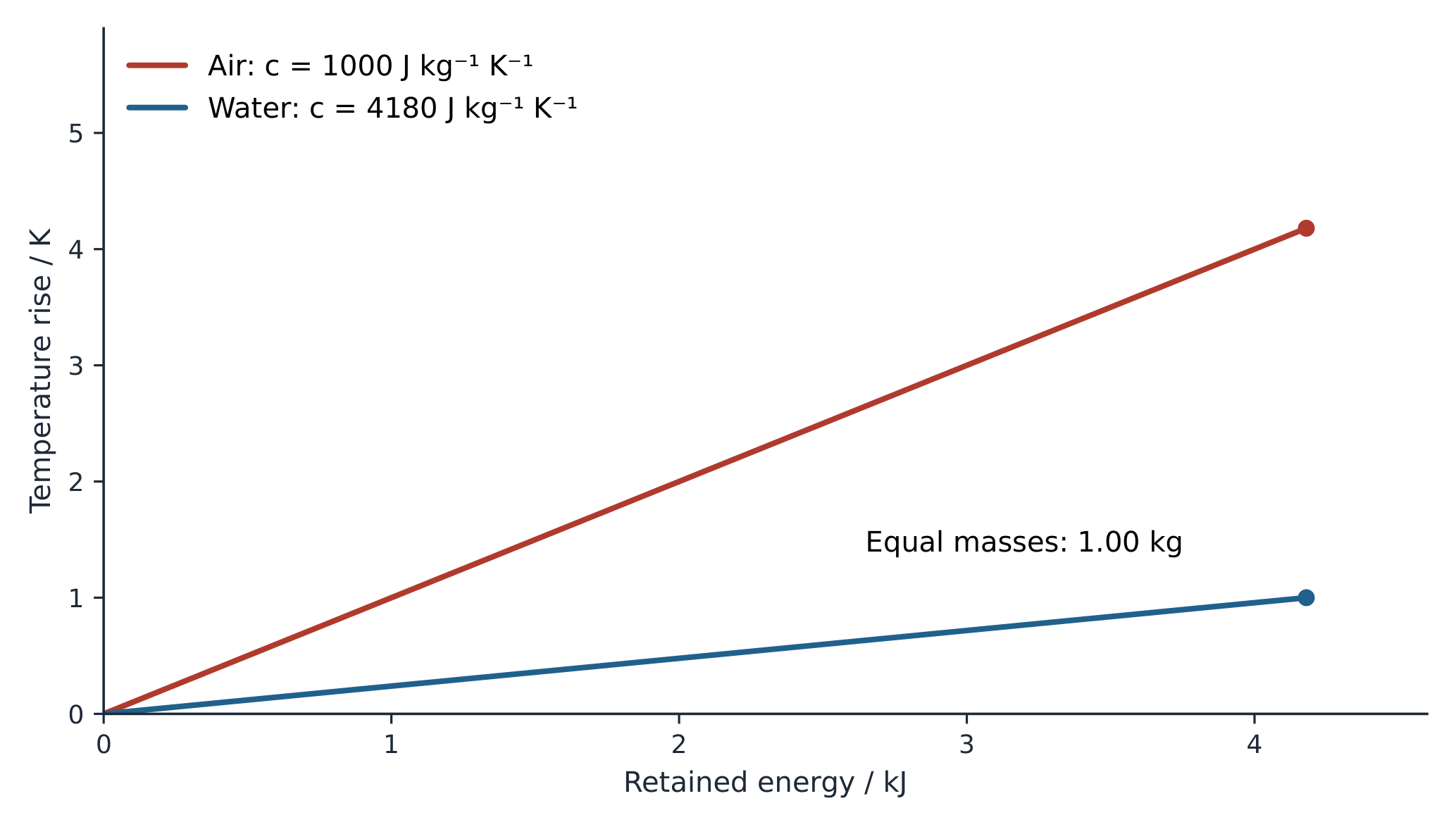
- Water can transfer heat away from a warm animal while a large body of water changes temperature relatively slowly. The surrounding water's large mass and heat capacity limit its temperature rise for a given retained energy. Currents, temperature difference and insulation also affect animal heat loss. Specific heat capacity alone cannot calculate a seal's cooling rate.
Compare equal masses with the same energy input
- Give equal 0.500 kg samples 2090 J retained energy, with no losses or phase changes. Use approximate specific heat capacities 4180 for water and 1000 for air, in joules per kilogram per kelvin. From $\Delta T=Q/(mc)$, water warms by $2090/(0.500\times4180)=1.00$ K; air warms by $2090/(0.500\times1000)=4.18$ K.
- This is an equal-mass comparison. Equal volumes contain very different masses and would give a different result. For another invented case, 0.250 kg water retaining 1045 J warms by $1045/(0.250\times4180)=1.00$ K. State what receives the energy; a heater supplying 1045 J does not establish that all 1045 J entered the water.
0.250 kg of water retains 1045 J. Use specific heat capacity 4180 joules per kilogram per kelvin. Find its temperature rise, neglecting losses and phase changes.
Difficulté 2/5 · 140 pièces + un petit bonus lors de la première réussite aujourd'hui
Temperature rise is retained heat divided by mc: 1045/(0.250 × 4180) = 1.00 K. Heater input and heat actually retained by water need not be identical.
Connect the properties to seals and loons
- A ringed seal receives buoyant support but still needs propulsion to overcome resistance when swimming. Its streamlined body and flippers relate to movement through water; blubber reduces heat transfer from a warm body to cold surroundings. Insulation slows heat loss rather than making the animal completely isolated from heat exchange.
- A loon, such as a black-throated loon, moves between water and air. Webbed feet provide propulsion in water and wings generate aerodynamic forces in flight. Suitable dry feathers can trap insulating air. Support, resistance and heat exchange change between habitats; an adaptation may involve several benefits and costs rather than solving every problem equally well.
Design a fair wetting comparison
- Compare equal water drops on clean surfaces at fixed temperature, recording preparation, drop volume and imaging geometry. Measure contact angle consistently rather than judging “stickiness” by appearance. A lower contact angle indicates greater wetting under the stated conditions. If testing detergent concentration, change that concentration systematically while holding the surface and other relevant conditions fixed.
- Repeat at each condition and consider trial order so gradual contamination or warming is not confused with the treatment. More repeats improve the evidence about scatter but do not repair the same biased camera angle in every image. Detergent changes the chemical system, including surface interactions; it is not simply an inert label added to otherwise identical water.
Process the invented contact-angle data
- Surface A gives 68, 71 and 69 degrees: mean $208/3\approx69.3$ degrees. Surface B gives 108, 112 and 110 degrees: mean $330/3=110$ degrees. A is more readily wetted in this investigation. The result does not measure cohesion alone; both the liquid and the surface influence the observed contact angle.
- The ranges are $71-68=3$ degrees for A and $112-108=4$ degrees for B. Record the original values as well as the means. Three trials on these two surfaces do not establish the behaviour of every leaf or waterproof material. Contamination, unequal drops and inconsistent viewing geometry remain possible alternative explanations without appropriate controls.
Invented contact angles for surface A are 68°, 71° and 69°. Find their mean to one decimal place.
Difficulté 2/5 · 140 pièces + un petit bonus lors de la première réussite aujourd'hui
(68 + 71 + 69)/3 = 69.333..., giving 69.3°. This is less than surface B’s mean 110°, so A is more readily wetted under the controlled conditions.
Build a complete explanation from cause to consequence
- For xylem, connect molecular polarity to hydrogen bonding, cohesion, a connected column and transmission of transpiration-driven tension. For a cold-water animal, connect the relevant thermal property to heat transfer and an insulating adaptation. For transport fluids, explain how interactions with solutes support an aqueous medium in which substances can move and react.
- Keep the inference within the model: a droplet is not covered by solid water, capillary rise is not a complete tree-transport theory, and a heat-capacity calculation is not a whole-animal heat-loss measurement. A good evaluation identifies what was measured, which assumptions linked it to the conclusion and what additional evidence would distinguish competing explanations.
Explain why a wettable capillary-tube demonstration helps teach water transport but does not by itself explain ascent in a tall tree.
Link the model to the biological mechanism and identify which parts of the real system it omits.
AHL: Separate a proposed source from conditions for retention
- Water-bearing asteroidal material is one proposed contributor to Earth's water. Comparing hydrogen isotope ratios and studying water-related material in meteorites help test source hypotheses. This does not establish that one impact supplied every ocean, or that all candidate sources contributed equally. NASA's account of source evidence also explains continuing uncertainty about comet contributions.
- Source and retention are different questions. Earth's gravity helps retain material, including an atmosphere; sufficiently cool conditions allow water vapour to condense. Temperature and pressure affect whether liquid water can persist. Gravity alone does not manufacture water or guarantee a liquid ocean, while a possible delivery mechanism alone does not explain long-term surface conditions.
AHL: Evaluate a habitable-zone claim
- A star's habitable zone is a range where surface liquid water could be possible on a suitable planet. Different stars have different ranges; atmosphere and planetary conditions matter. Being in that zone establishes neither actual water nor life. NASA's habitable-zone explanation treats it as a guide to possible conditions, rather than a biological detection.
- Subsurface liquid water can also interest a search for life beyond that surface zone. Internal heating can maintain potential liquid-water environments beneath ice; suitable chemistry and an energy source must also be considered. Known life's reliance on liquid water makes it a useful search target, but a possible habitat and evidence of organisms are different levels of inference.
AHL: A planet lies in its star’s habitable zone. Evaluate the claim that this proves it contains liquid water and living organisms.
A search criterion identifies possible suitable conditions; it does not by itself establish biological presence.