Votre plan d'apprentissage · Continuer · Réviser →
无 … 可 … (n'avoir pas de … pour …)
IntroduitVotre position enregistrée reste dans ce navigateur. Reprendre ne termine pas la leçon ni ne répond à ses questions.
Plus rien à dire
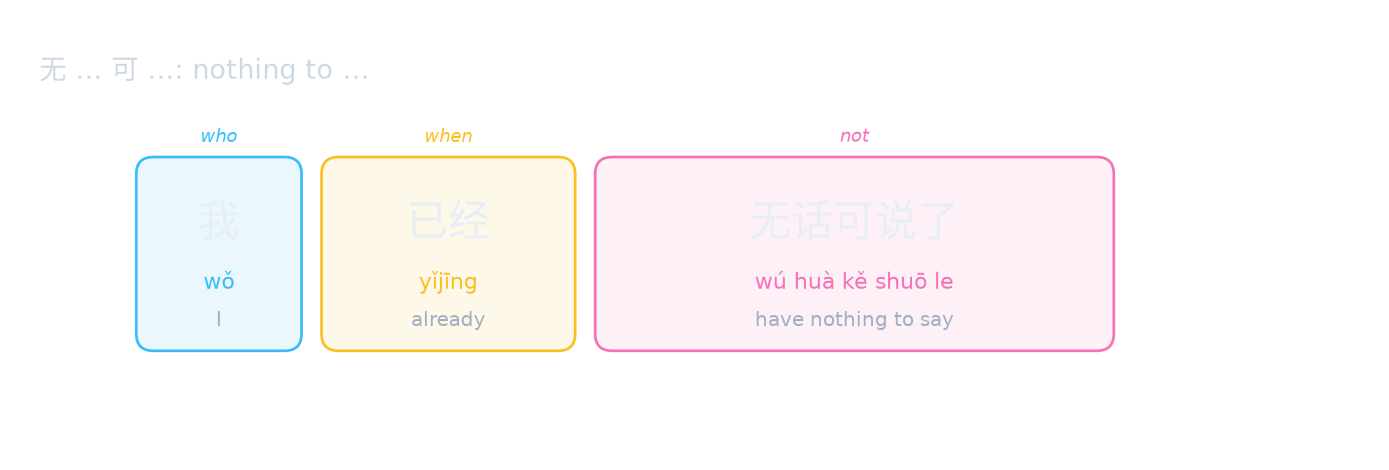
- Après un long débat, votre ami hausse les épaules et reste muet.
- I我already已经to have nothing to say…无话可说(completed / change)了。 — « Je n'ai plus rien à dire. »
without无 + nom + used in 可汗可 + verbe = ne pas avoir de … pour …
- without无 X used in 可汗可 V = il n'y a pas de X qui puisse être V-ed : to have nothing to say…无话可说 (rien à dire), have nowhere to go无处可去 (nulle part où aller), without无matter事used in 可汗可to do; to make做 (rien à faire).
- C'est concis et littéraire, souvent figé en expressions de quatre caractères.
at the weekend周末he他has nothing to do无事可做。
Complete: “I have nothing to say.” 我无话____说。
Difficulté 1/5 · 100 pièces + un petit bonus lors de la première réussite aujourd'hui
无 + noun + 可 + verb.
Formules fixes courantes
- have nowhere to go无处可去 = nulle part où aller : under; below; next (week)下(ongoing -ing)着heavy rain大雨,we / us我们have nowhere to go无处可去.
- homeless无家可归 = sans-abri (sans domicile où retourner) ; nowhere to go无路可走 = sans issue.
heavy rain大雨in中they他们have nowhere to go无处可去。
Match each phrase to its meaning.
Difficulté 2/5 · 140 pièces + un petit bonus lors de la première réussite aujourd'hui
无 X 可 V = no X to V.
Écrit et figé
- À l'oral, dites have no没有old variant of 话话say说 / not / haven't没area地方to go去 ; without无…used in 可汗可… est plus formel.
- Conservez l'ordre : without无 + nom + used in 可汗可 + verbe ; n'ajoutez pas (modifier / structural particle)的 ou (completed / change)了 à l'intérieur : to have nothing to say…无话可说, et non without无old variant of 话话(modifier / structural particle)的used in 可汗可say说.
无话可说 is more formal than 没话说.
Difficulté 1/5 · 100 pièces + un petit bonus lors de la première réussite aujourd'hui
True. 无…可… comes from literary Chinese (无话可说, 无家可归), so it is more formal than everyday 没话说.
without无…used in 可汗可… versus have no没有…can可以…
- to have nothing to say…无话可说 = have no没有anything什么old variant of 话话can可以say说.
- La forme without无…used in 可汗可… est plus courte et plus forte, typique de l'écriture et du discours formel.
I我have no没有anything什么can可以say说的。
Which is the spoken equivalent of 无话可说?
Difficulté 1/5 · 100 pièces + un petit bonus lors de la première réussite aujourd'hui
没有…可以… is the everyday form.
Résumé
- without无 + nom + used in 可汗可 + verbe = ne pas avoir de … pour … (to have nothing to say…无话可说, have nowhere to go无处可去, without无matter事used in 可汗可to do; to make做).
- Littéraire ; l'équivalent oral est have no没有…can可以….
Lisez la référence complète : HSK 5 grammaire — Structures de phrases.
After a long argument, your friend shrugs and goes quiet. Close the examples. Say a Mandarin response, then write it in Chinese. Explain briefly in English what the lesson’s pattern adds. Compare with the model, then change one detail and try again.
This is supported productive practice. Compare meaning and structure; your answer need not copy the model. A partner or teacher must hear the spoken response to comment on pronunciation.