Votre plan d'apprentissage · Continuer · Réviser →
Compléments de résultat 住 / 开 / 出来
IntroduitVotre position enregistrée reste dans ce navigateur. Reprendre ne termine pas la leçon ni ne répond à ses questions.
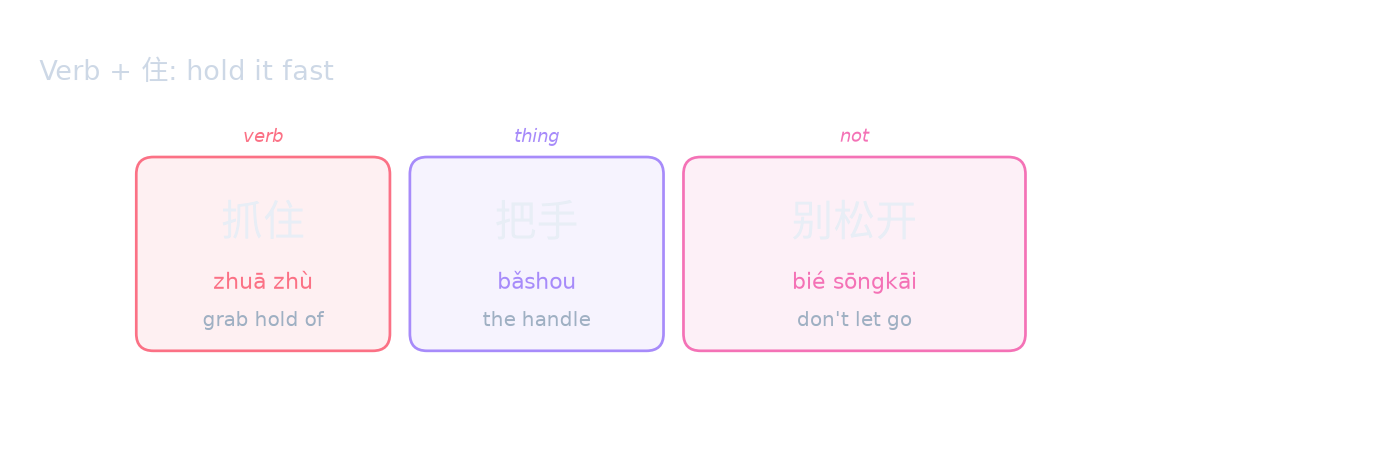
Serrer fort
- Vous aidez votre petite sœur à apprendre à faire du vélo.
- to grab hold of抓住handle把手,don't别to release松开! — « Accroche-toi aux poignées, ne lâche pas ! »
Verbe + to live (somewhere)住 = fixer, maintenir fermement
- to live (somewhere)住 rend le résultat stable : to grab hold of抓住 (saisir et maintenir), remember记住 (mémoriser), to stand站住 (s'arrêter), to stop拦住 (bloquer).
- remember记住my我(modifier / structural particle)的phone电话number号码。 — « Mémorise mon numéro de téléphone. »
please请remember记住my我的phone电话number号码。
Complete: “Remember: the meeting is at nine.” 记____:会议九点开始。
Difficulté 1/5 · 100 pièces + un petit bonus lors de la première réussite aujourd'hui
记住 = remember (fix in memory).
Verbe + to open; to drive开 / (make out)出来
- to open; to drive开 = ouvrir ou séparer : to open打开 (ouvrir), to pull open拉开 (tirer pour ouvrir), to leave走开 (s'éloigner), to depart离开 (partir).
- (make out)出来 = sortir, émerger ou être reconnu : want / think / miss想(make out)出来 (trouver une idée), see看(make out)出来 (reconnaître, deviner), to write写(make out)出来 (écrire).
I我see看(make out)出来he他not不happy高兴。
Match each verb to its meaning.
Difficulté 2/5 · 140 pièces + un petit bonus lors de la première réussite aujourd'hui
住 fixes, 开 separates, 出来 brings out.
Formes potentielles
- can't remember记不住 = ne pas pouvoir se souvenir ; to beat打not不to open; to drive开 = ne pas pouvoir ouvrir ; want / think / miss想not不(make out)出来 = ne pas pouvoir trouver.
- (make out)出来 peut s'entourer d'un objet : want / think / miss想to go out; to come out出一个means办法to come来 / want / think / miss想(make out)出来一个means办法.
“I can't open this bottle.” Which is correct?
Difficulté 1/5 · 100 pièces + un petit bonus lors de la première réussite aujourd'hui
Potential complement: 打不开.
see看(make out)出来 versus saw看见
- saw看见 = voir (avec les yeux) : my我saw看见he他(completed / change)了.
- see看(make out)出来 = comprendre, remarquer à partir de indices : my我see看(make out)出来he他at / in在to lie说谎 — « J'ai pu voir qu'il mentait. »
I我saw看见him他了。
看出来 and 看见 mean the same.
Difficulté 1/5 · 100 pièces + un petit bonus lors de la première réussite aujourd'hui
看见 = see; 看出来 = work out from clues.
Résumé
- to live (somewhere)住 = fixer fermement (remember记住, to grab hold of抓住) ; to open; to drive开 = ouvrir / séparer / s'éloigner (to open打开, to depart离开) ; (make out)出来 = sortir / être reconnu (want / think / miss想(make out)出来, see看(make out)出来).
- Potentiel : can't remember记不住, to beat打not不to open; to drive开, want / think / miss想not不(make out)出来.
Lire la référence complète : Grammaire HSK 5 — Compléments.
You are helping your little sister learn to ride a bike. Close the examples. Say a Mandarin response, then write it in Chinese. Explain briefly in English what the lesson’s pattern adds. Compare with the model, then change one detail and try again.
This is supported productive practice. Compare meaning and structure; your answer need not copy the model. A partner or teacher must hear the spoken response to comment on pronunciation.