Votre plan d'apprentissage · Continuer · Réviser →
差点没 : les quasi-accidents et le contexte
IntroduitVotre position enregistrée reste dans ce navigateur. Reprendre ne termine pas la leçon ni ne répond à ses questions.
The bus doors close just after you board
- You jump onto the bus, out of breath: I我nearly差点not / haven't没catch赶上the bus车,fortunately幸好driver司机to wait; and so on等(completed / change)了I我。 — "I almost missed the bus; luckily the driver waited for me."
- You caught the bus, but the sentence has not / haven't没 in it. This lesson shows why.
- Goal: read nearly差点 and nearly差点not / haven't没 correctly: did the thing happen or not?
1 · Something bad: nearly差点 = nearly差点not / haven't没
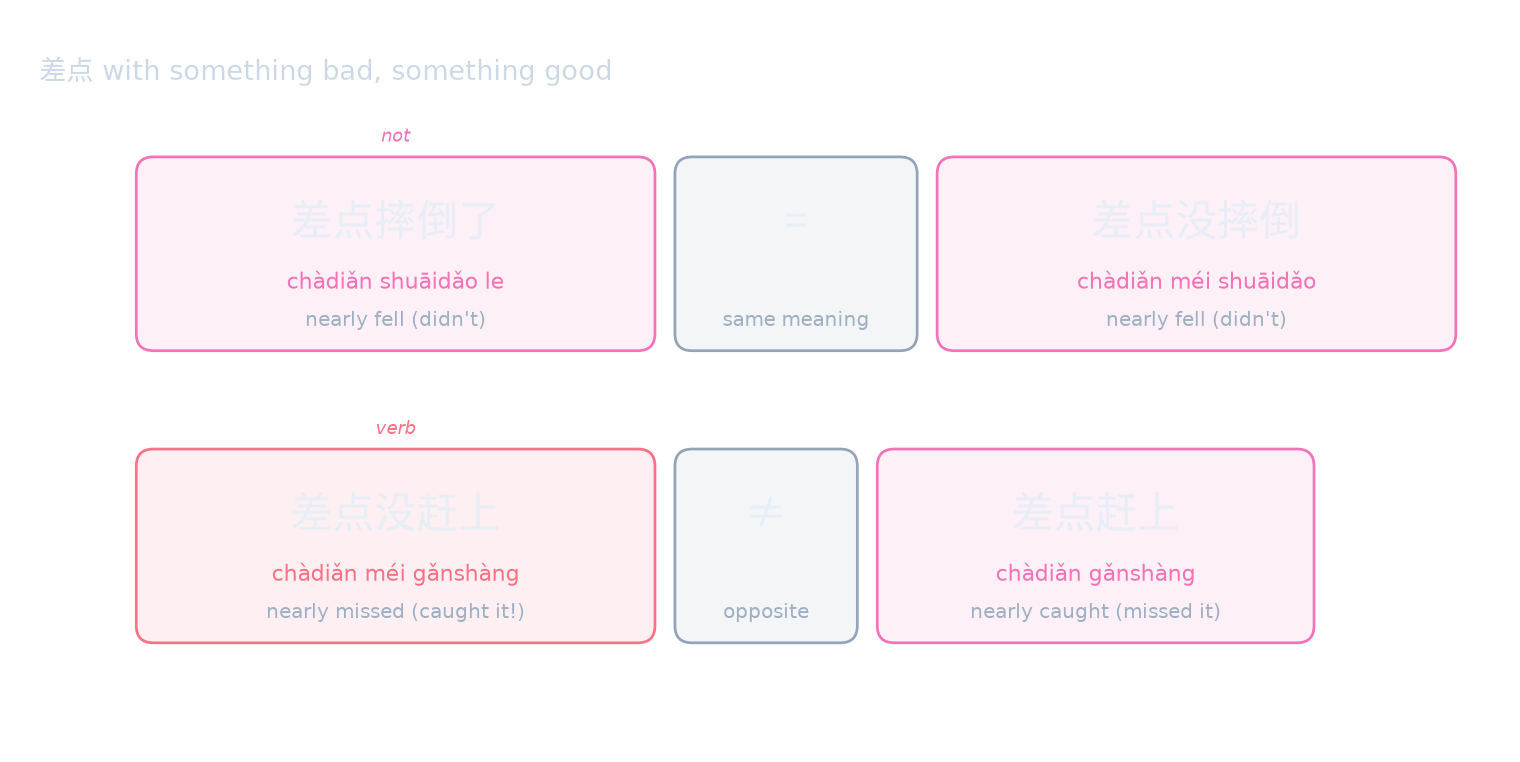
- With something you don't want (fall, be late, forget), both forms mean "nearly happened, but it didn't". Lucky!
- I我nearly差点fall over摔倒(completed / change)了 = I我nearly差点not / haven't没fall over摔倒。 Both: "I nearly fell (but I didn't)." I我nearly差点to forget忘(completed / change)了。 — "I almost forgot (but I remembered)."
I我nearly差点fall over摔倒了。
我差点没摔倒 means the speaker fell over.
Difficulté 1/5 · 100 pièces + un petit bonus lors de la première réussite aujourd'hui
Falling is bad, so 差点 and 差点没 both mean "nearly fell, but didn't".
2 · Something good: nearly差点 ≠ nearly差点not / haven't没
- With something you want (catch the bus, pass, buy a ticket), the two forms are opposites.
- nearly差点not / haven't没 + good thing = nearly failed, but succeeded (lucky): I我nearly差点not / haven't没catch赶上the bus车. nearly差点 + good thing = nearly succeeded, but failed (a pity): I我nearly差点catch赶上the bus车,but可是the bus车to go (of car, train etc)开走(completed / change)了。 — "I almost caught the bus, but it drove off."
I我nearly failed to差点没catch赶上the bus车。
我差点没考上大学. Did the speaker get into university?
Difficulté 1/5 · 100 pièces + un petit bonus lors de la première réussite aujourd'hui
Getting into university is good. 差点没 + good thing = nearly failed, but succeeded.
我差点买到票了,可是最后一张被别人买走了. Did the speaker get a ticket?
Difficulté 1/5 · 100 pièces + un petit bonus lors de la première réussite aujourd'hui
差点 + good thing = nearly succeeded, but failed. The second clause confirms it.
Ask one question first
- Before you read the result, ask: is this thing good or bad for the speaker? Then use the rule above.
- Don't count the not / haven't没 as a simple "not". If the result matters, say it clearly: I我nearly差点not / haven't没catch赶上,fortunately幸好in the end最后catch赶上(completed / change)了。 — "I nearly missed it, but luckily I caught it in the end."
Quel résultat est stated ?
Distinguer les sens dans des exemples contextuels complets, pas mécaniquement corrects ou rejeter les phrases isolées.
Match each sentence to what actually happened.
Difficulté 2/5 · 140 pièces + un petit bonus lors de la première réussite aujourd'hui
Being late is bad; catching the plane is good.
You nearly missed the train but made it. Complete: 我____赶上火车,幸好最后赶上了。
Difficulté 1/5 · 100 pièces + un petit bonus lors de la première réussite aujourd'hui
差点没 + good thing = nearly failed, but succeeded.
Recap
- Bad thing: nearly差点 X = nearly差点not / haven't没 X = nearly X, but it didn't happen.
- Good thing: nearly差点not / haven't没 X = nearly failed, but did X (lucky); nearly差点 X = nearly did X, but failed (a pity).
Read the full reference: HSK 5 grammar — Adverbs.
This morning you woke up late, ran, and caught the school bus at the last second. On the bus you nearly fell. Tell a friend both things in Chinese.
Your answer need not copy the model. A partner or teacher must hear the spoken response to comment on pronunciation.