Votre plan d'apprentissage · Continuer · Réviser →
得 (děi) (devoir / être obligé)
IntroduitVotre position enregistrée reste dans ce navigateur. Reprendre ne termine pas la leçon ni ne répond à ses questions.
Je dois y aller
- Il est 9 heures du soir et vous avez encore un devoir à rendre demain matin.
- I我have to得to walk走(completed / change)了,today今天evening晚上have to得to write写to finish完paper论文。 — « Je dois y aller ; je dois terminer ma dissertation ce soir. »
have to得 (děi) + verbe = devoir, falloir
- have to得 lu děi avant un verbe = « devoir, falloir », courant à l'oral : I我have to得to walk走(completed / change)了, you你have to得earlier早点儿sleep睡.
- Cela exprime une nécessité ou une obligation.
you你have to得earlier早点儿sleep睡。
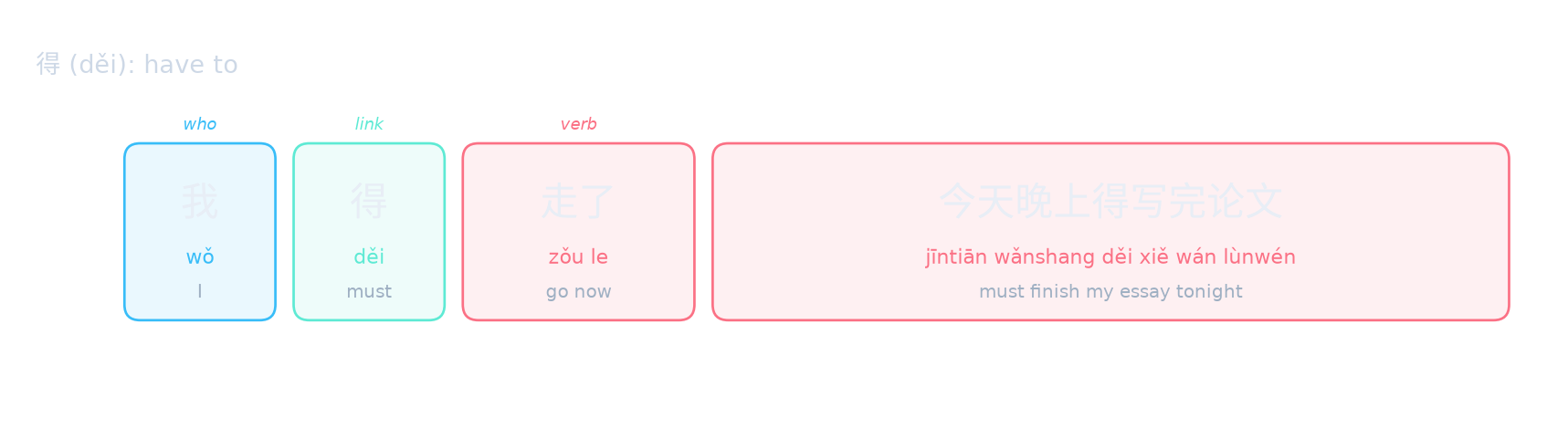
Complete (spoken): “I have to go now.” 我____走了。
Difficulté 1/5 · 100 pièces + un petit bonus lors de la première réussite aujourd'hui
得 (děi) + verb = must.
Nécessité parlée
- tomorrow明天there is有an exam考试,I我have to得revise复习。 — "Il y a un examen demain ; je dois réviser."
- 这件matter事have to得to ask问teacher老师。 — "Nous devrons demander à l'enseignant au sujet de cela."
tomorrow明天there is有an exam考试,I我have to得revise复习。
Build: “There's an exam tomorrow; I have to revise.”
Difficulté 3/5 · 200 pièces + un petit bonus lors de la première réussite aujourd'hui
Reason, then 得 + verb.
La négation est need not不用
- « Ne pas avoir besoin de » se traduit par need not不用, jamais par must not不得 : you你not不to be used for用来, et non you你must not不得to come来.
- Lisez děi uniquement avant un verbe signifiant « devoir » ; après un verbe (to run跑have to得fast; soon快), c'est la particule de.
Which says “You don't have to come”?
Difficulté 1/5 · 100 pièces + un petit bonus lors de la première réussite aujourd'hui
The negative of 得 (must) is 不用.
In 他跑得很快, 得 is read děi.
Difficulté 1/5 · 100 pièces + un petit bonus lors de la première réussite aujourd'hui
After a verb, 得 is the particle de.
have to得 versus must必须 et want / will / need要
- must必须 est plus fort et plus formel : you你must必须bring带ID身份证.
- want / will / need要 peut signifier « avoir besoin de / aller » : I我want / will / need要to go去bank银行. have to得 correspond au « devoir » familier.
you你must必须bring带ID身份证。
Résumé
- have to得 (děi) + Verbe = devoir, falloir (à l'oral).
- Négatif = need not不用 ; formel = must必须. Après un verbe, have to得 = de (complément).
Read the full reference: HSK 4 grammar — Auxiliary verbs.
It is 9 p.m. and you still have an essay due tomorrow morning. Close the examples. Say a Mandarin response, then write it in Chinese. Explain briefly in English what the lesson’s pattern adds. Compare with the model, then change one detail and try again.
This is supported productive practice. Compare meaning and structure; your answer need not copy the model. A partner or teacher must hear the spoken response to comment on pronunciation.