Votre plan d'apprentissage · Continuer · Réviser →
本来 (originellement / au début)
IntroduitVotre position enregistrée reste dans ce navigateur. Reprendre ne termine pas la leçon ni ne répond à ses questions.
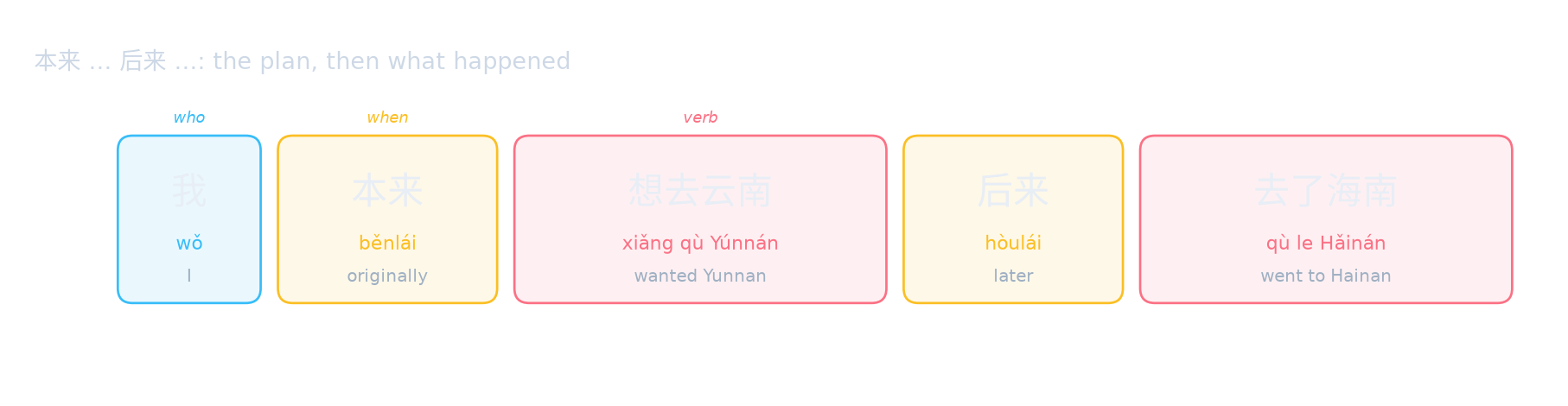
Changement de projet
- Vous deviez passer vos vacances au Yunnan, mais votre cousin vous a ensuite invité en Haïnan.
- I我originally本来want to想to go去Yunnan province in…云南,later后来to go去(completed / change)了Hainan Province, in the…海南。 — « Je voulais initialement aller au Yunnan, mais j'ai finalement été en Haïnan. »
originally本来 = initialement, au départ
- originally本来 décrit le projet ou la situation d'origine, généralement avant qu'un changement ne survienne.
- Il se place après le sujet (ou au début) : he他originally本来was是a doctor医生,later后来became当(completed / change)了a writer作家.
he他originally本来was是a doctor医生,later后来became当了a writer作家。
Complete: “I originally planned to leave on Monday.” 我____打算星期一走。
Difficulté 1/5 · 100 pièces + un petit bonus lors de la première réussite aujourd'hui
本来 = originally (before a change).
Plans qui ont changé
- I我originally本来unexpectedly不想come来,but可是friend朋友definitely一定want / will / need要I我come来。 — « Je ne voulais vraiment pas venir, mais mon ami a insisté. »
- originally本来 s'associe souvent avec later后来, but可是 ou but但是 pour marquer un changement.
I我originally本来not不want to想come来。
Build: “I didn't really want to come, but my friend insisted.”
Difficulté 3/5 · 200 pièces + un petit bonus lors de la première réussite aujourd'hui
本来 + original wish, 可是 + change.
La deuxième signification : bien sûr
- originally本来then / just就 = « devait être évident, naturellement » : student学生originally本来then / just就should应该to study; to learn学习 — « Les élèves sont, bien sûr, censés étudier. »
- Ce originally本来 n'indique pas de changement de plan ; il signifie que la chose était toujours vraie.
In 学生本来就应该学习, 本来就 means “of course, naturally”.
Difficulté 1/5 · 100 pièces + un petit bonus lors de la première réussite aujourd'hui
本来就 states something that was always true.
originally本来 versus so it turns out原来
- Les deux peuvent signifier « à l'origine » : originally本来 / so it turns out原来(modifier / structural particle)的plan计划.
- Seul so it turns out原来 annonce une découverte : so it turns out原来was是you你! — « Ah, c'est toi ! » originally本来 ne peut pas faire cela.
so it turns out原来it's是you你!
You open the door and find your old friend. Which fits? “____是你!”
Difficulté 1/5 · 100 pièces + un petit bonus lors de la première réussite aujourd'hui
A discovery takes 原来; 本来 cannot announce one.
Résumé
- originally本来 = à l'origine, avant un changement (souvent avec later后来 / but可是).
- originally本来then / just就 = naturellement, bien sûr. Seul so it turns out原来 peut signifier « c'est donc ça ».
Read the full reference: HSK 4 grammar — Adverbs.
You were going to spend the holiday in Yunnan, but then your cousin invited you to Hainan. Close the examples. Say a Mandarin response, then write it in Chinese. Explain briefly in English what the lesson’s pattern adds. Compare with the model, then change one detail and try again.
This is supported productive practice. Compare meaning and structure; your answer need not copy the model. A partner or teacher must hear the spoken response to comment on pronunciation.