Votre plan d'apprentissage · Continuer · Réviser →
Adjectif + 地 + Verbe (en formant un adverbe)
IntroduitVotre position enregistrée reste dans ce navigateur. Reprendre ne termine pas la leçon ni ne répond à ses questions.
How did they do it?
- Your grandmother crosses the busy road carefully; your little brother does his homework seriously for once.
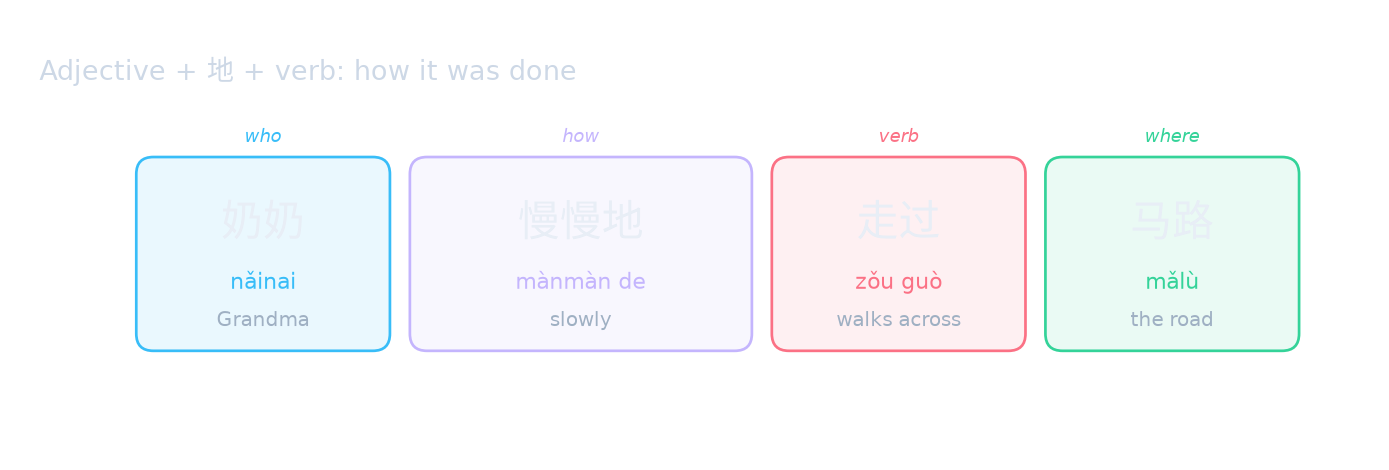
- grandma奶奶slowly慢慢(adverb -ly)地to walk past走过street马路。 Nǎinai mànmàn de zǒu guò mǎlù. — "Grandma slowly walks across the road." (adverb -ly)地 turns a description into how the action is done.
- Goal: say how someone does something with adjective + (adverb -ly)地 + verb, and build the description correctly for one-syllable words.
Adjective + (adverb -ly)地 + Verb
- Subject + Adjective + (adverb -ly)地 + Verb: the description comes before the verb and (adverb -ly)地 (de) links them.
- Two-syllable adjectives are the most common: seriously认真(adverb -ly)地study学习, happy; glad高兴地说, quiet安静(adverb -ly)地to read看书.
he他seriously认真地study学习。
Fill in the particle: 她安静____看书。
Difficulté 1/5 · 100 pièces + un petit bonus lors de la première réussite aujourd'hui
Adjective + 地 + Verb. 安静地看书 = “read quietly”.
Doubled and phrase descriptions
- Doubled adjectives often take (adverb -ly)地: child孩子(plural)们happily高高兴兴(adverb -ly)地go home回家(completed / change)了。 — "The children went home happily."
- A short phrase works too: very很fast; soon快(adverb -ly)地to eat吃to finish完(completed / change)了cooked rice饭, very非常to be careful小心(adverb -ly)地to open打开box盒子.
the children孩子们happily高高兴兴地go home回家了。
Build: “Grandma walks slowly across the road.”
Difficulté 3/5 · 200 pièces + un petit bonus lors de la première réussite aujourd'hui
Subject + Adjective + 地 + Verb + Object.
One-syllable adjectives need help
- A single-syllable adjective does not usually take (adverb -ly)地 on its own. Double it, or add very很:
- ✗ he他fast; soon快(adverb -ly)地to run跑(completed / change)了。 ✓ he他very很fast; soon快(adverb -ly)地to run跑(completed / change)了。 / ✓ he他快快(adverb -ly)地to run跑(completed / change)了。 — "He ran off quickly."
- ✗ she / her她慢地to speak说。 ✓ she / her她slowly慢慢地说。 Tā mànmàn de shuō. — "She speaks slowly."
- Two-syllable adjectives are fine alone: seriously认真(adverb -ly)地, happy; glad高兴(adverb -ly)地, quiet安静(adverb -ly)地.
“He opened the door quietly.” Which is correct?
Difficulté 1/5 · 100 pièces + un petit bonus lors de la première réussite aujourd'hui
A one-syllable adjective is doubled before 地: 轻轻地.
Keep the order and the character straight
- (adverb -ly)地 comes before the verb: seriously认真(adverb -ly)地study学习. After the verb you need (degree marker)得: he他学得very很seriously认真.
- Write (adverb -ly)地, not (modifier / structural particle)的, between the description and the verb; both are read de.
他学习认真地。 is a correct way to say “He studies seriously.”
Difficulté 1/5 · 100 pièces + un petit bonus lors de la première réussite aujourd'hui
地 + description must come before the verb (他认真地学习), or use 得 after it (他学得很认真).
(adverb -ly)地 before the verb, (degree marker)得 after it
- he他seriously认真(adverb -ly)地writes写school assignment作业 tells how he does it: carefully, while doing it.
- he他writes写(degree marker)得very很seriously认真 comments on the result or manner after the fact: "He writes very carefully."
he他writes写得very很carefully认真。
Choose the particle for both blanks: 他高兴__说: “我考得__很好!”
Difficulté 1/5 · 100 pièces + un petit bonus lors de la première réussite aujourd'hui
高兴地说 (地 before the verb) and 考得很好 (得 after the verb).
Recap
- Adjective + (adverb -ly)地 + Verb = do something in that way: slowly慢慢(adverb -ly)地to walk / to leave走, seriously认真(adverb -ly)地study学习.
- (adverb -ly)地 sits before the verb; (degree marker)得 follows the verb. Keep (modifier / structural particle)的 for nouns.
Read the full reference: HSK 3 grammar — Adjectives into adverbs.
Your grandmother crosses the busy road carefully; your little brother does his homework seriously for once. Close the examples. Say a Mandarin response, then write it in Chinese. Explain briefly in English what the lesson’s pattern adds. Compare with the model, then change one detail and try again.
This is supported productive practice. Compare meaning and structure; your answer need not copy the model. A partner or teacher must hear the spoken response to comment on pronunciation.