Votre plan d'apprentissage · Continuer · Réviser →
Dire son nom et demander celui des autres
IntroduitVotre position enregistrée reste dans ce navigateur. Reprendre ne termine pas la leçon ni ne répond à ses questions.
 4:32
HSK 1 · Présentations, identité et échanges courtois
Votre première conversation en chinois. Dites qui vous êtes, demandez qui est quelqu'un, et apprenez les quatre mots polits qui ouvrent chaque échange. Et rencontrez un petit mot, 吗…
Explications en anglais + exemples en mandarin · les sous-titres suivent le texte parlé
Dans cette leçon
Meet Lin An
-
Lin An introduces herself: I / me我to call / be called / (animals) cry, bark叫林安。 Wǒ jiào Lín Ān. — My name is Lin An.
-
I / me我 wǒ means I; to call / be called / (animals) cry, bark叫 jiào introduces the name here. Use your own name after I / me我to call / be called / (animals) cry, bark叫, including a non-Chinese name.
-
Before you start: Recall a greeting from the first meeting lesson. This lesson adds a name question; a name is different from an identity such as student.
Someone asks for your name. Which information would answer that request?
Difficulté 1/5 · 100 pièces + un petit bonus lors de la première réussite aujourd'hui
A name request needs a name. Your role and departure time answer different questions. The next steps teach the Mandarin frame.
Ask the other person’s name
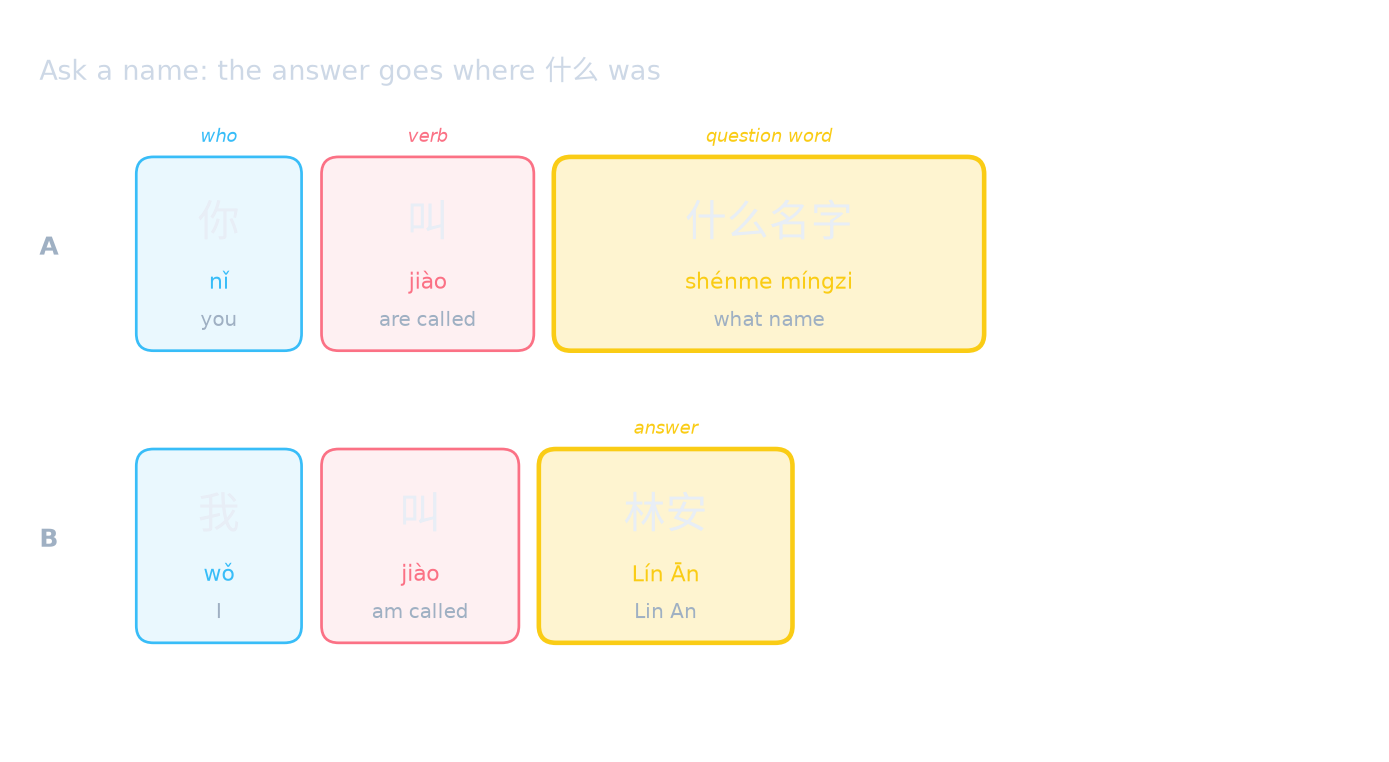
- you你to call / be called / (animals) cry, bark叫what什么name名字? Nǐ jiào shénme míngzi? — What is your name?
- you你 nǐ means you; what什么 shénme means what; name名字 míngzi means name. Learn what什么name名字 together: “what name”.
Complete the full name question: 你叫什么____?
Difficulté 1/5 · 100 pièces + un petit bonus lors de la première réussite aujourd'hui
什么名字 means what name.
Compare question and answer
- Question: you你to call / be called / (animals) cry, bark叫what什么name名字? Answer: I / me我to call / be called / (animals) cry, bark叫林安。 Change you你 to I / me我 because the person answering speaks about themself.
- Keep this simple naming pattern: I / me我to call / be called / (animals) cry, bark叫…… . Do not add to be / is是 to the pattern we are practising.
A: hello你好!you你to call / be called / (animals) cry, bark叫what什么name名字? B: I / me我to call / be called / (animals) cry, bark叫林安。you你(and …? / softener)呢? — Hello! What is your name? My name is Lin An. And you? you你(and …? / softener)呢 nǐ ne is an optional follow-up phrase.
Work through a decision: In you你to call / be called / (animals) cry, bark叫what什么name名字?, you你 addresses the listener. When that listener answers, they become the speaker and use I / me我:I / me我to call / be called / (animals) cry, bark叫林安。Keep the real person fixed while changing the pronoun for the new turn.
Compare a near miss: you你to call / be called / (animals) cry, bark叫林安 means the person addressed is called Lin An. It does not introduce your own name. I / me我to be / is是student学生 may be true, but it gives an identity rather than the name requested.
Someone asks 你叫什么名字? Which answer gives your name?
Difficulté 1/5 · 100 pièces + un petit bonus lors de la première réussite aujourd'hui
我叫林安 introduces the speaker’s name; 我是学生 gives an identity.
Match these words.
Difficulté 2/5 · 140 pièces + un petit bonus lors de la première réussite aujourd'hui
我 is the speaker and 你 is the person addressed.
You are playing Lin An. A partner asks 你叫什么名字? Choose your own introduction.
Difficulté 1/5 · 100 pièces + un petit bonus lors de la première réussite aujourd'hui
The answerer refers to themself with 我, and the given role is 林安. 你叫林安 describes the listener; 我叫王力 changes the name on the role card.
Hear a different name
- Play and find the name after to call / be called / (animals) cry, bark叫.
- Wang Li (a name)王力 is Wáng Lì. In these Chinese names, the surname is first: to rule王 / power力 and (bound form) woods林 / (bound form) calm安. You do not have to invent a Chinese name to study Chinese.
Learn the full polite question first. You may also hear the shorter you你to call / be called / (animals) cry, bark叫what什么? in conversation; it is not automatically an incomplete sentence.
Which name did you hear?
Difficulté 1/5 · 100 pièces + un petit bonus lors de la première réussite aujourd'hui
The name after 叫 is 王力, Wáng Lì.
In 林安, 林 is the surname.
Difficulté 1/5 · 100 pièces + un petit bonus lors de la première réussite aujourd'hui
These Chinese names put the family name before the given name.
A:我叫李明。你叫什么名字? B:我叫王力。In this fresh exchange, whose name is 王力?
Difficulté 1/5 · 100 pièces + un petit bonus lors de la première réussite aujourd'hui
B says 我叫王力, so 王力 is B’s name. The 我 in A’s earlier turn refers to A, not to the same speaker throughout the dialogue. Track each turn before assigning a name.
Introduce yourself
- Say I / me我to call / be called / (animals) cry, bark叫 followed by your own name. Ask someone else’s name, or answer the recorded question without reading.
- Write or type your name sentence. An IME lets you enter pinyin and choose characters; see the typing guide.
I / me我to call / be called / (animals) cry, bark叫…… gives your name. you你to call / be called / (animals) cry, bark叫what什么name名字? asks for another person’s name.
Later recall: Tomorrow, ask and answer the name question without the model, using a different fictional name. Switch speakers and track I / me我 again. A few days later, explain why an identity alone does not answer the question; revisit “Compare question and answer” after a pronoun mix-up.
Next: say who someone is.
Greet, ask a name, then receive the answer.
Difficulté 3/5 · 200 pièces + un petit bonus lors de la première réussite aujourd'hui
The order follows the situation given.
Write a new Mandarin greeting, name question and answer using a fictional name different from the lesson’s model. Say both roles aloud. Then switch roles and write the new answerer’s own name sentence; keep 我 tied to the current speaker.
Compare and revise your own wording. Written self-review does not assess pronunciation or conversation quality.