psychologie du développement
Introduit| English | Sens |
|---|---|
| cohort/ˈkəʊhɔːt/ | cohortes |
| conservation/ˌkɒnsəˈveɪʃn/ | Conservation |
| scaffolding/ˈskæfəʊldɪŋ/ | Échafaudage |
Is the difference age, experience or era?
- Imagine a fictional survey in which younger and older adults differ on a new technology task. The groups also grew up in different periods and may have different opportunities to practise. A one-time group difference does not reveal how either group changed with age.
- Developmental psychology asks about change in cognition, relationships and reasoning across life. Keep a theory's proposed pattern separate from the observations and research design used to test it.
Compare age groups or follow people
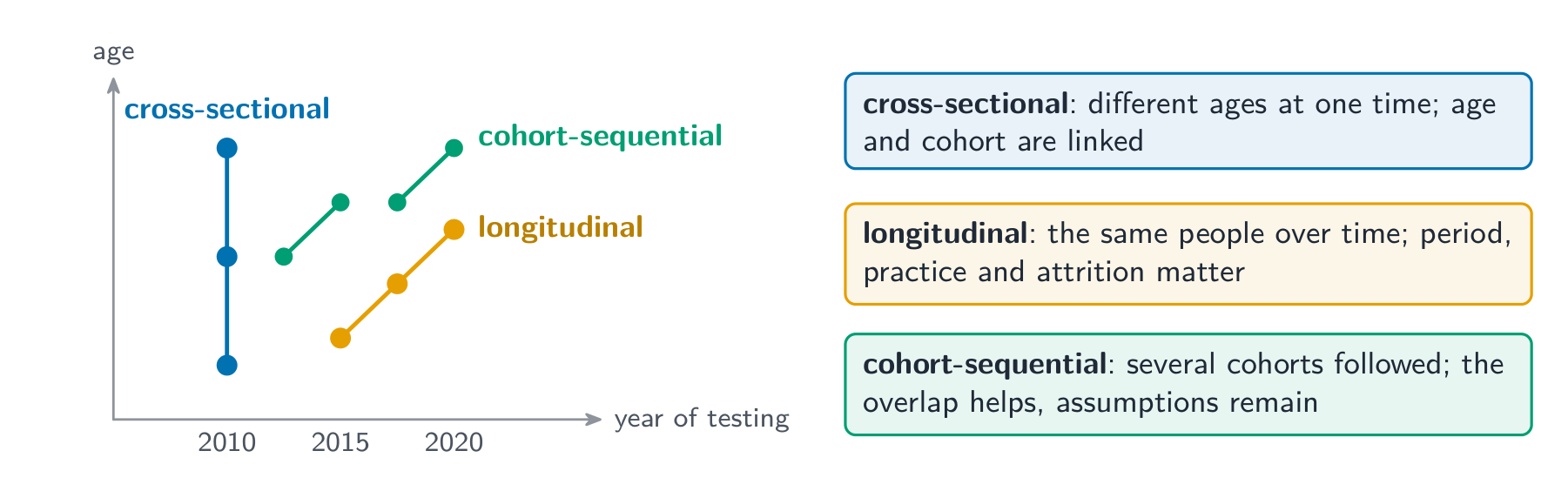
- A cross-sectional study compares different ages at one measurement period. Age and birth cohort 同龄群体 are linked: older participants were born earlier. Group differences can reflect age-related processes, cohort experiences or other differences; they do not directly measure individual change.
- A longitudinal study repeatedly measures the same people. It can describe within-person change, but ageing occurs alongside calendar time. Practice, period events and selective attrition can affect the results. People who remain may differ from those who leave.
Which design compares different ages at one period, leaving age linked with birth cohort?
Difficulté 1/5 · 100 pièces + un petit bonus lors de la première réussite aujourd'hui
A cross-sectional age comparison also compares birth cohorts. It does not directly measure how the same people changed over time; longitudinal and sequential designs have their own limits.
Follow several cohorts with overlap
- A cohort-sequential design follows several starting-age groups over time. Overlapping ages permit useful comparisons across cohorts and periods. This can test whether a pattern repeats; it does not automatically identify pure age, period and cohort effects without assumptions.
- In the fictional example below, people born in 1990 are age 30 in 2020 and 40 in 2030; people born in 2000 are age 20 and then 30. Assume measurements on birthdays. The two age-30 observations come from different cohorts and periods.

The lines show age arithmetic, not measured ability or causal effects. Age equals measurement year minus birth year under the stated birthday assumption.
Worked design check. Comparing the two groups in 2020 changes age and cohort together. Following the 1990 group to 2030 changes age and period together. Comparing both age-30 observations holds age fixed but changes cohort and period. Each contrast is useful; none alone separates all three.
Quel design est décrit ?
Identifier la structure réelle d'échantillonnage et de suivi, sans supposer une séparation causale.
In the fictional birthday-measurement example, people born in 2000 are measured in 2030. What is their age in years?
Difficulté 2/5 · 140 pièces + un petit bonus lors de la première réussite aujourd'hui
2030 − 2000 = 30 years on the stated birthday. A matching age in another cohort can occur in a different period.
Following the same people over time automatically separates pure age effects from period events, practice and selective attrition.
Difficulté 1/5 · 100 pièces + un petit bonus lors de la première réussite aujourd'hui
Age and calendar time change together. Following people measures within-person change but does not by itself identify its cause.
Piaget's stages describe proposed reasoning patterns
- Sensorimotor development, approximately birth to age 2, concerns learning through action and perception, including developing object permanence. The preoperational period, roughly 2–7, includes symbolic representation; classic tasks often show centration or difficulty with conservation 守恒.
- Concrete operational reasoning, roughly 7–11, includes reversible operations on concrete relations. Formal operational reasoning, proposed from adolescence, includes systematic hypothetical reasoning. These are approximate theory-linked guides, not deadlines or a guarantee that one response reveals a child's whole level.
Worked interpretation. A child says a taller glass has more liquid after watching a transfer with no addition or loss. That response fits difficulty conserving quantity in this task. It does not prove that all of the child's reasoning is preoperational; language, task demands and repeated evidence matter.
Quelle description piagétienne correspond ?
Reliez le comportement aux stades de Piaget.
In a classic conservation task, no liquid is added or lost. A child says the taller, thinner glass has more after a transfer. Which interpretation most directly fits that response?
Difficulté 1/5 · 100 pièces + un petit bonus lors de la première réussite aujourd'hui
The response gives height too much weight relative to conserved quantity. It is evidence about that task response, not proof of the child’s entire stage or capacity.
Put the stages in Piaget’s proposed sequence.
Difficulté 3/5 · 200 pièces + un petit bonus lors de la première réussite aujourd'hui
Sensorimotor, preoperational, concrete operational, formal operational. Approximate age guides do not guarantee uniform performance across tasks.
A child’s age alone proves formal operational reasoning in every task.
Difficulté 1/5 · 100 pièces + un petit bonus lors de la première réussite aujourd'hui
Approximate stage ages are theory-linked guides; actual reasoning and task context need evidence.
Vygotsky: support can reveal emerging competence
- The zone of proximal development distinguishes what a learner can do independently from what they can do with suitable guidance or a more capable partner. Social interaction and language can support learning; a helped answer is not identical to independent mastery.
- Scaffolding 支架 is a related instructional idea: temporary, responsive support that is reduced as competence develops. The helper might model a step, give a cue or ask a focused question. Giving every answer without checking later independent performance does not demonstrate learning.
Worked teaching choice. A learner cannot plan a sequence alone but succeeds when a partner asks, “What comes first?” Reduce the cue and try a new problem. Success without the cue gives stronger evidence of independent performance than merely repeating the helped answer.
Vygotsky's zone of proximal ____ is the gap between what a child can do alone and with help.
Difficulté 1/5 · 100 pièces + un petit bonus lors de la première réussite aujourd'hui
The zone of proximal development concerns the difference between independent performance and what suitable support makes possible. A helped response is not yet independent mastery.
Which follow-up best checks whether guided success has become independent performance?
Difficulté 1/5 · 100 pièces + un petit bonus lors de la première réussite aujourd'hui
Reducing responsive support and checking transfer can distinguish assisted success from independent competence.
Attachment findings need their study context
- In Harlow's rhesus-monkey surrogate studies, milk came from the cloth surrogate for some infants and from the wire surrogate for others. Infants spent much more contact time with the cloth surrogate in both conditions. This challenged a feeding-only account in that setting; it does not establish every cause of human attachment or make food unimportant.
- Ainsworth's Strange Situation examines patterns of exploration, separation and reunion with a particular caregiver. Secure, avoidant and resistant patterns were later supplemented by a disorganised classification. One cry or one reunion action cannot classify the whole pattern; these are not fixed personality types or, by themselves, diagnoses.
One infant crying during one separation is enough to identify a fixed attachment personality type.
Difficulté 1/5 · 100 pièces + un petit bonus lors de la première réussite aujourd'hui
The Strange Situation considers the broader pattern, including reunion and caregiver context. A single action does not establish a fixed type or diagnosis.
Erikson's eight psychosocial challenges
- Erikson proposed trust versus mistrust in infancy; autonomy versus shame and doubt in toddlerhood; initiative versus guilt in the preschool period; and industry versus inferiority in the school years. The labels concern psychosocial themes, not Piaget's reasoning operations.
- The later themes are identity versus role confusion in adolescence; intimacy versus isolation in young adulthood; generativity versus stagnation in middle adulthood; and integrity versus despair in later life. These proposed associations are not rigid deadlines, and a challenge can remain relevant beyond its usual period.
Worked distinction. A case about contributing to the next generation fits Erikson's generativity theme. A case about reversing a concrete transformation concerns Piagetian operations. Match the kind of question before choosing a stage label.
Within Erikson’s framework, concern about contributing to the next generation most directly fits
Difficulté 1/5 · 100 pièces + un petit bonus lors de la première réussite aujourd'hui
Generativity concerns contributing beyond oneself, often associated with middle adulthood. The theme is not an exclusive age deadline.
Moral reasoning is about the justification
- Kohlberg's preconventional level emphasises punishment, reward and personal exchange; the conventional level emphasises approval, rules and maintaining social order; the postconventional level considers rights, social contracts or general ethical principles. The reason given matters, not merely the action chosen.
- Gilligan challenged the limited attention to care and relationships in dominant accounts of moral development. Care and justice can both be relevant; this is not a rule assigning one style to every woman or man. A moral-reasoning score also does not guarantee moral behaviour.
Worked comparison. “I should help because I will get a reward” and “I should help because I promised and others rely on me” can support the same action with different reasons. Identify the justification; do not classify the action alone.
A person says a rule should be followed because maintaining an orderly society is important. Which Kohlberg level best fits this stated reason?
Difficulté 1/5 · 100 pièces + un petit bonus lors de la première réussite aujourd'hui
Maintaining social order is a conventional justification. Classify the stated reasoning rather than the action alone.
Lifespan cognition has several trajectories
- Fluid abilities concern solving unfamiliar problems; crystallised abilities concern accumulated knowledge. Many speeded or novel-processing measures peak earlier than knowledge measures, but abilities differ in their timing. There is no single age at which all cognition begins the same decline.
- Knowledge can remain stable or grow across much of adulthood, while some other abilities show earlier average declines. This is not a prediction for every individual or an assurance of lifelong improvement. Health, education, task demands, cohort and practice effects can influence observed patterns.
Knowledge-based abilities can remain stable or increase through much of adulthood, though patterns vary by ability, person and study.
Difficulté 1/5 · 100 pièces + un petit bonus lors de la première réussite aujourd'hui
This qualified pattern does not imply that all abilities share one peak, that every person improves, or that knowledge never declines.
Evaluate the strongest justified conclusion
- First identify the comparison: different people now, the same people later, or overlapping cohorts. Then ask what the task measures and who is missing. A stage label or an age difference is a description to investigate, not a demonstrated cause.
- Look for convergence across tasks, samples and designs. Preserve uncertainty when patterns differ: a vocabulary result, a speeded-task result and a social-reasoning result need not have identical developmental curves.
Worked critique. A study retests volunteers after ten years and reports stable scores among those who returned. Stability among returners is informative, but it does not prove no age-related change in the full starting group. Examine who returned, comparable measurement, practice effects and events during the interval.
A study measures the same volunteers at ages 30 and 40. Only half return, and their mean score is unchanged. State what is supported and explain two reasons this does not establish an absence of age-related change for the full starting group.
Les participants de retour ont des scores moyens observés inchangés sur cette mesure. L'attrition sélective pourrait les distinguer de ceux qui n'ont pas retourné. La pratique, la comparabilité des mesures et les événements durant l'intervalle peuvent affecter les changements observés. Une moyenne stable peut également masquer des changements individuels. Examinez les données manquantes, les différences à la ligne de base, la mesure et les preuves de comparaison appropriées avant de généraliser au groupe initial complet.
Recap
- Separate age, cohort and period; each design offers useful comparisons and limits.
- Interpret task responses before inferring a broad developmental stage.
- Distinguish supported performance from later independent competence.
- Read attachment, psychosocial and moral-reasoning concepts in their own frameworks.
- Compare cognitive abilities and individuals without assuming one universal lifespan curve.
- cohort: A group sharing a birth period or another defining starting experience.
- conservation: Recognition that a relevant quantity stays the same through a transformation that does not add or remove it.
- scaffolding: Temporary, responsive support reduced as a learner becomes more capable.
A one-time study finds older adults lower on a speeded task but higher on vocabulary. A report claims all intelligence declines uniformly because of ageing. Explain three problems with that conclusion.
Les deux tâches montrent déjà des modèles différents, donc elles ne soutiennent pas une courbe uniforme pour toute la cognition. Une comparaison transversale par âge compare également des cohortes et ne mesure pas le changement individuel. Les exigences des tâches, l'échantillonnage, l'éducation, la santé et d'autres facteurs peuvent contribuer ; les résultats de groupe ne déterminent pas la trajectoire de chaque personne ni n'établissent le vieillissement comme cause unique.