Spectres thermiques et mise à l'échelle à un électron
Introduit| English | Sens |
|---|---|
| blackbody/ˈblækbɒdi/ | corps noir |
| emissivity/ɪmɪˈsɪvɪti/ | émissivité |
| series limit/ˈsɪəriːz ˈlɪmɪt/ | limite de série |
Peak, flux, line
- A 3000 K filament's spectrum peaks near 966 nm; its total output scales as $T^4$; a helium ion emits a sharp line at 164 nm. Three different observables, three different formulas.
- GRE questions test Planck's law, Wien and Stefan–Boltzmann (including stars), grey-body radiation and Bohr-model scaling with $Z$.
Blackbody 黑体 radiation
- Planck: $B_\lambda = \dfrac{2hc^2}{\lambda^5}\dfrac{1}{e^{hc/\lambda k_BT} - 1}$, per wavelength per solid angle. A hotter body is brighter at every wavelength, and its peak moves to shorter wavelength.
- Wien: $\lambda_{\max}T \approx 2.898\times10^{-3}$ m·K. Total surface flux $\sigma T^4$, so a star of radius $R$ has luminosity $L = 4\pi R^2\sigma T^4$. The peak of $B_\nu$ is not at $c/\lambda_{\max}$.
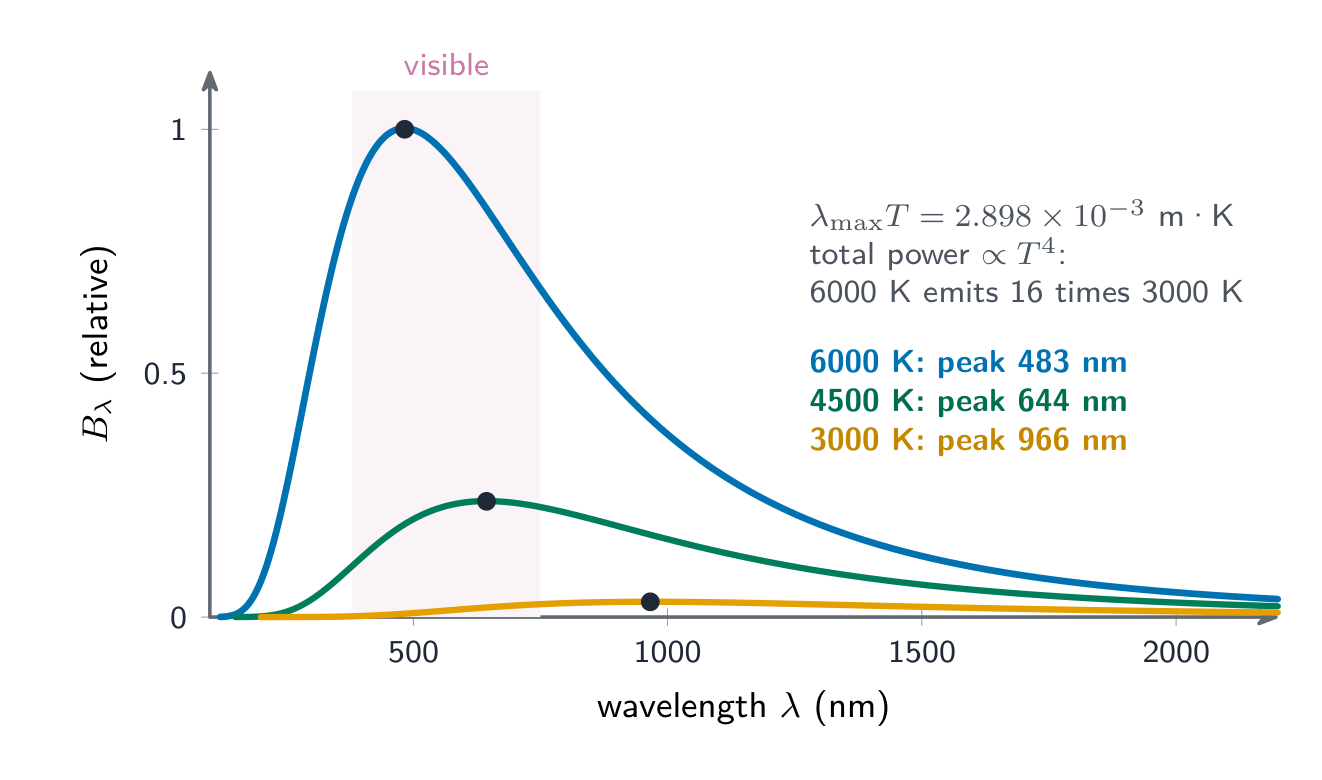
Peak wavelength of a 6000 K blackbody in nm (nearest whole)?
Difficulté 2/5 · 140 pièces + un petit bonus lors de la première réussite aujourd'hui
Wien's law: $\lambda_{max} = 2.898\times10^{-3}/6000 = 4.83\times10^{-7}$ m, which is 483 nm.
A blackbody's absolute temperature doubles. By what factor does its total emitted power grow?
Difficulté 2/5 · 140 pièces + un petit bonus lors de la première réussite aujourd'hui
The Stefan–Boltzmann law gives $P \propto T^4$, so doubling $T$ multiplies the power by 16.
The spectrum per unit frequency peaks at $c/\lambda_{\max}$.
Difficulté 1/5 · 100 pièces + un petit bonus lors de la première réussite aujourd'hui
The Jacobian moves the peak.
A star has the same surface temperature as the Sun but 10 times its radius. Its luminosity, in solar units?
Difficulté 2/5 · 140 pièces + un petit bonus lors de la première réussite aujourd'hui
$L \propto R^2T^4$: $10^2 = 100$.
Grey bodies
- A grey surface with emissivity 发射率 $\varepsilon$ radiates net power $\varepsilon\sigma A(T^4 - T_{\text{env}}^4)$, kelvin only. A good absorber is an equally good emitter: the same $\varepsilon$ for both.
3000 K, $\varepsilon = 0.5$, $A = 2\times10^{-4}$ m², cold surroundings: $0.5 \times 5.67\times10^{-8} \times 2\times10^{-4} \times 3000^4 \approx 459$ W. A photon at the 966 nm peak carries $1240/966 \approx 1.28$ eV.
Use kelvin inside every $T^4$; a Celsius value makes the radiated power wrong by orders of magnitude.
A blackbody at 400 K radiates net power $P$ into surroundings at 0 K. Moved into surroundings at 200 K, its net power is $kP$. Find $k$ (three decimal places).
Difficulté 2/5 · 140 pièces + un petit bonus lors de la première réussite aujourd'hui
$(400^4 - 200^4)/400^4 = 1 - 1/16 = 0.9375$: the surroundings return only a sixteenth.
Bohr scaling
- One electron around charge $Ze$: $r_n = a_0n^2/Z$, $v_n = Z\alpha c/n$, $E_n = -13.6Z^2/n^2$ eV. Radius and energy carry different powers of $Z$: He⁺ is half the size of hydrogen and bound four times as strongly.
- The model is historical: the real 1s state has $l = 0$, not angular momentum $\hbar$, but its energies are right.
Comment cela évolue-t-il ?
Appliquez la loi d'échelle du modèle de Bohr avec Z et n.
Bohr radius of the $n = 2$ orbit of Li²⁺ ($Z = 3$), in units of $a_0$ (three decimal places)?
Difficulté 2/5 · 140 pièces + un petit bonus lors de la première réussite aujourd'hui
Bohr radii scale as $n^2/Z$: $4/3 = 1.333\,a_0$.
Ionisation energy of ground-state Li²⁺ ($Z = 3$), in eV (one decimal place)?
Difficulté 2/5 · 140 pièces + un petit bonus lors de la première réussite aujourd'hui
$13.6 \times 3^2 = 122.4$ eV.
Lines, limits, ionisation
- Emission: $E_\gamma = 13.6Z^2\left(\dfrac1{n_f^2} - \dfrac1{n_i^2}\right)$, $\lambda = 1240/E_\gamma$ nm. So every line of a $Z$ ion is $Z^2$ times shorter in wavelength than the matching hydrogen line. Series limit 谱线系限: $n_i \to \infty$.
- He⁺ $3 \to 2$: $7.56$ eV, 164 nm. Ionising from $n = 3$ needs only $54.4/9 = 6.04$ eV.
The Balmer series limit ($n_f = 2$) of hydrogen is at about
Difficulté 1/5 · 100 pièces + un petit bonus lors de la première réussite aujourd'hui
The Balmer limit is the ionisation energy from $n = 2$, 3.4 eV, so $\lambda = 1240/3.4 \approx 365$ nm.
Worked GRE question: a hotter, smaller star
Star X has twice the surface temperature and half the radius of star Y. The ratio of their luminosities, $L_X/L_Y$, is
- (A) 1
- (B) 2
- (C) 4
- (D) 8
- (E) 16
Fast route. $L \propto R^2T^4 = \left(\tfrac12\right)^2 \times 2^4 = \tfrac14 \times 16 = 4$. Answer (C).
Traps. (E) ignores the radius. (A) treats the two changes as cancelling. Check each power: area $R^2$, flux $T^4$.
Worked GRE question: the helium ion's first line
Hydrogen's Lyman-α line ($n = 2 \to 1$) is at 121.6 nm. The same transition in singly ionised helium, He⁺, is at about
- (A) 486 nm
- (B) 243 nm
- (C) 121.6 nm
- (D) 60.8 nm
- (E) 30.4 nm
Fast route. Energies scale as $Z^2 = 4$, so wavelengths divide by 4: $121.6/4 = 30.4$ nm. Answer (E).
Traps. (D) scales by $Z$ instead of $Z^2$. (A) multiplies instead of divides: a more tightly bound electron emits shorter wavelengths.
Common errors
- Celsius in $T^4$ or in Wien's law. Use kelvin.
- Forgetting the radius in a star's luminosity. $L = 4\pi R^2\sigma T^4$.
- Scaling hydrogen-like energies by $Z$. Energies go as $Z^2$; radii as $1/Z$.
- Peak frequency $= c/\lambda_{\max}$. The two peaks are different points of the spectrum.
Recap
- $\lambda_{\max} \propto 1/T$; flux $\propto T^4$; star $L = 4\pi R^2\sigma T^4$.
- Grey body: $\varepsilon\sigma A(T^4 - T_{\text{env}}^4)$; good absorbers are good emitters.
- $r \propto n^2/Z$, $E \propto Z^2/n^2$, wavelengths $\propto 1/Z^2$; transitions differ from ionisation.
- emissivity: The ratio of a surface’s thermal radiation to that of a blackbody.
- blackbody: An ideal body that absorbs all radiation and emits the Planck spectrum for its temperature.
- series limit: The shortest-wavelength line of a series, from an electron arriving from very far away.