Faibles perturbations et sous-espaces dégénérés
Introduit| English | Sens |
|---|---|
| perturbation/pətəˈbeɪʃn/ | perturbation |
| expectation value/ekspɪkˈteɪʃn ˈvæljuː/ | valeur moyenne |
| degenerate/dɪˈdʒenəreɪt/ | dégeneré |
Zero shift, changed state
- A weak tilt $\gamma(x - L/2)$ across a symmetric well gives every state a zero first-order energy shift, yet the wavefunctions do change, and second-order shifts appear.
- GRE perturbation 微扰 theory tests first-order shifts as expectation values 期望值, symmetry arguments, second order and degenerate 简并的 levels.
First order
- $H = H_0 + \lambda W$: $E_n^{(1)} = \lambda\langle n|W|n\rangle = \lambda\int|\psi_n|^2W\,dx$ — a weighted average over the whole state.
- Infinite well $0 < x < L$: $\langle x\rangle = L/2$, so $W = \gamma x$ shifts every level by $\gamma L/2$. 2 nm well, $\gamma = 0.05$ eV/nm: 0.05 eV.
A 3 nm infinite well gets $W = \gamma x$ with $\gamma = 0.1$ eV/nm. First-order shift in eV?
Difficulté 2/5 · 140 pièces + un petit bonus lors de la première réussite aujourd'hui
The first-order shift is $\langle\gamma x\rangle = \gamma L/2 = 0.1 \times 3/2 = 0.15$ eV, since the probability is symmetric about the centre.
Symmetry
- $|\psi_n|^2$ is symmetric about $L/2$, so odd perturbations like $\gamma(x - L/2)$ give zero first-order shift.
- $\eta(x - L/2)^2$ gives $\eta L^2\left[\tfrac1{12} - \tfrac{1}{2\pi^2n^2}\right] > 0$, depending on $n$.
Nul au premier ordre ?
Utiliser la symétrie de la densité du puits infini pour prédire les décalages au premier ordre.
For an infinite-well state, $W = \gamma(x - L/2)^3$ gives a first-order shift of
Difficulté 1/5 · 100 pièces + un petit bonus lors de la première réussite aujourd'hui
$|\psi|^2$ is symmetric about $L/2$ while $(x - L/2)^3$ is odd about it, so the expectation value is zero.
Infinite well $0 < x < L$ with a perturbation $V_0 = 0.2$ eV in the right half only. First-order shift of the $n = 3$ level, in eV?
Difficulté 2/5 · 140 pièces + un petit bonus lors de la première réussite aujourd'hui
Chaque $|\psi_n|^2$ is symmetric about $L/2$, so half the probability lies in the step: $0.2 \times \tfrac12 = 0.1$ eV.
Second order
- $E_n^{(2)} = \sum_{m \ne n}\dfrac{|\lambda W_{mn}|^2}{E_n^0 - E_m^0}$: always $\le 0$ for the ground state.
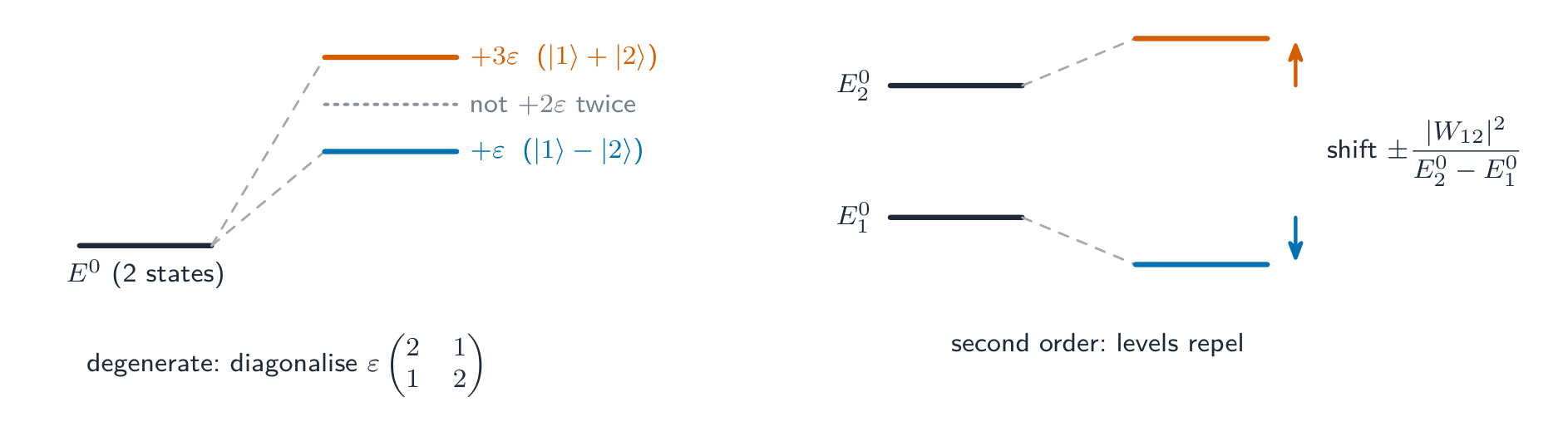
- Coupled levels repel: the lower one moves down and the upper one up, by $|W_{12}|^2/\Delta E$. Valid when couplings are small compared with level gaps; near-degeneracy breaks it.
- Exact check: an oscillator with $W = \lambda x$ is just shifted, $\tfrac12m\omega^2x^2 + \lambda x$ has its minimum lowered by $\lambda^2/2m\omega^2$. First order gives 0 ($\langle x\rangle = 0$); second order gives exactly $-\lambda^2/2m\omega^2$.
The second-order shift of a nondegenerate ground state is
Difficulté 1/5 · 100 pièces + un petit bonus lors de la première réussite aujourd'hui
Every denominator is negative.
Two levels 1.0 eV apart are coupled by $|W_{12}| = 0.1$ eV. Second-order downward shift of the lower level, in eV?
Difficulté 2/5 · 140 pièces + un petit bonus lors de la première réussite aujourd'hui
$|W_{12}|^2/\Delta E = 0.01/1.0 = 0.01$ eV; the upper level rises by the same amount.
An oscillator with $m\omega^2 = 2$ eV/nm² gets $W = \lambda x$, $\lambda = 0.4$ eV/nm. Ground-state energy change in eV (with sign)?
Difficulté 2/5 · 140 pièces + un petit bonus lors de la première réussite aujourd'hui
$-\lambda^2/2m\omega^2 = -0.16/4 = -0.04$ eV, exact.
Degenerate levels
- Write $W$ as a matrix in the degenerate subspace and diagonalise: eigenvalues are the first-order shifts.
$\varepsilon\begin{pmatrix} 2&1\\1&2 \end{pmatrix}$: shifts $3\varepsilon$ (symmetric combination) and $\varepsilon$ (antisymmetric). Reading the diagonal would wrongly give $2\varepsilon$ twice. A multiple of $I$ never splits a degeneracy.
- Hydrogen examples: the Stark effect (electric field) splits $n = 2$ at first order only because $2s$ and $2p$ are degenerate; the ground state shifts only at second order.
Choose the states that diagonalise $W$ in the degenerate block first; then ordinary first-order theory applies to each.
A degenerate pair has perturbation matrix $\varepsilon\begin{pmatrix} 1&2\\2&1 \end{pmatrix}$ with $\varepsilon = 0.002$ eV. Splitting in eV?
Difficulté 2/5 · 140 pièces + un petit bonus lors de la première réussite aujourd'hui
The matrix has eigenvalues $3\varepsilon$ et $-\varepsilon$, so the splitting is $4\varepsilon = 0.008$ eV.
A perturbation equal to a constant times the identity shifts a degenerate level without splitting it.
Difficulté 1/5 · 100 pièces + un petit bonus lors de la première réussite aujourd'hui
True. Every state in the level gets the same shift, so the degeneracy remains.
Worked GRE question: a step in the well
A particle in an infinite well $0 < x < L$ is perturbed by a potential $V_0$ in the left half ($0 < x < L/2$) and zero in the right half. To first order, the energy of the $n$th level changes by
- (A) 0
- (B) $V_0/4$
- (C) $V_0/2$
- (D) $V_0$
- (E) an amount that depends on $n$
Fast route. $E^{(1)} = V_0 \times P(\text{left half})$, and every $|\psi_n|^2$ is symmetric about $L/2$, so $P = \tfrac12$. Answer (C).
Traps. (E): the probability in each half is exactly $\tfrac12$ for every $n$. (D) forgets the particle spends only half its time in the step.
Worked GRE question: an oscillator in a field
A charged harmonic oscillator (mass $m$, frequency $\omega$) in its ground state feels a weak extra potential $\lambda x$. The leading change in its ground-state energy is
- (A) 0
- (B) $+\dfrac{\lambda^2}{2m\omega^2}$
- (C) $-\dfrac{\lambda^2}{2m\omega^2}$
- (D) $\lambda\sqrt{\hbar/2m\omega}$
- (E) $-\dfrac{\lambda^2}{m\omega^2}$
Fast route. First order vanishes ($\langle x\rangle = 0$). Completing the square shifts the parabola's minimum down by $\lambda^2/2m\omega^2$, and second order gives exactly that. Answer (C).
Traps. (A) stops at first order. (B) has the wrong sign: a ground state's second-order shift is never positive.
Common errors
- Reading only the diagonal in a degenerate level. Diagonalise the block.
- Zero first-order shift means no effect. Second order and the wavefunctions still change.
- A positive second-order ground-state shift. It is $\le 0$.
- Using perturbation theory across a tiny gap. It breaks down when the coupling is comparable to the gap.
Recap
- $E^{(1)} = \langle W\rangle$ in the unperturbed state.
- Odd perturbation, symmetric density: zero at first order.
- Ground-state $E^{(2)} \le 0$; degenerate levels: diagonalise the block.
- perturbation: A small extra term added to a solvable Hamiltonian.
- expectation value: The average result of measuring an observable over many identical preparations.
- degenerate: Sharing the same energy with another independent state.