Transitoires RC et RL, impédance et résonance
Introduit| English | Sens |
|---|---|
| transient/ˈtrænsɪənt/ | transitoire |
| resonance/ˈrezənəns/ | résonance |
| reactance/rɪˈæktəns/ | réactance |
| quality factor | quality factor |
What cannot jump
- Flip a switch: a capacitor's voltage and an inductor's current cannot change instantly. Long afterwards, the capacitor blocks DC and the inductor passes it freely.
- GRE circuit questions test RC and RL transients 暂态, impedance, phase and resonance 共振.
RC transients
- $R\dfrac{dq}{dt} + \dfrac qC = V_s$, $\tau = RC$. Charging from zero: $V_C = V_s(1 - e^{-t/\tau})$, $I = \dfrac{V_s}{R}e^{-t/\tau}$. After one $\tau$ the capacitor is 63% charged; after $5\tau$, 99%.
- Discharging: $V_C = V_0e^{-t/\tau}$. Half-life $\tau\ln 2 \approx 0.69\tau$.
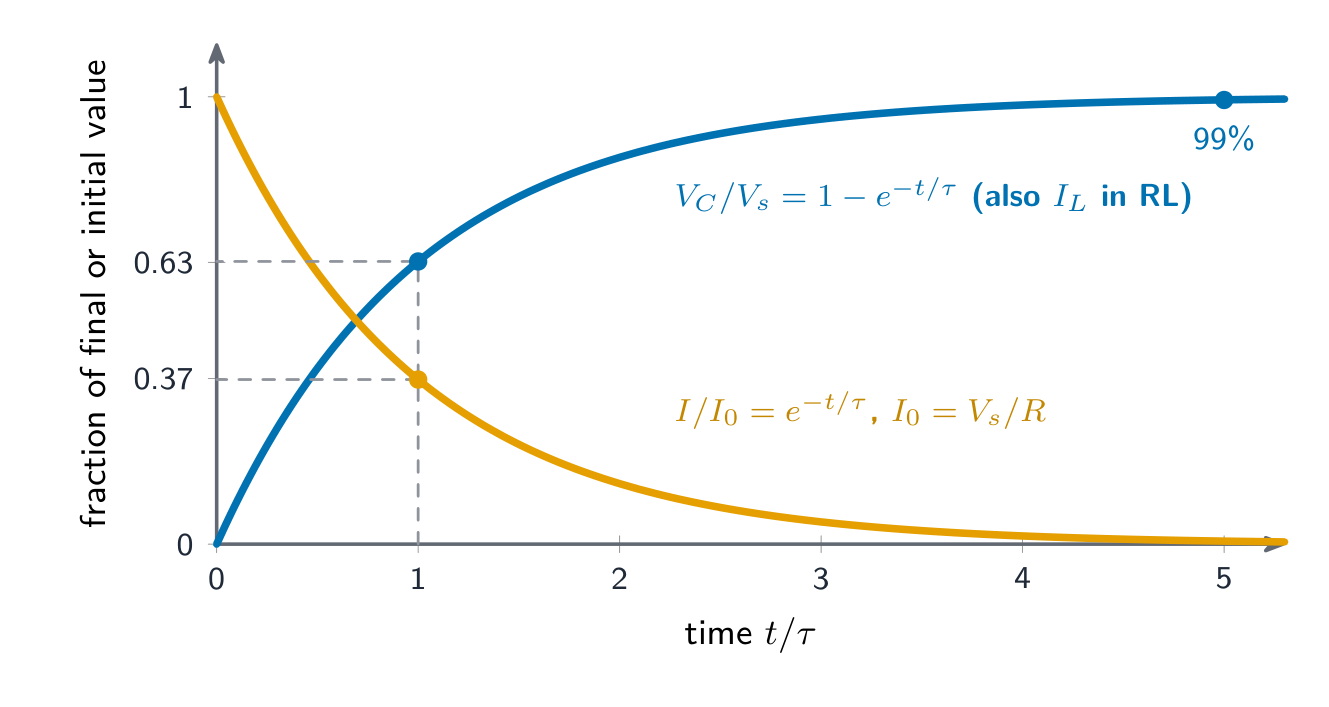
$R = 2000$ Ω, $C = 1$ mF, $V_s = 12$ V: $\tau = 2$ s. At $t = \tau$: $V_C = 12(1 - e^{-1}) = 7.59$ V and $I = 6\text{ mA} \times e^{-1} = 2.21$ mA.
$R = 3$ kΩ, $C = 2$ mF. Time constant in s?
Difficulté 2/5 · 140 pièces + un petit bonus lors de la première réussite aujourd'hui
$\tau = RC = 3000 \times 0.002 = 6$ s.
A capacitor discharges through a resistor with $\tau = 10$ ms. Time for its voltage to halve, in ms (one decimal place)?
Difficulté 2/5 · 140 pièces + un petit bonus lors de la première réussite aujourd'hui
$t = \tau\ln 2 = 10 \times 0.693 = 6.9$ ms.
RL transients
- $L\dfrac{dI}{dt} + RI = V_s$, $\tau = L/R$. $I = \dfrac{V_s}{R}(1 - e^{-t/\tau})$ from zero. $L = 0.4$ H, $R = 2$ Ω: $\tau = 0.2$ s.
- Two snapshots solve most switch questions. Just after switching: an uncharged capacitor acts as a wire, an inductor carrying no current acts as a break. Long after: capacitor = open circuit, inductor = wire.
- Stored energies $\tfrac12CV^2$, $\tfrac12LI^2$ end as heat in $R$. Charging a capacitor from a battery always wastes half the battery's work $QV$ in the resistor, whatever $R$ is.
Fil ou interruption ?
Utilisez la continuité de V_C et I_L lors du commutateur et en régime permanent.
$L = 0.5$ H, $R = 5$ Ω. Time constant in s?
Difficulté 2/5 · 140 pièces + un petit bonus lors de la première réussite aujourd'hui
$\tau = L/R = 0.5/5 = 0.1$ s.
Long after a DC source is switched on, an ideal capacitor in series behaves like
Difficulté 1/5 · 100 pièces + un petit bonus lors de la première réussite aujourd'hui
Once the capacitor is fully charged, no steady current flows through it, so it acts as an open circuit.
The time constant of an RL circuit is $L/R$.
Difficulté 1/5 · 100 pièces + un petit bonus lors de la première réussite aujourd'hui
True. $L/R$ has units of henries per ohm, which is seconds; the current reaches about 63% of its final value after one $L/R$.
A 2 μF capacitor is charged from a 50 V battery through a resistor. Heat produced in the resistor, in mJ?
Difficulté 2/5 · 140 pièces + un petit bonus lors de la première réussite aujourd'hui
Heat $= \tfrac12CV^2 = \tfrac12 \times 2\times10^{-6} \times 2500 = 2.5$ mJ, equal to the stored energy.
Impedance and phase
- $Z_R = R$, $Z_L = i\omega L$, $Z_C = \dfrac{1}{i\omega C}$. Series: $Z = R + i(\omega L - \tfrac{1}{\omega C})$, $|I| = |V|/|Z|$.
- The reactance 电抗 is $X = \omega L - \tfrac{1}{\omega C}$, and $\tan\varphi = X/R$: current lags when $X > 0$ (inductive), leads when $X < 0$. Never add $R$, $\omega L$ and $1/\omega C$ as plain numbers.
Resonance
- $\omega_0 = 1/\sqrt{LC}$ makes $X = 0$: current is largest and in phase. $R = 10$ Ω, $L = 0.1$ H, $C = 1$ mF, $V_{\text{rms}} = 20$ V: $\omega_0 = 100$ rad/s, $I_{\text{rms}} = 2$ A, $P = 40$ W.
- The free (damped) oscillation frequency $\sqrt{1/LC - (R/2L)^2}$ is a different quantity. The quality factor 品质因数 $Q = \omega_0L/R$ measures sharpness: the resonance width is about $\omega_0/Q$. Here $Q = 100 \times 0.1/10 = 1$, a broad peak.
$L = 0.2$ H, $C = 50$ μF. Resonant angular frequency in rad/s (nearest whole)?
Difficulté 2/5 · 140 pièces + un petit bonus lors de la première réussite aujourd'hui
$\omega_0 = 1/\sqrt{LC} = 1/\sqrt{0.2 \times 50\times10^{-6}} = 1/\sqrt{10^{-5}} = 316$ rad/s.
Series RLC with $L = 0.5$ H, $C = 2$ μF, $R = 50$ Ω. Quality factor $Q = \omega_0L/R$?
Difficulté 2/5 · 140 pièces + un petit bonus lors de la première réussite aujourd'hui
$\omega_0 = 1/\sqrt{10^{-6}} = 1000$ rad/s; $Q = 1000 \times 0.5/50 = 10$.
Worked GRE question: the moment the switch closes
A 12 V battery is connected through a switch to a 3 Ω resistor in series with a parallel pair: a 6 Ω resistor and an ideal inductor. Immediately after the switch closes, the current from the battery is
- (A) 0
- (B) 1.33 A
- (C) 2 A
- (D) 4 A
- (E) 6 A
Fast route. The inductor's current starts at zero, so it acts as a break: the current goes through $3 + 6 = 9$ Ω, $12/9 = 1.33$ A. Answer (B). Long after, the inductor shorts the 6 Ω resistor: $12/3 = 4$ A.
Traps. (D) is the long-time answer. (A) treats the inductor as blocking the whole circuit.
Worked GRE question: where the energy goes
A 10 μF capacitor, initially uncharged, is charged to 100 V through a resistor from a 100 V battery. The total energy dissipated in the resistor is
- (A) 0.025 J
- (B) 0.05 J
- (C) 0.1 J
- (D) 0.5 J
- (E) It depends on the resistance.
Fast route. The battery does work $QV = CV^2 = 0.1$ J; the capacitor stores $\tfrac12CV^2 = 0.05$ J; the rest, 0.05 J, is heat. Answer (B).
Traps. (E): a smaller $R$ gives a larger current for a shorter time, and the heat is the same. (C) is the battery's total work.
Common errors
- Letting $V_C$ or $I_L$ jump. They are continuous at a switch.
- Swapping the snapshots. Just after: capacitor = wire, inductor = break; long after: the reverse.
- $\tau = RL$ or $R/L$. It is $L/R$ (and $RC$ for a capacitor).
- Adding $R$ and reactances as plain numbers. $|Z| = \sqrt{R^2 + X^2}$.
Recap
- $\tau_{RC} = RC$, $\tau_{RL} = L/R$; $V_C$ and $I_L$ are continuous; 63% after one $\tau$.
- Snapshots: just after and long after a switch; charging wastes half the battery's work.
- $Z = R + i(\omega L - 1/\omega C)$; phase from $X/R$.
- Driven resonance at $1/\sqrt{LC}$; only $R$ dissipates.
- transient: The decaying part of a circuit’s response after a change.
- resonance: The frequency at which a driven circuit's reactances cancel and the current is largest.
- reactance: The imaginary part of impedance, from inductors and capacitors.