Référentiels accélérés et tournants
Introduit| English | Sens |
|---|---|
| apparent force/əˈpærənt fɔːs/ | force apparente |
| Coriolis/ˌkɒrɪˈəʊliz/ | Coriolis |
| centrifugal/ˌsentrɪˈfjuːɡl/ | centrifuge |
Standing still still takes a force
- A person standing on a turning carousel has no acceleration relative to it, yet the floor must push them inward. In the carousel's frame, an outward apparent force 惯性力 balances that push.
- GRE mechanics tests accelerating frames, the Coriolis 科里奥利, centrifugal 离心的 and Euler terms, and their directions.
Translating frames
- $m\mathbf a' = \mathbf F_{\text{real}} - m\mathbf A$: in a frame accelerating at $\mathbf A$, every body feels an extra $-m\mathbf A$, like extra gravity. Elevator accelerating up at $a$: $N = m(g + a)$; in free fall, $N = 0$ (weightlessness).
- 10 kg passenger, $a = 2$ m/s², $g = 10$: $N = 120$ N, the same physics as the ground-frame $N - mg = ma$. In a car braking at $A$, a hanging lamp swings forward and settles at $\tan\theta = A/g$ from the vertical.
50 kg person in an elevator accelerating downward at 3 m/s² ($g = 10$). Normal force in N?
Difficulté 2/5 · 140 pièces + un petit bonus lors de la première réussite aujourd'hui
Accelerating downward reduces the normal force: $N = m(g - a) = 50 \times 7 = 350$ N.
A car accelerates at 10 m/s² ($g = 10$). Angle of a hanging lamp from the vertical, in degrees?
Difficulté 2/5 · 140 pièces + un petit bonus lors de la première réussite aujourd'hui
$\tan\theta = A/g = 1$, so 45°, hanging toward the back.
Rotating frames
- $m\mathbf a' = \mathbf F - 2m\boldsymbol\Omega \times \mathbf v' - m\boldsymbol\Omega \times (\boldsymbol\Omega \times \mathbf r) - m\dot{\boldsymbol\Omega} \times \mathbf r$.
- Coriolis (needs relative velocity $\mathbf v'$, size $2m\Omega v'_\perp$), centrifugal (outward from the axis, $m\Omega^2r$), Euler (only if $\Omega$ changes).
- On a platform turning anticlockwise seen from above, Coriolis pushes a moving body to the right of its motion. The Northern Hemisphere is the same: winds and long-range shells drift right; the Southern Hemisphere, left.
Quelles forces apparentes agissent ?
Déterminer quels termes du repère en rotation sont non nuls.
0.5 kg at 2 m from the axis, $\Omega = 3$ rad/s. Centrifugal magnitude in N?
Difficulté 2/5 · 140 pièces + un petit bonus lors de la première réussite aujourd'hui
The centrifugal force is $m\Omega^2 r = 0.5 \times 9 \times 2 = 9$ N.
1 kg, $\Omega = 0.5$ rad/s, relative speed 4 m/s perpendicular to $\Omega$. Coriolis magnitude in N?
Difficulté 2/5 · 140 pièces + un petit bonus lors de la première réussite aujourd'hui
The Coriolis force is $2m\Omega v = 2 \times 1 \times 0.5 \times 4 = 4$ N when $v$ is perpendicular to $\Omega$.
In the Southern Hemisphere, a long-range shell fired north drifts
Difficulté 1/5 · 100 pièces + un petit bonus lors de la première réussite aujourd'hui
Seen from above the south pole, Earth turns clockwise, so Coriolis deflects moving bodies to the left: for a northward shell that is west.
Getting directions right
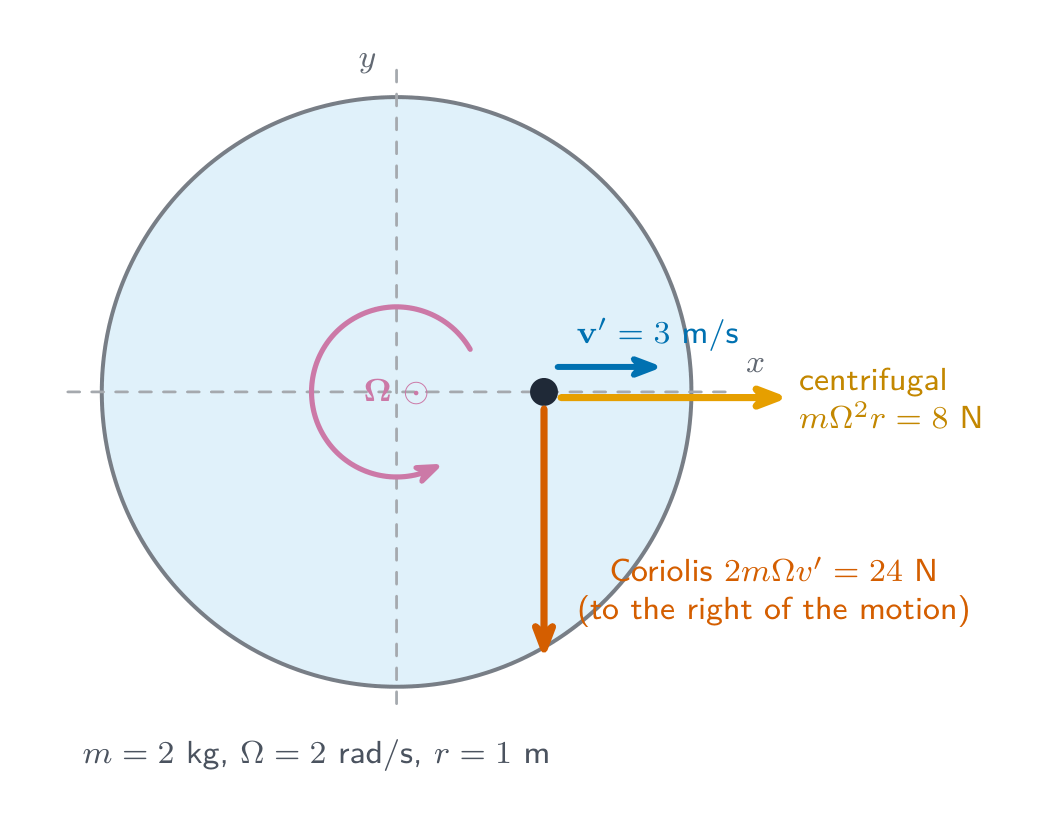
- $\boldsymbol\Omega$ along $+z$ (anticlockwise from above), particle on $+x$ moving outward along $+x$: centrifugal $+x$; $\boldsymbol\Omega \times \mathbf v' = +y$, so Coriolis points $-y$.
$m = 2$ kg, $\Omega = 2$ rad/s, $r = 1$ m, $v' = 3$ m/s outward: centrifugal $2 \cdot 4 \cdot 1 = 8$ N along $+x$; Coriolis $2 \cdot 2 \cdot 2 \cdot 3 = 24$ N along $-y$. With no real force, $\mathbf a' = (4, -12)$ m/s².
$\boldsymbol\Omega$ along $+z$; a particle moves with $\mathbf v'$ along $+y$. The Coriolis force points along
Difficulté 1/5 · 100 pièces + un petit bonus lors de la première réussite aujourd'hui
Ω × v′ ∝ ẑ × ŷ = −x̂; times −2m gives +x.
A 3 kg box rests on a platform 2 m from the axis, $\Omega = 1$ rad/s. Size of the Coriolis force on it, in N?
Difficulté 2/5 · 140 pièces + un petit bonus lors de la première réussite aujourd'hui
At rest in the rotating frame $v' = 0$, so the Coriolis force is zero; only the centrifugal force (6 N) appears.
Checks
- At rest on a steady platform, the real force is $m\Omega^2r$ inward. Coriolis does no work ($\perp \mathbf v'$).
- Set $\Omega \to 0$, $A \to 0$: ordinary Newtonian motion must return.
The Coriolis force does no work on a particle moving in the rotating frame.
Difficulté 1/5 · 100 pièces + un petit bonus lors de la première réussite aujourd'hui
True. It is $-2m\,\boldsymbol\omega \times \mathbf v'$, always perpendicular to the relative velocity $\mathbf v'$, so it changes direction but not speed.
Worked GRE question: the swinging lamp
A lamp hangs from the roof of a train that accelerates forward at $g/\sqrt3$. In equilibrium relative to the train, the string makes an angle with the vertical of
- (A) 0°
- (B) 30°, toward the front
- (C) 30°, toward the back
- (D) 60°, toward the back
- (E) 45°, toward the back
Fast route. In the train's frame, effective gravity is $\mathbf g - \mathbf A$: down and backward. $\tan\theta = A/g = 1/\sqrt3$, so $\theta = 30°$, with the lamp hanging back. Answer (C).
Traps. (B) gets the direction wrong: the apparent force is opposite to the acceleration. (D) uses $g/A$.
Worked GRE question: a ball on a merry-go-round
A merry-go-round turns anticlockwise when seen from above at 0.5 rad/s. A 0.2 kg ball rolls on it at 2 m/s relative to the platform. The size of the Coriolis force is
- (A) 0.1 N
- (B) 0.2 N
- (C) 0.4 N
- (D) 0.8 N
- (E) 2 N
Fast route. $2m\Omega v' = 2 \times 0.2 \times 0.5 \times 2 = 0.4$ N, pointing to the right of the ball's motion. Answer (C). It does not depend on where the ball is.
Traps. (B) drops the factor 2. A centrifugal-style $m\Omega^2r$ needs a radius, which is not given: a hint that it is not what is being asked.
Common errors
- Apparent force along the acceleration. It is $-m\mathbf A$, opposite.
- Coriolis from the inertial velocity. Use the velocity relative to the rotating frame; a body at rest there feels none.
- Dropping the 2 in $2m\Omega v'$.
- Calling centrifugal force real in the ground frame. There, only the inward real force acts.
Recap
- Translating frame: subtract $m\mathbf A$.
- Coriolis $-2m\boldsymbol\Omega \times \mathbf v'$ uses relative velocity.
- Centrifugal outward from the axis; Euler only when $\Omega$ changes.
- Anticlockwise rotation (Northern Hemisphere): moving bodies drift right.
- apparent force: A term that appears only because the frame of reference accelerates.
- Coriolis: The rotating-frame force minus 2m Omega cross v on a moving body.
- centrifugal: Directed outward from the rotation axis in a rotating frame.