Échos Doppler acoustiques et limites d'ondes stationnaires
Introduit| English | Sens |
|---|---|
| Doppler/ˈdɒplə/ | Doppler |
| antinode/ˌæntɪˈnəʊd/ | ventre |
| fundamental/ˌfʌndəˈmentl/ | fréquence fondamentale |
An echo shifted twice
- A driver sounds a 500 Hz siren while approaching a wall. The echo comes back at about 530 Hz: the sound was Doppler 多普勒-shifted on the way out and again on the way back.
- GRE sound questions test Doppler shifts and echoes, standing waves in pipes and on strings, wave speed and decibels.
Source moving or observer moving
- Speeds are relative to the air. Source approaching a still observer: $f' = f\dfrac{c}{c - u_s}$. Observer approaching a still source: $f' = f\dfrac{c + u_o}{c}$. Both moving: $f' = f\dfrac{c \pm u_o}{c \mp u_s}$, with the upper signs for approach.
- A moving source squeezes the wavelength in front of it; a moving observer meets the crests more often. That is why the two formulas differ, and receding flips the sign of each speed.
The source and observer formulas are not interchangeable: a source approaching at $u$ and an observer approaching at $u$ give different shifts.
A listener runs at 34 m/s toward a stationary 680 Hz source ($c = 340$ m/s). Frequency heard in Hz?
Difficulté 2/5 · 140 pièces + un petit bonus lors de la première réussite aujourd'hui
A moving observer hears $f(c + v_o)/c = 680 \times 374/340 = 748$ Hz.
A 600 Hz source moves away from a still listener at 40 m/s ($c = 340$ m/s). Frequency heard, in Hz (nearest whole)?
Difficulté 2/5 · 140 pièces + un petit bonus lors de la première réussite aujourd'hui
Receding source: $f' = 600 \times \dfrac{340}{340 + 40} = 537$ Hz.
Echo from a fixed wall
- Treat the wall as an observer, then as a source. It receives $f\dfrac{c}{c - u}$ and re-emits it unchanged; the approaching driver hears $f\dfrac{c + u}{c - u}$.
$f = 500$ Hz, $u = 10$ m/s, $c = 340$ m/s: $500 \times \tfrac{350}{330} \approx 530.3$ Hz. For small $u/c$ the fractional shift is about $2u/c$, which is how radar speed guns work.
A 400 Hz siren approaches a fixed wall at 20 m/s ($c = 340$ m/s). Echo frequency heard by the driver in Hz?
Difficulté 2/5 · 140 pièces + un petit bonus lors de la première réussite aujourd'hui
The wall receives $400 \times 340/(340 - 20) = 425$ Hz and reflects it; the approaching driver hears $425 \times (340 + 20)/340 = 450$ Hz.
Pipes: nodes and antinodes 波腹
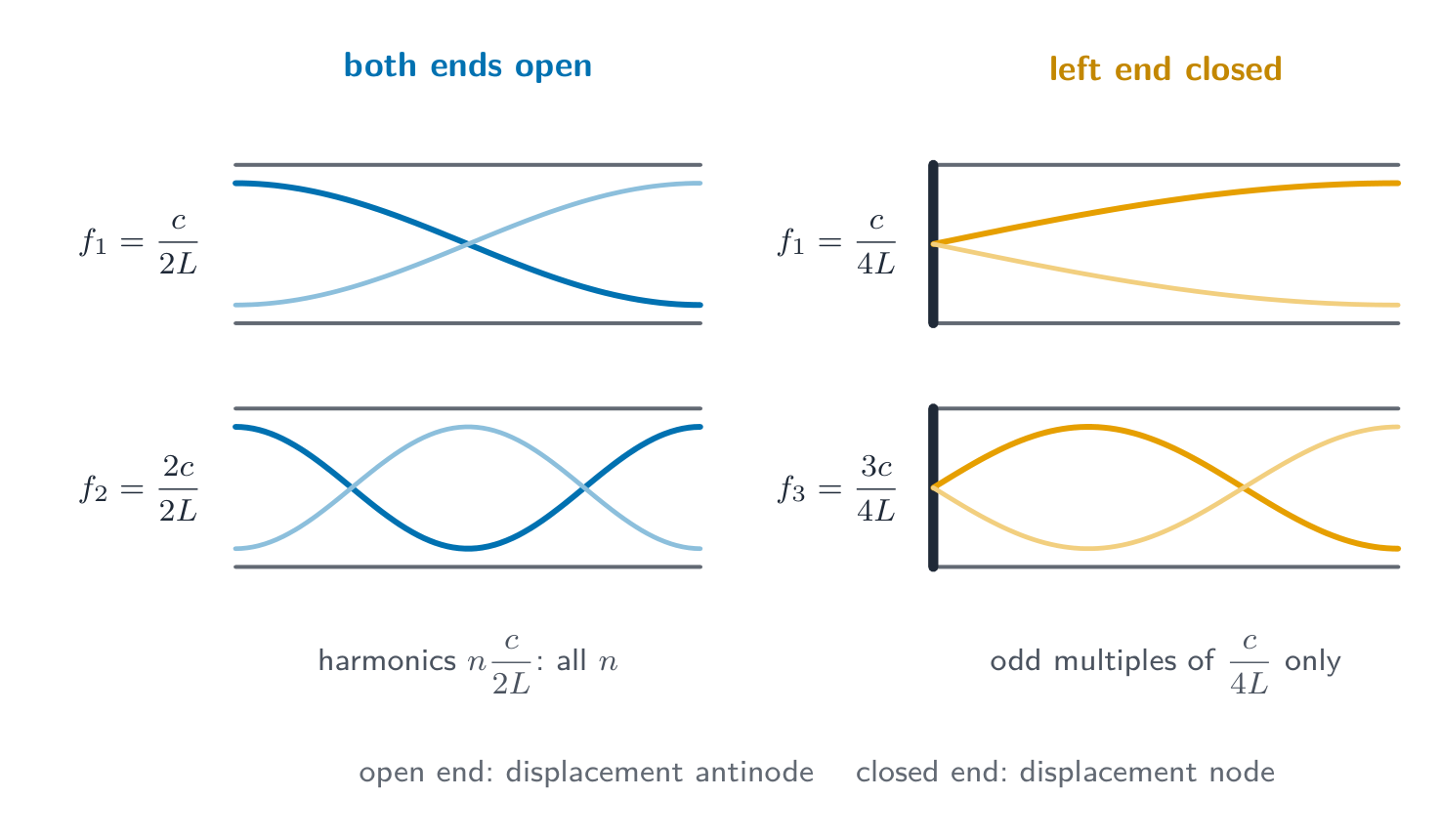
- Open end: displacement antinode. Closed end: displacement node.
- Both open: $f_n = \dfrac{nc}{2L}$, all $n$. One closed: $f_n = \dfrac{(2n - 1)c}{4L}$, odd multiples only.
A 0.50 m pipe closed at one end, $c = 340$ m/s. Fundamental in Hz?
Difficulté 2/5 · 140 pièces + un petit bonus lors de la première réussite aujourd'hui
A pipe closed at one end is a quarter wavelength long at its fundamental: $f = c/4L = 340/2 = 170$ Hz.
The next resonance of that closed pipe above 170 Hz is
Difficulté 1/5 · 100 pièces + un petit bonus lors de la première réussite aujourd'hui
A closed pipe has only odd harmonics, so after 170 Hz comes $3 \times 170 = 510$ Hz.
Closing one end
- A 0.85 m pipe in 340 m/s air: both open gives 200, 400, 600 Hz. Closing one end gives 100, 300, 500 Hz.
- The fundamental 基频 halves, and none of the old frequencies survives: they are even multiples of $c/4L$.
Quel tuyau résonne ?
Distinguer les résonances ouverte–ouverte et ouverte–fermée.
Closing one end of an open pipe halves its fundamental frequency and leaves only odd harmonics.
Difficulté 1/5 · 100 pièces + un petit bonus lors de la première réussite aujourd'hui
True. The fundamental changes from $c/2L$ à $c/4L$, and a closed–open pipe supports only odd multiples of it.
Strings, wave speed and loudness
- A string fixed at both ends has nodes at both ends, so $f_n = \dfrac{nv}{2L}$, with wave speed $v = \sqrt{T/\mu}$ (tension over mass per length). Quadrupling the tension doubles every frequency.
- Sound intensity level $\beta = 10\log_{10}(I/I_0)$ dB. Each factor of 10 in intensity adds 10 dB; doubling the intensity adds 3 dB. Intensity from a point source falls as $1/r^2$: doubling the distance loses 6 dB.
A 0.65 m string has wave speed 286 m/s. Its fundamental frequency in Hz?
Difficulté 2/5 · 140 pièces + un petit bonus lors de la première réussite aujourd'hui
$f_1 = v/2L = 286/1.3 = 220$ Hz.
You move from 2 m to 20 m from a small speaker. By how many dB does the sound level fall?
Difficulté 2/5 · 140 pièces + un petit bonus lors de la première réussite aujourd'hui
Intensity falls by $10^2$ (inverse square), so the level falls by $10\log_{10}100 = 20$ dB.
Worked GRE question: tightening a string
A guitar string's fundamental is 220 Hz. If the tension is increased by a factor of 4 (length and mass unchanged), the new fundamental is
- (A) 55 Hz
- (B) 110 Hz
- (C) 220 Hz
- (D) 440 Hz
- (E) 880 Hz
Fast route. $f \propto v \propto \sqrt T$: $\sqrt4 = 2$, so 440 Hz. Answer (D).
Traps. (E) takes $f \propto T$. (B) inverts the dependence.
Worked GRE question: ten machines
One machine produces a sound level of 70 dB at a point. Ten identical machines running together (incoherent sources) produce a level of
- (A) 70 dB
- (B) 73 dB
- (C) 77 dB
- (D) 80 dB
- (E) 700 dB
Fast route. Incoherent intensities add: 10 times the intensity is $+10$ dB, so 80 dB. Answer (D).
Traps. (E) adds decibels as if they were intensities. (B) is two machines (+3 dB).
Common errors
- Swapping source and observer formulas. The source speed goes in the denominator.
- One Doppler factor for an echo. The reflector both receives and re-emits.
- Even harmonics in a closed pipe. Only odd multiples of $c/4L$.
- Adding decibels. Add intensities, then convert.
Recap
- $f' = f(c \pm u_o)/(c \mp u_s)$; speeds relative to the medium.
- Echo from a fixed wall: $f(c + u)/(c - u)$.
- Open–open: $nc/2L$; open–closed: odd multiples of $c/4L$; string: $nv/2L$ with $v = \sqrt{T/\mu}$.
- $\beta = 10\log(I/I_0)$: ×10 intensity is +10 dB, ×2 is +3 dB.
- Doppler: The shift in observed frequency caused by motion of source or observer.
- fundamental: The lowest resonant frequency of a system.
- antinode: A point of a standing wave where the oscillation is largest.