Mécanique classique
Introduit| English | Sens |
|---|---|
| small oscillations/smɔːl ˌɒsɪˈleɪʃnz/ | petites oscillations |
| free-body diagram/friː ˈbɒdi ˈdaɪəɡræm/ | diagramme corps libre |
| generalised coordinates/ˈdʒenərəlaɪzd kəʊˈɔːdɪnəts/ | coordonnées généralisées |
Constant speed, still accelerating
- A planet on a circular orbit keeps the same speed, yet it accelerates: its velocity turns, so $a = v^2/r$ toward the centre.
- Classical mechanics is about a fifth of the GRE Physics test, the largest single area. It tests vector forces, circular motion, which conservation law applies, orbits, small oscillations 小振动 and the Lagrangian.
Newton's law is a vector law
- $\sum \mathbf F = m\mathbf a$ component by component. Draw the free-body diagram 受力分析图, choose axes along the constraint, then write components. Block on an incline of angle $\theta$ with kinetic friction $\mu$: $a = g(\sin\theta - \mu\cos\theta)$ sliding down, $N = mg\cos\theta$.
- Circular motion needs a net inward force $mv^2/r$; it is not an extra force. At the top of a vertical loop, gravity alone supplies it when $v^2 = gR$: the slowest speed that keeps contact.
A block slides down a 30° incline with kinetic friction coefficient 0.20. Acceleration in m/s²? ($g = 9.8$ m/s², two decimal places)
Difficulté 2/5 · 140 pièces + un petit bonus lors de la première réussite aujourd'hui
$a = g(\sin 30° - 0.2\cos 30°) = 9.8(0.5 - 0.173) = 3.20$ m/s².
Which quantity is conserved?
- Momentum: zero net external impulse. Mechanical energy: no work by non-conservative forces. Angular momentum about a point: zero net external torque about that point.
- A collision can conserve momentum and lose kinetic energy.
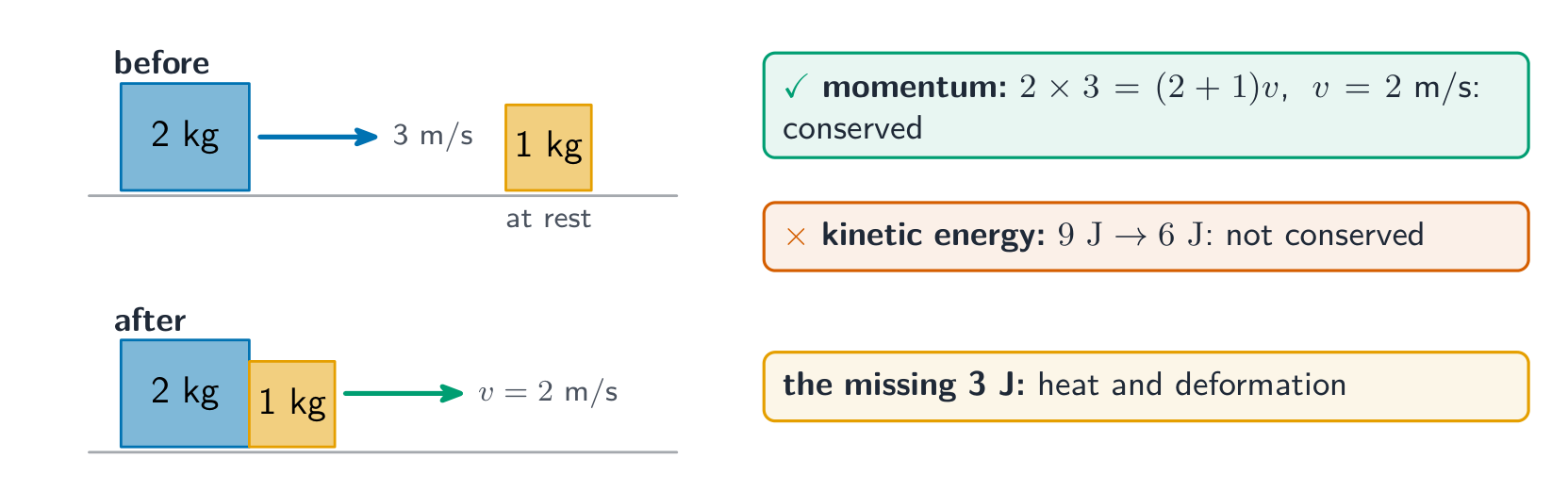
Momentum conserved does not mean kinetic energy conserved: check each law against its own condition.
Qu'est-ce qui est conservé ?
Déterminer quelle loi de conservation s'applique à un système.
A 3 kg cart at 4 m/s hits a 1 kg cart at rest; they stick. How much kinetic energy (J) is lost?
Difficulté 2/5 · 140 pièces + un petit bonus lors de la première réussite aujourd'hui
Momentum is conserved: $3 \times 4 = 4v$, so $v = 3$ m/s. Kinetic energy falls from $\tfrac12 \cdot 3 \cdot 4^2 = 24$ J to $\tfrac12 \cdot 4 \cdot 3^2 = 18$ J, so 6 J is lost.
Momentum is conserved in an inelastic collision even though kinetic energy is not.
Difficulté 1/5 · 100 pièces + un petit bonus lors de la première réussite aujourd'hui
True. With no external impulse, total momentum is always conserved; in an inelastic collision some kinetic energy becomes heat, sound or deformation.
Gravity and circular orbits
- Gravity supplies the centripetal force: $\dfrac{GMm}{r^2} = \dfrac{mv^2}{r}$, so $v = \sqrt{GM/r}$ and $T^2 = \dfrac{4\pi^2}{GM}r^3$ (Kepler's third law). A wider orbit is slower.
- Energies on a circular orbit: $K = \dfrac{GMm}{2r}$, $U = -\dfrac{GMm}{r}$, total $E = -\dfrac{GMm}{2r} = -K$. Escape speed from radius $r$ is $\sqrt{2GM/r}$, which is $\sqrt2$ times the orbital speed there.
A satellite orbits at 7.7 km/s. What speed (km/s, one decimal place) would let it escape from that radius?
Difficulté 2/5 · 140 pièces + un petit bonus lors de la première réussite aujourd'hui
Escape speed is $\sqrt2$ times orbital speed: $7.7 \times 1.414 = 10.9$ km/s.
For a circular orbit, the total energy $E$ and kinetic energy $K$ are related by
Difficulté 1/5 · 100 pièces + un petit bonus lors de la première réussite aujourd'hui
$K = GMm/2r$ et $U = -GMm/r = -2K$, so $E = K + U = -K$.
Small oscillations
- Near a stable minimum of $U(x)$, $U \approx U_0 + \tfrac12 U''(x_0)(x - x_0)^2$: a spring with $k = U''(x_0)$, so $\omega = \sqrt{U''(x_0)/m}$. Find the minimum from $U' = 0$, then take the second derivative there.
- Spring: $\omega = \sqrt{k/m}$; simple pendulum: $\omega = \sqrt{g/\ell}$. Doubling the mass on a spring divides $\omega$ by $\sqrt2$, not 2.
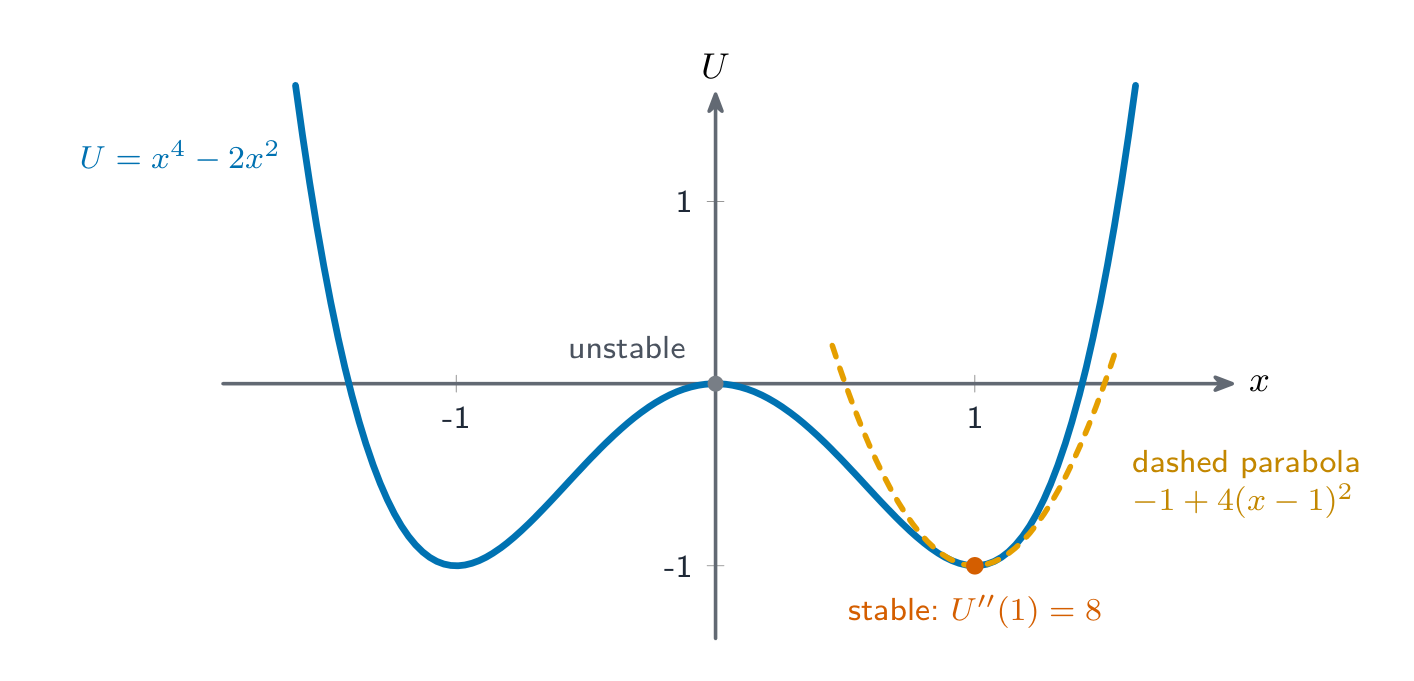
A 1 kg particle moves in $U(x) = x^4 - 2x^2$ (SI units). Find $\omega$ for small oscillations about $x = 1$, to two decimal places.
Difficulté 2/5 · 140 pièces + un petit bonus lors de la première réussite aujourd'hui
$U'' = 12x^2 - 4 = 8$; $\omega = \sqrt 8$.
The mass on a spring is quadrupled. The oscillation period
Difficulté 1/5 · 100 pièces + un petit bonus lors de la première réussite aujourd'hui
The period is $T = 2\pi\sqrt{m/k}$, so it scales as $\sqrt{m}$: four times the mass doubles the period.
The Lagrangian
- $L = T - V$ in generalised coordinates 广义坐标; $\dfrac{d}{dt}\dfrac{\partial L}{\partial \dot q} = \dfrac{\partial L}{\partial q}$.
- Spring: $L = \tfrac12 m\dot x^2 - \tfrac12 kx^2$ gives $m\ddot x + kx = 0$. If $L$ does not contain $q$, then $\partial L/\partial \dot q$ is conserved: for a central force, $L$ has no $\phi$, so angular momentum $mr^2\dot\phi$ is constant.
If $L$ does not depend on $q$, the generalised ____ $\partial L/\partial\dot q$ is conserved.
Difficulté 1/5 · 100 pièces + un petit bonus lors de la première réussite aujourd'hui
Euler–Lagrange gives d/dt of it equal to 0.
Worked GRE question: a wider orbit
A satellite moves to a circular orbit of four times the radius. Its orbital period is multiplied by
- (A) 2
- (B) 4
- (C) 8
- (D) 16
- (E) 64
Fast route. $T \propto r^{3/2}$: $4^{3/2} = 8$. Answer (C). Its speed halves ($v \propto r^{-1/2}$) while the path is 4 times longer.
Traps. (B) assumes the speed stays the same. (E) is $T^2$, not $T$. (A) is the speed factor, inverted.
Worked GRE question: the loop-the-loop
A bead slides without friction from rest down a track into a vertical loop of radius $R$. From what minimum height above the bottom of the loop must it start to stay on the track at the top?
- (A) $R$
- (B) $1.5R$
- (C) $2R$
- (D) $2.5R$
- (E) $3R$
Fast route. At the top, $v^2 \ge gR$. Energy: $mgh = mg(2R) + \tfrac12m(gR)$, so $h = 2.5R$. Answer (D).
Traps. (C) only reaches the height of the top, with zero speed there, so it falls off sooner. For a ball that rolls, part of the energy goes into spin and it must start higher ($2.7R$ for a solid sphere).
Common errors
- Adding $mv^2/r$ as a separate force on a free-body diagram. It is the net inward force.
- Faster in a wider orbit. $v = \sqrt{GM/r}$ falls as $r$ grows.
- Using $U''$ at the wrong point. First solve $U' = 0$, then check $U'' > 0$.
- Kinetic energy conserved because momentum is. Each law has its own condition.
Recap
- Turning velocity means acceleration $v^2/r$, supplied by real forces; loop top needs $v^2 \ge gR$.
- Momentum: no external impulse; energy: no non-conservative work; angular momentum: no external torque.
- Orbits: $v = \sqrt{GM/r}$, $T^2 \propto r^3$, $E = -GMm/2r$, escape speed $\sqrt2\,v$.
- $\omega = \sqrt{U''/m}$ near a minimum; Lagrange: $L = T - V$, cyclic coordinates give conserved momenta.
- small oscillations: Motion close to a stable equilibrium, where the restoring force is nearly linear.
- free-body diagram: A sketch of one object showing every force acting on it.
- generalised coordinates: Any independent variables that fix a system’s configuration.