Compréhension de lecture : tests d'options indépendantes et sélection de phrases
Introduit| English | Sens |
|---|---|
| inference/ˈɪnfərəns/ | inférence |
| speculation/ˌspekjʊˈleɪʃn/ | spéculation |
A survey result is not everyone's view
- Suppose a library interviews its visitors about evening opening. Their answers may tell you something about those visitors, but they do not automatically tell you what every student wants. Reading questions often turn on that difference in scope.
- This lesson uses fictional passages about maps and a library. Treat their statements as information for the reading task, not historical records or real survey findings. Judge each answer against the supplied passage.
Recognise the answer format
- An official select-one-or-more reading question has three options; one, two or all three can be correct. Select every supported answer and no unsupported one. There is no partial credit for an incomplete or over-selected set.
- Test each option independently: accepting one does not settle another. Here independently means using the text for each decision; it does not mean that the claims are unrelated or independent in a probability model.
In a select-all question, each option is judged ____.
Difficulté 1/5 · 100 pièces + un petit bonus lors de la première réussite aujourd'hui
Judge each option separately from the text. In the official three-option format, one, two or all three can be correct; select every supported answer and no others.
In an official three-option select-one-or-more reading question, choosing one supported option earns partial credit even if another correct option is missed.
Difficulté 1/5 · 100 pièces + un petit bonus lors de la première réussite aujourd'hui
The complete supported set is required; there is no partial credit for an incomplete or over-selected set.
Read a complete practice passage
- Fictional passage: “Some early cartographers deliberately enlarged their patrons' territories to support land claims. Others, working for navigators, prized accuracy and aimed to match survey records.” The passage supplies both a deliberate distortion and a different stated aim.
- Keep the groups distinct. It supports a conclusion about some maps and some mapmakers; it does not give their proportions, payments or the reliability of every map from the period.
Judge all three options
- A: Not all these maps aimed for geographical accuracy. Supported: the first group deliberately changed territory size to support land claims. B: Some cartographers valued accuracy. Supported: the second group explicitly prized it.
- C: All early cartographers were dishonest. Not supported: the passage does not establish a universal claim about people's honesty. Select A and B. A correct first choice gives no reason to stop before checking B and C.
Fictional passage: “Some early cartographers deliberately enlarged their patrons’ territories to support land claims. Others, working for navigators, prized accuracy and aimed to match survey records.” Which statements are supported? Select all that apply.
Difficulté 2/5 · 140 pièces + un petit bonus lors de la première réussite aujourd'hui
The deliberate distortion supports not all aiming for geographical accuracy; the second group explicitly valued accuracy. A universal claim about all early cartographers’ honesty is not established. Each option needs its own evidence.
Give each claim an evidence status
- Supported means the text states the claim or gives enough grounds for it. Contradicted means the text gives information against it. “Every mapmaker in the passage aimed for accuracy” conflicts with the first group's stated deliberate distortion.
- Unstated means the text does not settle the claim. “The patrons paid extra for the distortion” adds a payment arrangement. Rejecting it as an answer does not prove that no such payment occurred.

If a passage does not say that a patron paid extra, it proves that no extra payment occurred.
Difficulté 1/5 · 100 pièces + un petit bonus lors de la première réussite aujourd'hui
Unstated does not mean false. With no payment information, neither an extra payment nor its absence is established.
Preserve the scope words
- “Some mapmakers valued accuracy” does not establish all, most or usually. Those words make different claims about how widely something applies. Do not make a selected option stronger than its evidence.
- A statement with two parts must have support for both. “Some mapmakers valued accuracy and received extra pay for it” adds an unsupported second part, even though its first part is correct.
Fictional passage: “Some early cartographers deliberately enlarged their patrons’ territories to support land claims. Others, working for navigators, prized accuracy and aimed to match survey records.” Which option is only partly supported and therefore should not be selected?
Difficulté 1/5 · 100 pièces + un petit bonus lors de la première réussite aujourd'hui
Valuing accuracy is stated; receiving extra pay for it is not. A conjunction requires support for both parts.
Fictional passage: “Some early cartographers deliberately enlarged their patrons’ territories to support land claims. Others, working for navigators, prized accuracy and aimed to match survey records.” Explain why “some valued accuracy,” “all aimed for accuracy,” and “patrons paid extra” have different evidence statuses.
Une explication possible. Comparez les liens d'évidence avec votre formulation ; ce modèle local ne prévoit pas de score au GRE.
Infer without adding a new story
- An inference 推断 is a conclusion drawn from information in the passage. The first group's deliberate distortion supports “not every map in the passage aimed for accuracy,” even though that exact sentence is not quoted.
- Speculation 臆测 adds a claim without enough support. The mapmakers' concern for accuracy does not by itself establish that navigators required accurate maps, and a patron's benefit does not establish bribery. Use the stated relationship, not an imagined cause.
Confirmé, infirmé ou non mentionné ?
Utilisez ce passage fictif pour chaque carte : certains cartographes agrandissaient délibérément les domaines pour soutenir des revendications foncières ; d'autres accordaient de la valeur à l'exactitude et visaient à correspondre aux registres de levé. Aucune quantité, proportion ou arrangement de paiement n'est fourni.
Fictional passage: “Some early cartographers deliberately enlarged their patrons’ territories to support land claims. Others, working for navigators, prized accuracy and aimed to match survey records.” Is “The mapmakers were bribed by their patrons” a supported inference?
Difficulté 1/5 · 100 pièces + un petit bonus lors de la première réussite aujourd'hui
The text supplies a deliberate action and a purpose, but no payment arrangement or bribery. This is unsupported; the absence of that information does not establish that bribery was impossible.
Select a sentence for its requested role
- In an official select-in-passage task, select the complete sentence that meets the question's description. Some questions restrict you to specified paragraphs; stay inside that range and check every part of the requested role.
- The practice here uses numbered sentences and answer choices to rehearse that decision. A sentence can mention the correct topic yet serve the wrong role: a claim, supporting example, contrast, background detail and limitation do different jobs.
Put this sentence-selection check in a sensible order.
Difficulté 3/5 · 200 pièces + un petit bonus lors de la première réussite aujourd'hui
Identify the task and permitted range, then evaluate candidates against the entire description. A topic match alone is insufficient.
Read the numbered map passage
- Fictional passage: [1] The maps in this archive served different aims. [2] A landowner's map labelled 1507 deliberately enlarged the estate beyond surveyed borders to strengthen a territorial claim. [3] A navigator's chart, by contrast, aimed to match survey records as closely as possible.
- [4] Both maps were drawn in ink. [5] These two examples do not establish how common either approach was among all early maps. The date is a label in this invented passage, not an assertion about a real surviving map.
Match the job, not just the topic
- For evidence that a territorial aim shaped a map, choose [2]: it names the altered estate and its purpose. [1] states the broader claim; [3] supplies a contrasting aim; [4] gives a shared material but no evidence of territorial purpose.
- For a limit on generalising from the examples, choose [5]. It narrows what the evidence establishes. A sentence can perform more than one role, but every part of the question's particular description must apply.

Fictional passage: [1] The maps in this archive served different aims. [2] A landowner’s map labelled 1507 deliberately enlarged the estate beyond surveyed borders to strengthen a territorial claim. [3] A navigator’s chart, by contrast, aimed to match survey records as closely as possible. [4] Both maps were drawn in ink. [5] These two examples do not establish how common either approach was among all early maps. Which sentence gives specific evidence that a territorial aim shaped a map? This numbered-choice practice adapts a select-in-passage task.
Difficulté 1/5 · 100 pièces + un petit bonus lors de la première réussite aujourd'hui
Sentence [2] provides both the changed estate and its stated territorial purpose. [1] is the broad claim, [3] contrasts an accuracy aim, [4] is a material detail, and [5] limits generalisation. The date belongs to a fictional example.
Fictional passage: [1] The maps in this archive served different aims. [2] A landowner’s map labelled 1507 deliberately enlarged the estate beyond surveyed borders to strengthen a territorial claim. [3] A navigator’s chart, by contrast, aimed to match survey records as closely as possible. [4] Both maps were drawn in ink. [5] These two examples do not establish how common either approach was among all early maps. Which statements about this passage are supported? Select all that apply.
Difficulté 2/5 · 140 pièces + un petit bonus lors de la première réussite aujourd'hui
Sentence [1] states different aims; [2] states the estate enlargement and purpose; [5] explicitly limits conclusions about frequency. All three options are supported.
Fictional passage: [1] The maps in this archive served different aims. [2] A landowner’s map labelled 1507 deliberately enlarged the estate beyond surveyed borders to strengthen a territorial claim. [3] A navigator’s chart, by contrast, aimed to match survey records as closely as possible. [4] Both maps were drawn in ink. [5] These two examples do not establish how common either approach was among all early maps. Explain why [2], rather than [1], [4] or [5], answers a request for specific evidence of a territorial purpose.
Une explication possible. Comparez les liens d'évidence avec votre formulation ; ce modèle local ne prévoit pas de score au GRE.
Keep evidence within its reach
- The preserved sketch below uses the invented map example. Its example can support some political influence when read with the stated purpose in [2]. It does not measure whether political goals mattered as much as geography, or establish a claim about all early maps.
- Treat that broad wording as something to question. A relevant example can support a narrower claim without proving every stronger version. A sentence about colours would also need a stated link to the argument before it could provide the requested evidence.
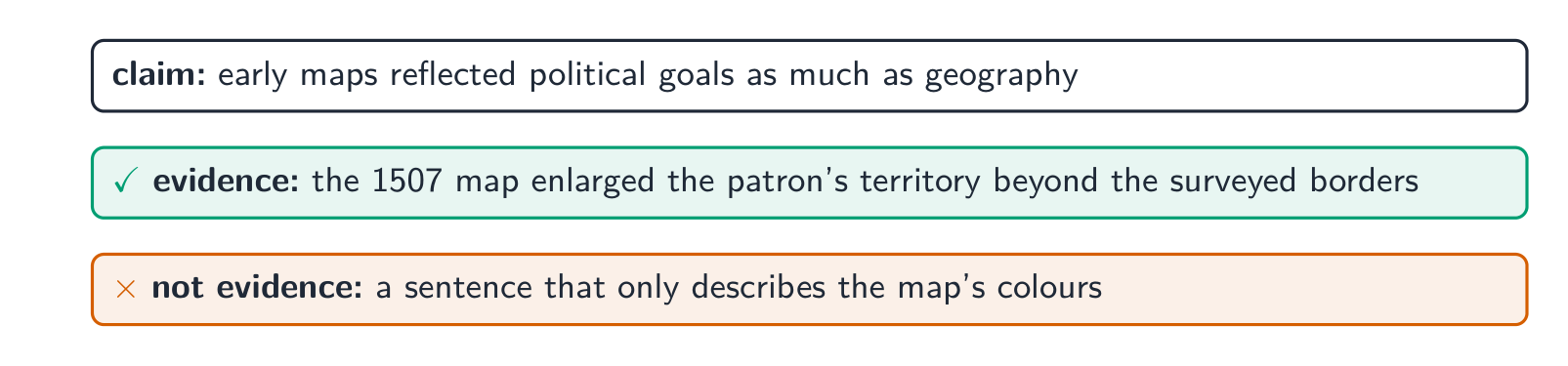
The preserved sketch pairs one enlarged-estate example with the broad wording “political goals as much as geography.” Explain what the fictional example supports and what it leaves unmeasured.
Une explication possible. Comparez les liens d'évidence avec votre formulation ; ce modèle local ne prévoit pas de score au GRE.
Separate a result from a motive
- A map larger than survey records might reflect an error, a different scale or a deliberate choice. Size difference alone does not settle the maker's intention. In the fictional passage, deliberately and to strengthen a territorial claim provide that missing information.
- Likewise, “valued accuracy” describes a preference or aim; it does not guarantee that every chart was accurate. Check whether the question asks about intention, actual outcome, cause or frequency before transferring evidence between them.
A fictional description says only that a map’s estate is larger than survey records show. Which added detail would most directly establish that the enlargement was intentional and served a territorial claim?
Difficulté 1/5 · 100 pièces + un petit bonus lors de la première réussite aujourd'hui
The stated deliberate action and purpose connect intention to the difference. Size alone, ink and age do not establish that motive.
Transfer to the library passage
- Fictional passage: [1] Evening library opening may improve access for some students. [2] During one trial week, eighteen of twenty interviewed library users said they lacked a quiet place to study at home.
- [3] The interviews covered only existing users, so they did not measure the views of students who never visited. [4] The head librarian proposed a broader student survey before drawing a school-wide conclusion. These invented numbers belong only to this practice passage.
Test scope and role in the new passage
- “Some interviewed users reported lacking quiet study space” is supported by [2]. “Every student wants evening opening” is not established. “The interviews included students who never visited” is contradicted by [3]. Keep these three statuses separate.
- For a limitation of the interview evidence, [3] states the coverage gap. [2] reports the result; [4] proposes a response to the gap. A sensible next action is not itself the sentence stating the limitation.
Fictional passage: [1] Evening library opening may improve access for some students. [2] During one trial week, eighteen of twenty interviewed library users said they lacked a quiet place to study at home. [3] The interviews covered only existing users, so they did not measure the views of students who never visited. [4] The head librarian proposed a broader student survey before drawing a school-wide conclusion. Which statements are supported? Select all that apply.
Difficulté 2/5 · 140 pièces + un petit bonus lors de la première réussite aujourd'hui
The reported eighteen users provide at least some interviewed users lacking quiet space. The passage does not establish every student’s preference; [3] excludes never-visitors from the interviews.
Fictional passage: [1] Evening library opening may improve access for some students. [2] During one trial week, eighteen of twenty interviewed library users said they lacked a quiet place to study at home. [3] The interviews covered only existing users, so they did not measure the views of students who never visited. [4] The head librarian proposed a broader student survey before drawing a school-wide conclusion. Which sentence states a limitation of the interview evidence?
Difficulté 1/5 · 100 pièces + un petit bonus lors de la première réussite aujourd'hui
Sentence [3] states the coverage limitation. [2] gives results, while [4] proposes a response to that limitation.
Build a short evidence trail
- For each option, write a sentence number and a short reason: supported, contradicted or unstated. If the answer is an inference, explain the link; do not demand an exact quotation or accept a paraphrase that quietly changes its scope.
- For sentence selection, state the required job, examine the eligible sentences and test the full description. Before finishing, check that you selected every supported option or the single requested sentence, according to the actual question format.
Quel rôle joue cette phrase ?
Chaque carte contient suffisamment d'un passage fictif pour identifier le rôle principal de la phrase déclarée.
Fictional passage: [1] Evening library opening may improve access for some students. [2] During one trial week, eighteen of twenty interviewed library users said they lacked a quiet place to study at home. [3] The interviews covered only existing users, so they did not measure the views of students who never visited. [4] The head librarian proposed a broader student survey before drawing a school-wide conclusion. Give one supported conclusion about the interviewees, explain the limit on a school-wide conclusion, and select the sentence stating that limit rather than the proposed next action.
Une explication possible. Comparez les liens d'évidence avec votre formulation ; ce modèle local ne prévoit pas de score au GRE.
Recap
- Judge each select-all option against the text, preserving scope and checking every clause. Supported, contradicted and unstated are different; lack of support does not prove the opposite.
- Select a sentence for its exact role within the allowed passage range. Distinguish a claim, evidence, purpose, outcome and limitation; use fictional examples only for the conclusions they support.
- inference: A conclusion drawn from information or evidence.
- speculation: A claim based on guesswork rather than sufficient evidence.