Verbal : lecture et structure de l'argumentation
Introduit| English | Sens |
|---|---|
| perspective/pəˈspektɪv/ | perspective |
| assumption/əˈsʌmpʃn/ | hypothèse implicite |
A plausible explanation can still be too strong
- A museum raises ticket prices, a competitor opens, and attendance falls. Did the price rise contribute, cause the whole fall, or merely happen first? Those are different claims.
- Reading questions test how reasons support a claim. Track the writer's perspective 观点 and any unstated assumption 假设. A familiar topic is not a substitute for evidence in the passage.
Read a short argument as a whole
- A fictional report says: “Annual visits fell from 10,000 to 8,000 after ticket prices rose. The director blames the entire fall on the price rise. A new museum also opened nearby during that year.”
- It ends: “The timing makes a price effect possible, but these figures alone do not show how much either change mattered.” The writer questions the director's certainty without denying that price could matter.
Map jobs rather than topics
- The report's structure is: attendance figures → director's explanation → alternative explanation → writer's limited conclusion. “A museum” names the topic; “questions a single-cause explanation” describes the passage's purpose.
- Give each paragraph a short job label, then connect it to the larger argument. A detail can supply evidence, illustrate a claim, qualify it or challenge it; its job depends on the surrounding sentences.
Track who says what
- In the report, “the director blames” assigns the strong claim to the director. The last sentence gives the writer's more cautious position. Reporting a claim does not mean accepting it.
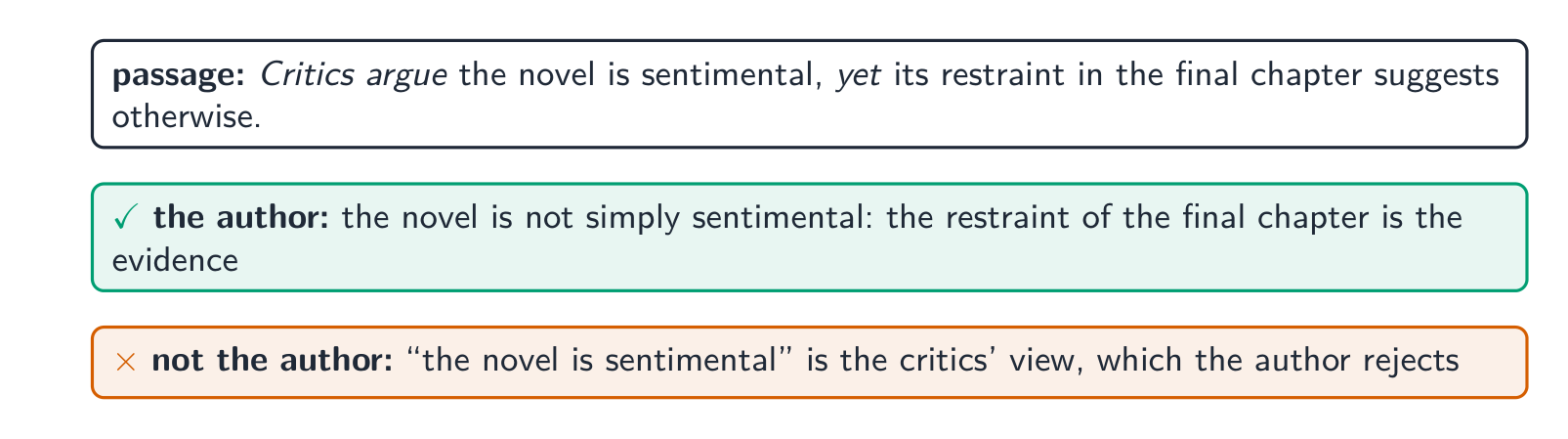
- In “Critics argue the novel is sentimental; yet its restraint in the final chapter suggests otherwise,” the writer challenges the critics. Here “suggests otherwise” supplies the rejection; “critics argue” alone would not tell us the writer's response.
“Some historians claim the treaty was a failure; the evidence, however, points to lasting stability.” Which position does the writer advance?
Difficulté 1/5 · 100 pièces + un petit bonus lors de la première réussite aujourd'hui
The first claim is attributed to historians. The writer contrasts it with evidence of lasting stability. This context, rather than “however” by itself, identifies the position.
The words “critics argue” alone guarantee that the writer rejects the critics’ view.
Difficulté 1/5 · 100 pièces + un petit bonus lors de la première réussite aujourd'hui
They identify whose view is reported. The writer may accept, reject or leave it open; read the response and surrounding context.
Separate evidence from conclusion
- Evidence is information offered as a reason. In the museum report, the recorded fall from 10,000 to 8,000 is evidence. The statement that prices caused the whole fall is the director's conclusion, not another measurement.
- Ask “What is this sentence offered to support?” The same statement can be a conclusion in one argument and a reason in a later one. A confident tone or a number does not make a statement proven.
After does not by itself mean because
- The report places the price rise before the fall. That timing fits a causal explanation, but it also fits a competitor effect or a mixture. A before-and-after comparison alone does not separate these possibilities.
- The new competitor weakens the claim that price explains everything. Its existence does not prove it caused any lost visits, and it does not prove price caused none. A possible alternative exposes a gap; it is not automatically the true explanation.
A contributing cause need not be the only cause
- Compare “Price caused some of the decline” with “Price caused all of it.” In a possible case, 1,000 visits are lost because of price and another 1,000 because of the competitor. Price contributes even though another cause exists.
- To attribute the whole decline to price, the director must address competing explanations for the lost visits. To claim only a contribution, the director needs a genuine price effect; excluding every other cause is too strong a requirement.

A total decline of 2,000 visits includes 1,000 lost because of price and 1,000 because of a competitor. Which statement fits this possible case?
Difficulté 1/5 · 100 pièces + un petit bonus lors de la première réussite aujourd'hui
Price contributes to the decline without explaining the whole decline. A second cause does not erase the first.
Find a necessary assumption by denying it
- For “The price rise contributed to the decline,” a necessary idea is that at least some lost visits would have occurred without the rise. Deny it: none of the lost visits would have occurred without the rise. That removes any price contribution to this decline.
- The negation test checks whether the argument needs a proposed bridge. Denying a necessary assumption breaks the reasoning; it need not make the conclusion impossible by every other route. A statement that merely helps is not necessarily required.
Quel rôle joue cette phrase ?
Rapport : « Les prix sont passés de 15 à 25 dollars. Les visites annuelles sont passées de 10,000 à 8,000. Un concurrent s'est installé à proximité. Nous concluons que la hausse des prix a contribué à la baisse. » Classez chaque affirmation par rapport à ce rapport.
Argument: “Museum attendance fell after ticket prices rose. The rise contributed to the decline.” Which idea must this causal claim accept?
Difficulté 1/5 · 100 pièces + un petit bonus lors de la première réussite aujourd'hui
A contribution means that price made a difference to at least some lost visits. Denying that bridge removes the claimed effect. The price rise is already stated evidence; other causes may also contribute.
An unstated idea that an argument needs in order to work is an ____.
Difficulté 1/5 · 100 pièces + un petit bonus lors de la première réussite aujourd'hui
An assumption is a needed bridge in the reasoning; stated evidence or an optional supporting fact is different.
Un magasin dit : « Les commandes ont chuté après la hausse des frais de livraison. Cette hausse a causé une partie de la baisse. » Expliquer pourquoi « aucune autre cause n'a contribué » n'est pas nécessaire. Énoncer un lien causal nécessaire et le nier.
Comparer la portée exacte de votre réponse avec le passage et utiliser la liste de contrôle pour réviser votre raisonnement.
Necessary and sufficient are different directions
- “Only members may borrow” makes membership necessary for permission to borrow. It does not promise that every member may borrow; an unpaid fee could block permission. Also, permission does not mean someone actually borrows.
- If a passage states that all borrowers are members, membership follows from being a borrower. Reverse reasoning fails: a member need not be a borrower. A sufficient condition guarantees the result; a necessary condition must hold for it.

“Only members may borrow” guarantees that every member has permission to borrow.
Difficulté 1/5 · 100 pièces + un petit bonus lors de la première réussite aujourd'hui
Only-members makes membership necessary for permission. Additional restrictions may still prevent a member from borrowing.
Strengthen or weaken the exact link
- For the museum argument, evidence that many former visitors stopped because of cost supports a price effect. Evidence that visits were already falling at the same rate before the price rise weakens the inference from timing alone. Neither statement fixes the exact size of the price effect.
- Keep the conclusion fixed while judging new information. A controlled comparison might be strong support without being a necessary assumption. “More support,” “required premise” and “proof” name different standards.
A director cites a fall immediately after a price rise as evidence that price caused the whole fall. Which new fact most directly weakens that timing-based reasoning?
Difficulté 1/5 · 100 pièces + un petit bonus lors de la première réussite aujourd'hui
An established fall at the same rate before the price change undermines assigning the whole fall to that change. It does not prove the price effect is zero.
Keep the strength of the wording
- “Some,” “most” and “all” are different quantities; “may,” “probably” and “must” express different strengths. From “some visitors objected to price,” do not infer that most did. From “price may matter,” do not infer that it certainly does.
- Deny words exactly when testing an assumption. The denial of “all visitors objected” is “at least one did not,” not “none objected.” The denial of “some objected” is “none objected.”
What is the logical denial of “All surveyed visitors objected to the price”?
Difficulté 1/5 · 100 pièces + un petit bonus lors de la première réussite aujourd'hui
One counterexample is enough to make an all-statement false. “None” is stronger than the required denial.
Draw only supported inferences
- Suppose every archive borrower is registered, and Imani is an archive borrower. Imani must be registered. If Tomas is registered, that alone does not establish that he borrows: the rule gives no such reverse link.
- Try a counterexample that keeps every stated fact true. Tomas could be registered but never borrow. That possibility defeats “Tomas must be a borrower,” even if borrowing seems likely. Use passage facts rather than outside knowledge or personal agreement.
Every archive borrower is registered. Imani is a borrower. Tomas is registered. Select all statements that must follow from these facts.
Difficulté 2/5 · 140 pièces + un petit bonus lors de la première réussite aujourd'hui
Imani is registered by the stated rule, and at least one registered person (Imani) borrows. Tomas might never borrow; the rule cannot be reversed.
Chercheur utilisant un laboratoire est formé. Noor l'utilise ; Evan est formé. Que conclure sur Noor ? Evan doit-il utiliser le laboratoire ? Donner un contre-exemple cohérent avec tous les faits.
Comparer la portée exacte de votre réponse avec le passage et utiliser la liste de contrôle pour réviser votre raisonnement.
Read a sentence's function in context
- “Admittedly, prices can affect demand; however, the report cannot isolate their effect here.” The first clause concedes a general point before the writer limits what this evidence establishes. It does not concede that price caused the entire decline.
- “Thus” often introduces a conclusion and “however” a contrast, but the words are clues. Ask which ideas are connected and whose conclusion it is. A quoted speaker can use “thus” inside a view the writer later rejects.
Match each complete example to the function of its marked clause.
Difficulté 2/5 · 140 pièces + un petit bonus lors de la première réussite aujourd'hui
Read each clause with its surrounding argument. A connector or speaker label alone does not determine the writer’s response.
Match the answer to the question's scope
- A main-purpose answer should cover the passage's overall move: the museum writer questions an unsupported attribution of the whole decline. “Describe ticket prices” is too narrow; “prove price never affects museums” is too broad and reverses the caution.
- A detail question may need one sentence; an inference may combine several. For multiple-answer questions, test each option against the passage separately. A statement can be true in the passage yet fail to answer the specific question.
Meaning and tone come from nearby words
- In “The timing makes the explanation plausible, but does not establish it,” plausible means reasonable enough to consider, not proven. Replace the word in its sentence and keep both the grammar and the writer's degree of confidence.
- The museum writer is cautious about a particular causal claim. Calling the tone hostile to all museums adds an attitude the text does not supply. Distinguish criticism of evidence from dislike of a person or institution.
“The timing makes the explanation plausible, but does not establish it.” What does “plausible” mean here?
Difficulté 1/5 · 100 pièces + un petit bonus lors de la première réussite aujourd'hui
The contrast with “does not establish it” makes the explanation reasonable to consider but unproven.
Check a second passage independently
- A fictional library report says: “A town extended library opening hours, and loans rose the next month. Staff credit the longer hours. That month, the library also started a school reading programme.”
- It ends: “The rise is encouraging, but the available totals cannot establish which change produced it.” The writer accepts the increase, reports the staff explanation and leaves the cause unresolved. The school programme is an alternative to investigate, not a demonstrated cause.
Loans rose after a library extended its hours and started a school programme. Staff credit the hours. The writer says totals cannot establish which change caused the rise. What is the writer’s main point?
Difficulté 1/5 · 100 pièces + un petit bonus lors de la première réussite aujourd'hui
The writer accepts the observed rise while withholding a causal attribution. The totals do not choose between the explanations.
Lire : « Une bibliothèque a prolongé ses heures et les prêts ont augmenté. Le personnel attribue cela aux heures, mais un programme de lecture scolaire a commencé en même temps. Les totaux disponibles ne peuvent pas séparer les effets. » Identifier le fait observé, la claim du personnel, la position de l'auteur et une comparaison utile supplémentaire.
Comparer la portée exacte de votre réponse avec le passage et utiliser la liste de contrôle pour réviser votre raisonnement.
Use a short evidence trail
- Before choosing, state the question's job and predict a brief answer. For the library writer's view: “Loans rose; the cause remains uncertain.” Then find the sentence or link that supports each part.
- For each rejected option, name the error: wrong speaker, stronger quantity, reversed implication, outside information or wrong scope. If an answer mixes a supported claim with an unsupported one, the whole answer fails.
La conclusion en découle-t-elle ?
Chaque carte présente ses propres faits et inférence proposée. Décidez si l'inférence est étayée ou dépasse ces faits.
Lisez : « Certains producteurs affirment qu'une récolte précoce améliore toujours la saveur. Lors d'un essai, la récolte précoce a aidé une variété de pommes mais a réduit la saveur d'une autre. L'essai ne fournit donc aucune base pour une règle couvrant toutes les variétés. » Énoncez le but principal, la fonction de l'essai et pourquoi « la récolte précoce n'aide jamais » constitue un résumé erroné.
Comparer la portée exacte de votre réponse avec le passage et utiliser la liste de contrôle pour réviser votre raisonnement.
Recap
- Map each part's job, identify the speaker and preserve the writer's level of certainty. Separate stated evidence from the conclusion drawn from it.
- Check the exact causal claim, deny proposed necessary assumptions carefully and test inferences with counterexamples. Choose what answers the question using the passage.
- assumption: An unstated idea on which an argument's reasoning depends.
- perspective: A point of view on an issue, including how the writer interprets or evaluates it.