Currency changes, prices and the current account
Introduit| English | Sens |
|---|---|
| revaluation/rɪˌvæljuːˈeɪʃn/ | réévaluation |
| devaluation/diːˌvæljuːˈeɪʃn/ | dévaluation |
China lets the yuan rise, 2005
- For ten years the yuan was fixed at about 8.28 per dollar. On 21 July 2005 China's central bank raised its value by about 2% to 8.11, and then let it rise slowly. By 2013 a dollar bought only about 6.1 yuan.
- Changes in a currency's value change prices for exporters and importers.
Official changes
- Revaluation 货币升值(官方调整) is a government decision to raise a fixed currency's value.
- Devaluation 货币贬值(官方调整) is a decision to lower it. In floating markets the same moves are called appreciation and depreciation.
Match each term to its meaning.
Difficulté 2/5 · 140 pièces + un petit bonus lors de la première réussite aujourd'hui
Official or market change.
Effects on prices
- A fall in the yuan makes Chinese exports cheaper abroad and imports dearer in China.
- A rise does the opposite: exports dearer, imports cheaper.
China revalues the yuan. What happens to Chinese exports?
Difficulté 1/5 · 100 pièces + un petit bonus lors de la première réussite aujourd'hui
Each yuan costs foreigners more.
Worked example: the yuan falls from 7 to 8
A Chinese toy costs 70 yuan. An American book costs 20 dollars.
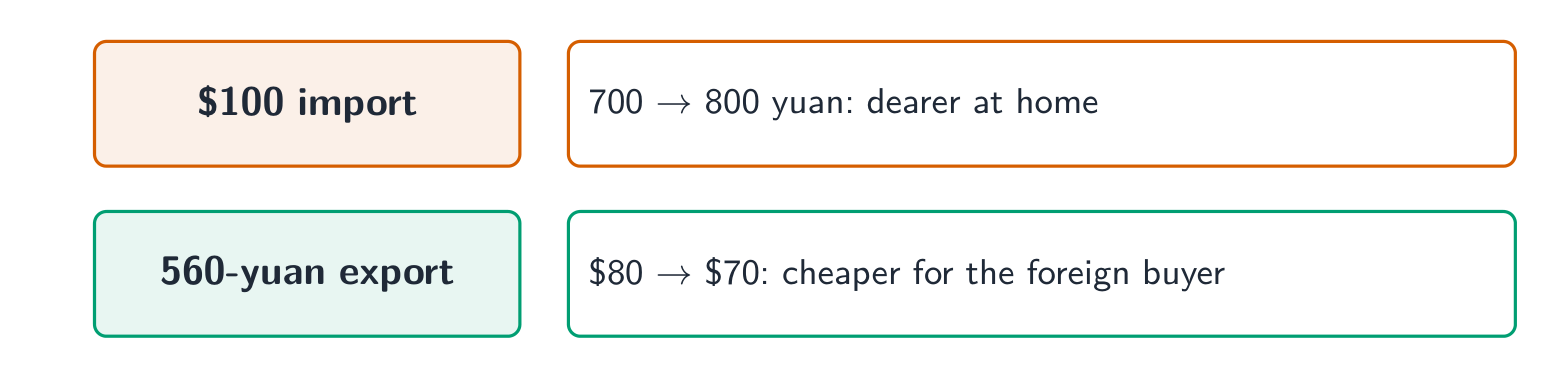
- Toy in dollars: $\dfrac{70}{7} = 10$ before; $\dfrac{70}{8} = 8.75$ after — cheaper for Americans.
- Book in yuan: $20 \times 7 = 140$ before; $20 \times 8 = 160$ after — dearer for Chinese buyers.
- Likely result: exports rise, imports fall, and the current account improves.
Currency quotations and converted prices
Convert between currencies using an explicit quote, then compare the quote with its reciprocal. Each comparison holds the original-currency amounts fixed.
A Chinese bicycle costs 560 yuan. What does it cost in dollars at 8 yuan per dollar?
Difficulté 2/5 · 140 pièces + un petit bonus lors de la première réussite aujourd'hui
560 ÷ 8.
A 50-dollar US textbook costs how many yuan at 8 yuan per dollar?
Difficulté 2/5 · 140 pièces + un petit bonus lors de la première réussite aujourd'hui
50 × 8.
Does the current account improve?
- Only if demand responds. If buyers keep buying imports because they have no substitutes, the import bill can rise.
- Effects take time: contracts are signed months ahead.
Inflation risk
- Dearer imports raise costs of oil, food and parts, which can push up inflation.
- Firms that buy imported materials may lose some of their export advantage.
A fall in the currency can raise inflation by making imports dearer.
Difficulté 1/5 · 100 pièces + un petit bonus lors de la première réussite aujourd'hui
Imported costs rise.
A weaker currency is not always good for the economy. Exporters gain, but consumers and firms that import pay more, and inflation may rise. Weigh both sides.
A weaker currency is good for every group in the economy.
Difficulté 1/5 · 100 pièces + un petit bonus lors de la première réussite aujourd'hui
Importers and consumers pay more.
Revaluation raises a fixed currency's value; devaluation lowers it. A fall in the currency makes exports cheaper and imports dearer, which may improve the current account if demand responds, but can raise inflation.
Evaluate the effect of a devaluation on a country's current account.
Exchange-rate changes.