Free trade and reasons for protection
Introduit| English | Sens |
|---|---|
| free trade/friː treɪd/ | commerce libre |
| infant industry/ˈɪnfənt ˈɪndʌstri/ | industrie naissante |
China joins the WTO, 2001
- In December 2001 China joined the World Trade Organization and cut many of its tariffs. Its exports grew more than eightfold by 2015, and China became the world's largest exporter of goods. Freer trade transformed its economy.
- But countries still argue about when to protect their own industries.
Free trade
- Free trade 自由贸易 is trade between countries without tariffs, quotas or other barriers.
- Each country specializes in what it produces at lowest cost, so total output rises.
Free trade means
Difficulté 1/5 · 100 pièces + un petit bonus lors de la première réussite aujourd'hui
No barriers.
Winners and losers
- Consumers gain lower prices and more choice; exporters gain bigger markets.
- Home producers facing cheaper imports lose sales, and their workers may lose jobs.
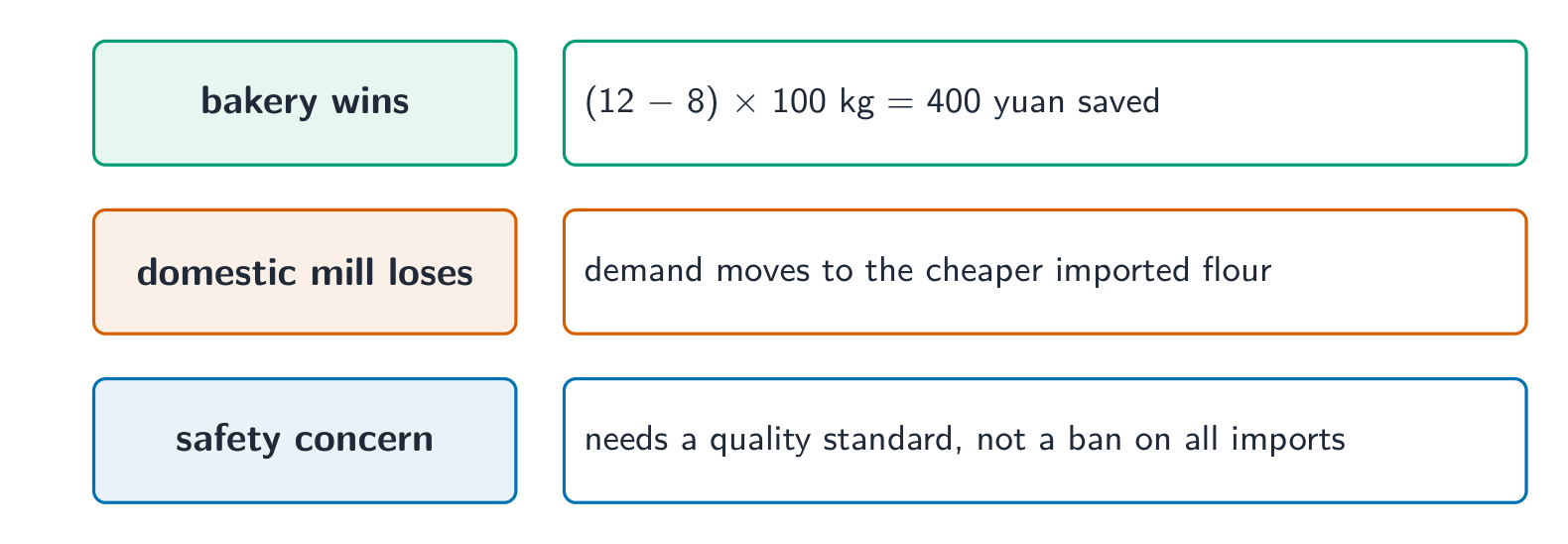
Match each group to a likely effect of free trade.
Difficulté 2/5 · 140 pièces + un petit bonus lors de la première réussite aujourd'hui
Winners and losers.
Worked example: imported flour
Home flour costs 4 yuan a kilogram; imported flour 3 yuan. A bakery uses 1000 kg a month.
- Bakery saves: $(4 - 3) \times 1000 = 1000$ yuan a month, and can cut bread prices.
- Home millers: lose the bakery's order, and may cut jobs.
- Overall: buyers gain more than millers lose, but the losses fall on a few people.
Home rice costs 6 yuan a kg and imported rice 5. A restaurant uses 400 kg a month. How much does it save by importing?
Difficulté 2/5 · 140 pièces + un petit bonus lors de la première réussite aujourd'hui
(6 − 5) × 400.
The infant-industry argument
- An infant industry 幼稚产业 is a new industry that cannot yet compete with established foreign firms.
- South Korea protected its young car makers, such as Hyundai, in the 1970s and 1980s; they later became major exporters.
An infant industry is a new industry that cannot yet compete with established foreign firms.
Difficulté 1/5 · 100 pièces + un petit bonus lors de la première réussite aujourd'hui
Temporary protection may help.
Other reasons for protection
- Protecting jobs, national security (food, energy, weapons), and stopping dumping — selling abroad below cost.
- Protection can also lead to retaliation: other countries raise their tariffs too.
Which are arguments for protection?
Difficulté 2/5 · 140 pièces + un petit bonus lors de la première réussite aujourd'hui
Protection usually raises prices.
Protection is not free. Tariffs save some jobs but raise prices for every buyer and may invite retaliation. An infant industry that never grows up keeps needing help.
Tariffs save jobs at no cost to anyone.
Difficulté 1/5 · 100 pièces + un petit bonus lors de la première réussite aujourd'hui
Buyers pay higher prices.
Free trade lets countries specialize, lowering prices and raising output. Gains are spread widely; losses fall on producers who face imports. Protection may help infant industries or security, but raises prices and risks retaliation.
A developing country wants to protect its new solar-panel industry with tariffs. Evaluate this.
Protection.