Equilibrium, shortages and surpluses
Introduit| English | Sens |
|---|---|
| excess demand/ekˈses dɪˈmænd/ | excès de demande |
| excess supply/ekˈses səˈplaɪ/ | excès d'offre |
Masks in early 2020
- In January 2020, demand for face masks exploded and shops sold out within hours. Prices rose, and factories expanded fast: China's daily mask output rose from about 10 million to over 100 million by the end of February. The shortage pushed the market towards a new balance.
- A market finds a price where buyers' and sellers' plans match.
Equilibrium
- The equilibrium price is where quantity demanded equals quantity supplied.
- Water bottles: at 15 yuan, 70 are demanded and 70 supplied — the market clears.
Prices 4, 6, 8 yuan; demand 120, 90, 60; supply 50, 90, 130. What is the equilibrium price?
Difficulté 2/5 · 140 pièces + un petit bonus lors de la première réussite aujourd'hui
Demand = supply = 90.
Below equilibrium: a shortage
- At 10 yuan, 90 are demanded but only 30 supplied: excess demand 超额需求 of $90 - 30 = 60$.
- Queues form and buyers compete, so the price is pushed up.
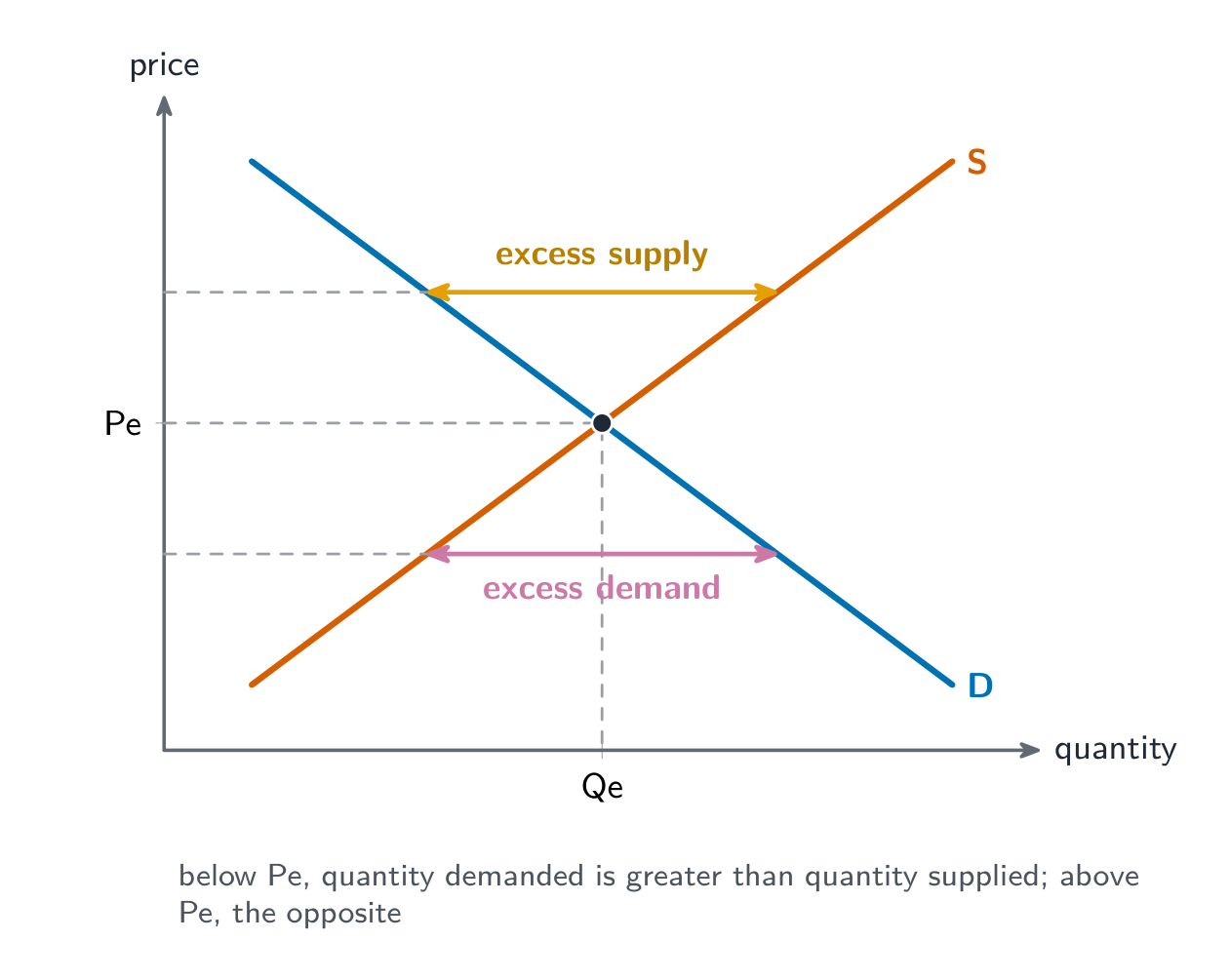
Worked example: reading the schedule
Prices 10, 15, 20 yuan; demand 90, 70, 50; supply 30, 70, 100.
- Equilibrium: 15 yuan, 70 bottles (demand equals supply).
- At 10 yuan: excess demand $90 - 30 = 60$ — a shortage.
- At 20 yuan: excess supply 超额供给 $100 - 50 = 50$ — a surplus; sellers cut prices to clear stock.
Read the gap from the schedule
At 15 yuan, 70 bottles are demanded and 70 supplied: equilibrium. At 10 yuan, excess demand is 90 − 30 = 60; at 20 yuan, excess supply is 100 − 50 = 50. Subtract the two quantities; never add them.
Using that schedule, what is the excess demand at 4 yuan?
Difficulté 2/5 · 140 pièces + un petit bonus lors de la première réussite aujourd'hui
120 − 50.
Using that schedule, what is the excess supply at 8 yuan?
Difficulté 2/5 · 140 pièces + un petit bonus lors de la première réussite aujourd'hui
130 − 60.
Moving to a new equilibrium
- An increase in demand (shift right) raises price and quantity. An increase in supply lowers price and raises quantity.
- For masks in 2020: demand rose first (price up), then supply rose (price back down).
Match each change to its effect on equilibrium price.
Difficulté 2/5 · 140 pièces + un petit bonus lors de la première réussite aujourd'hui
Shift and read the new crossing.
When prices cannot move
- If the government fixes a price below equilibrium, the shortage stays and queues or black markets appear.
- A price set above equilibrium leaves unsold stock.
A government fixes the price of bread below equilibrium. What is likely?
Difficulté 1/5 · 100 pièces + un petit bonus lors de la première réussite aujourd'hui
The price cannot rise to clear the market.
Excess demand is a difference, not a sum. At 10 yuan it is $90 - 30 = 60$, not $90 + 30$. Subtract the smaller quantity from the larger.
At 10 yuan, with 90 demanded and 30 supplied, excess demand is 120.
Difficulté 1/5 · 100 pièces + un petit bonus lors de la première réussite aujourd'hui
It is 90 − 30 = 60.
Equilibrium is where demand equals supply. Below it there is excess demand, which pushes the price up; above it, excess supply pushes the price down. Shifts in demand or supply move the market to a new equilibrium.
Explain what happened to the price of face masks in early 2020, first when demand rose and then when factories expanded.
Equilibrium changes.