How a market sets a price
Introduit| English | Sens |
|---|---|
| market/ˈmɑːkɪt/ | An arrangement through which buyers and sellers exchange goods or services. |
| demand/dɪˈmænd/ | The quantity of a good or service that buyers are willing and able to purchase at different prices over a period. |
| supply/səˈplaɪ/ | The quantity sellers are willing and able to offer at different prices over a specified period. |
| equilibrium/ˌiːkwɪˈlɪbrɪəm/ | équilibre |
| excess demand/ekˈses dɪˈmænd/ | The amount by which quantity demanded exceeds quantity supplied at a given price. |
| excess supply/ekˈses səˈplaɪ/ | The amount by which quantity supplied exceeds quantity demanded at a given price. |
| price elasticity of demand/praɪs ɪlæˈstɪsɪti ɒv dɪˈmænd/ | The percentage change in quantity demanded divided by the percentage change in price. |
Why pork doubled in price
- In 2019 African swine fever killed or forced the culling of a large share of China's pigs.
- By late 2019 pork cost about twice as much as a year earlier — and nobody passed a law to raise it.
- The price rose because the market 市场 itself adjusted. This lesson shows how.
Demand: what buyers plan to buy
- Demand 需求 is the quantity buyers are willing and able to buy at each price, in a given period.
- When the price rises, buyers plan to buy less: the demand curve slopes down.
- A change in price moves us along the curve; a change in income, tastes or the price of chicken shifts the whole curve.
The price of pork falls. What happens to the demand curve for pork?
Difficulté 1/5 · 100 pièces + un petit bonus lors de la première réussite aujourd'hui
A change in the good's own price causes a movement along the demand curve, never a shift.
Supply: what sellers plan to sell
- Supply 供给 is the quantity sellers are willing and able to sell at each price.
- A higher price makes selling more profitable, so the supply curve slopes up.
- Fewer pigs, higher feed costs or a new tax shift supply to the left: less is offered at every price.
Which changes shift the supply of pork to the LEFT?
Difficulté 2/5 · 140 pièces + un petit bonus lors de la première réussite aujourd'hui
Fewer pigs, higher costs and a tax all reduce the amount offered at every price. A higher pork price is a movement along supply.
Equilibrium: where plans agree
- Equilibrium 均衡 is the price at which the quantity demanded equals the quantity supplied.
- At that price there is no shortage and no surplus, so the price has no reason to change.
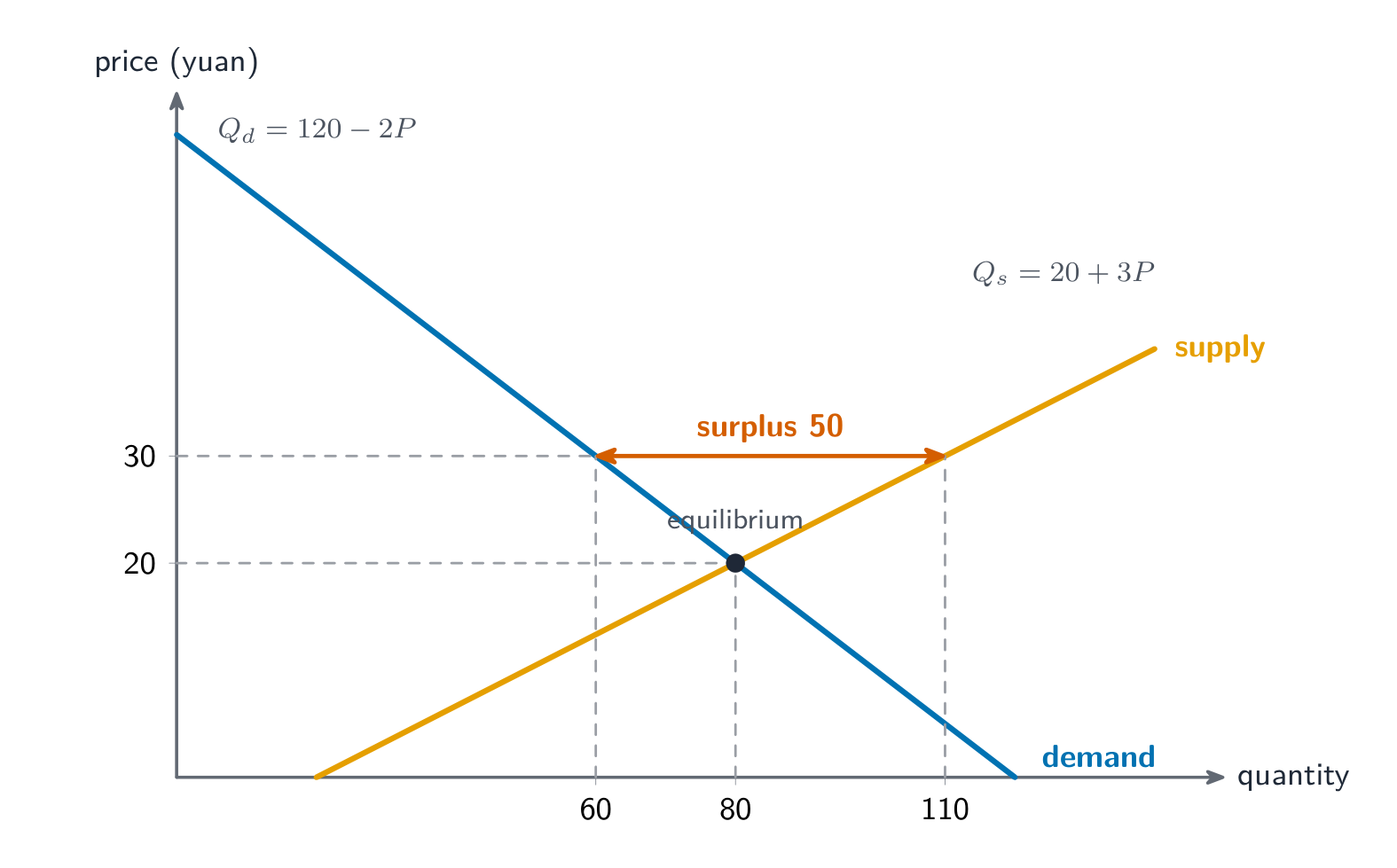
Worked example: find the equilibrium
Demand is $Q_d = 120 - 2P$ and supply is $Q_s = 20 + 3P$.
- Equilibrium needs $Q_d = Q_s$, so $120 - 2P = 20 + 3P$.
- Rearrange: $100 = 5P$, so $P = 20$.
- Quantity: $Q_d = 120 - 2(20) = 80$; check $Q_s = 20 + 3(20) = 80$ ✓.
Where the two schedules agree
Qd = 120 − 2P and Qs = 20 + 3P. Setting them equal gives 100 = 5P, so P = 20 and Q = 80. Read the rows: at 10 there is a shortage and at 30 a surplus.
Demand is $Q_d = 90 - 3P$ and supply is $Q_s = 10 + 2P$. Find the equilibrium price.
Difficulté 2/5 · 140 pièces + un petit bonus lors de la première réussite aujourd'hui
$90 - 3P = 10 + 2P$, so $80 = 5P$ et $P = 16$. Then $Q = 90 - 48 = 42$.
Away from equilibrium, the price moves
- At $P = 10$: $Q_d = 100$ but $Q_s = 50$. There is excess demand 超额需求 of $50$ units.
- Buyers compete for scarce units, so the price rises. As it rises, $Q_d$ falls and $Q_s$ grows until they meet at $P = 20$.
- Above $P = 20$ the opposite happens: excess supply 超额供给 pushes the price down.
With $Q_d = 90 - 3P$ et $Q_s = 10 + 2P$, what is the excess demand at $P = 10$?
Difficulté 2/5 · 140 pièces + un petit bonus lors de la première réussite aujourd'hui
$Q_d = 60$ et $Q_s = 30$, so excess demand is $60 - 30 = 30$ units. The price will rise towards 16.
Back to pork: a supply shift
- Swine fever shifted pork supply to the left. At the old price there was now excess demand.
- The price rose to a new, higher equilibrium, and the quantity sold fell.
- Some buyers switched to chicken and beef, so their demand curves shifted right and their prices rose too.
A supply shock in the pork market
Drag the supply shock to the right. Supply shifts left, the price rises and the quantity sold falls.
Swine fever shifts pork supply to the left. What happens at the new equilibrium?
Difficulté 1/5 · 100 pièces + un petit bonus lors de la première réussite aujourd'hui
Less is offered at every price, so the price is bid up and buyers move along demand to a smaller quantity.
When the pork price rose, the demand curve for chicken shifted to the right.
Difficulté 1/5 · 100 pièces + un petit bonus lors de la première réussite aujourd'hui
Chicken is a substitute. A higher pork price is a non-price factor for chicken, so chicken demand shifts right.
"The price rose, so demand fell" is the classic mistake. A rise in the pork price does not shift the demand curve. Buyers move along the same curve to a smaller quantity demanded. Only a non-price factor — income, tastes, the price of a substitute — shifts demand.
What the rest of topic 1 adds
- Why consumers choose as they do, and how strongly they respond to price: price elasticity of demand 需求价格弹性.
- What decides supply and how fast it can respond.
- How taxes and subsidies move the equilibrium, and who really pays.
Put the steps of a market's adjustment to a supply fall in order.
Difficulté 3/5 · 200 pièces + un petit bonus lors de la première réussite aujourd'hui
A shortage at the old price drives the price up until the two quantities are equal again.
A market price is set where buyers' plans meet sellers' plans. A shortage pushes the price up and a surplus pushes it down until the plans agree. Price changes move along a curve; other factors shift it.