Votre plan d'apprentissage · Continuer · Réviser →
Speaking Part 3: the discussion
IntroduitVotre position enregistrée reste dans ce navigateur. Reprendre ne termine pas la leçon ni ne répond à ses questions.
Dans cette leçon
| English | Sens |
|---|---|
| anniversary/ˌænɪˈvɜːsəri/ | |
| summarise/ˈsʌməraɪz/ | |
| suggestion/səˈdʒestʃn/ | |
| disagree politely/ˌdɪsəˈɡriː pəˈlaɪtli/ | |
| interaction/ˌɪntəˈrækʃn/ | Communication or action in which people or things influence one another. |
Not a speech: a conversation
- Two candidates get the same task: plan the company's tenth-anniversary celebration. Candidate A talks for two minutes without stopping. Candidate B listens, agrees, disagrees politely and suggests something new.
- Candidate B scores higher on Interactive Communication. Part 3 tests how well you work with another person: suggest, respond, ask, and reach a decision together.
Why does Candidate B score higher in the example?
Difficulté 1/5 · 100 pièces + un petit bonus lors de la première réussite aujourd'hui
Part 3 rewards interaction, not long speeches.
The discussion task
| Preliminary | Vantage | Higher | |
|---|---|---|---|
| Task | a situation with pictures or written prompts | a business topic to discuss, with points | a short business situation with two discussion points |
| Talk together | about 2 minutes | about 3 minutes | most of the 7-minute part |
| Then | the examiner asks further questions on the theme | the same | the same |
- Imagine you are colleagues at work, facing a real decision. The opinions you give are your own.
- Aim to reach a decision, or at least to compare ideas and explain which you prefer.
Match each level with how long the candidates talk together.
Difficulté 2/5 · 140 pièces + un petit bonus lors de la première réussite aujourd'hui
Then the examiner asks further questions on the same theme.
In Part 3 you must pretend to have opinions you don't really hold.
Difficulté 1/5 · 100 pièces + un petit bonus lors de la première réussite aujourd'hui
You imagine a work situation, but the opinions you express are your own.
The conversation cycle
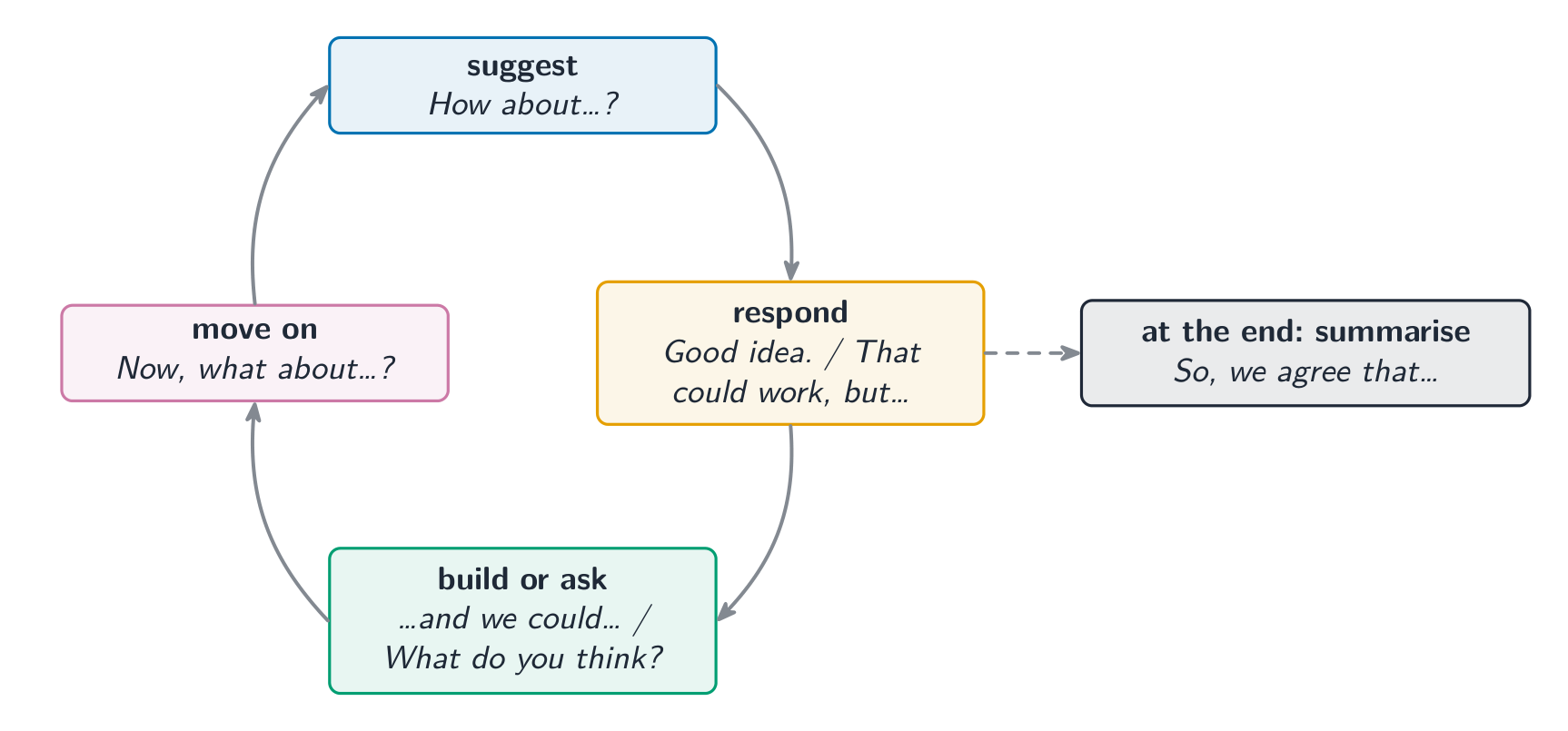
- Suggest → respond → build or ask → move on. Keep the turns short so the conversation goes back and forth.
- At the end, summarise: "So we agree that…". It shows you have reached a decision.
Put the conversation cycle in order.
Difficulté 3/5 · 200 pièces + un petit bonus lors de la première réussite aujourd'hui
Then repeat, and summarise at the end.
Listen: a model discussion
- Wei and Lucy plan the company's anniversary. Listen for suggestions, polite disagreement and the summary.
Transcript
Wei: So, we need to decide how to celebrate the company's tenth anniversary. Shall we start with the type of event? Lucy: Yes, good idea. What do you think about a dinner at a hotel? Wei: That could work, but it might be quite expensive for two hundred people. How about a party in our own building instead? Lucy: Hmm, I see what you mean about the cost. But our building isn't really big enough, is it? Wei: That's true. What about hiring a park for an afternoon? Families could come too. Lucy: I like that. It's cheaper than a hotel, and the staff's families would enjoy it. What about the weather, though? Wei: We could hold it in June, when it's usually dry, and book a large tent just in case. Lucy: OK, so we agree: a family afternoon in a park in June, with a tent. Now, who should we invite apart from staff?
Listen. Why does Wei not want a dinner at a hotel?
Difficulté 1/5 · 100 pièces + un petit bonus lors de la première réussite aujourd'hui
"That could work, but it might be quite expensive for two hundred people."
What do they decide?
Difficulté 1/5 · 100 pièces + un petit bonus lors de la première réussite aujourd'hui
"OK, so we agree: a family afternoon in a park in June, with a tent."
Language for working together
| Job | Phrases |
|---|---|
| Suggest | How about…? · What about…ing? · Shall we…? · Why don't we…? |
| Ask your partner | What do you think? · Do you agree? · …, don't you think? |
| Agree | Good idea. · I agree. · That's a good point. |
| Disagree politely | That could work, but… · I see what you mean, but… · I'm not sure about that, because… |
| Move on and summarise | Now, what about…? · So, we agree that… |
- Polite disagreement is not rude: it makes the conversation interesting. Always add a reason.
Match each phrase with its job.
Difficulté 2/5 · 140 pièces + un petit bonus lors de la première réussite aujourd'hui
A small set of phrases covers every move in the discussion.
Which is the best way to disagree?
Difficulté 1/5 · 100 pièces + un petit bonus lors de la première réussite aujourd'hui
Acknowledge the idea, then give your reason.
What lowers the Part 3 mark
- Long monologues. If you speak for a minute without stopping, your partner can't take part, and you lose interaction marks.
- Only agreeing. "Yes. Yes. I agree." gives the examiner nothing. Agree and add an idea.
- Ignoring what your partner said. Respond to their words: "I see what you mean about the cost, but…"
Saying "Yes, I agree" to everything your partner says is a good strategy.
Difficulté 1/5 · 100 pièces + un petit bonus lors de la première réussite aujourd'hui
Agree and add an idea, a reason or a question.
The three rules of Part 3
- Short turns, many of them: suggest, respond, ask.
- Disagree politely, with a reason: That could work, but…
- Finish with a decision: So, we agree that…
Your partner says: "I think we should give every customer a free gift at the trade fair." Record your reply: respond politely, give your view with a reason, and add a suggestion or a question.
Replay and check that your partner could easily answer you. If not, end with a question.
Que s’est-il passé ? Seule l’équipe du site voit ces informations.