Higher Tier, Chemistry-only: gas volumes at room temperature and pressure
Introduit| English | Sens |
|---|---|
| molar gas volume/ˈməʊlə ɡæs ˈvɒljuːm/ | volume molaire gazeux |
| room temperature and pressure/ruːm ˈtemprɪtʃə ænd ˈpreʃə/ | température et pression ambiantes |
How big is the airbag?
- A car airbag fills in about 30 milliseconds with nitrogen gas from a chemical reaction. Engineers must make exactly enough gas to fill it.
- For gases, there is a shortcut: the volume depends only on the number of moles, not on which gas it is.
- This lesson is Higher Tier.
The molar gas volume
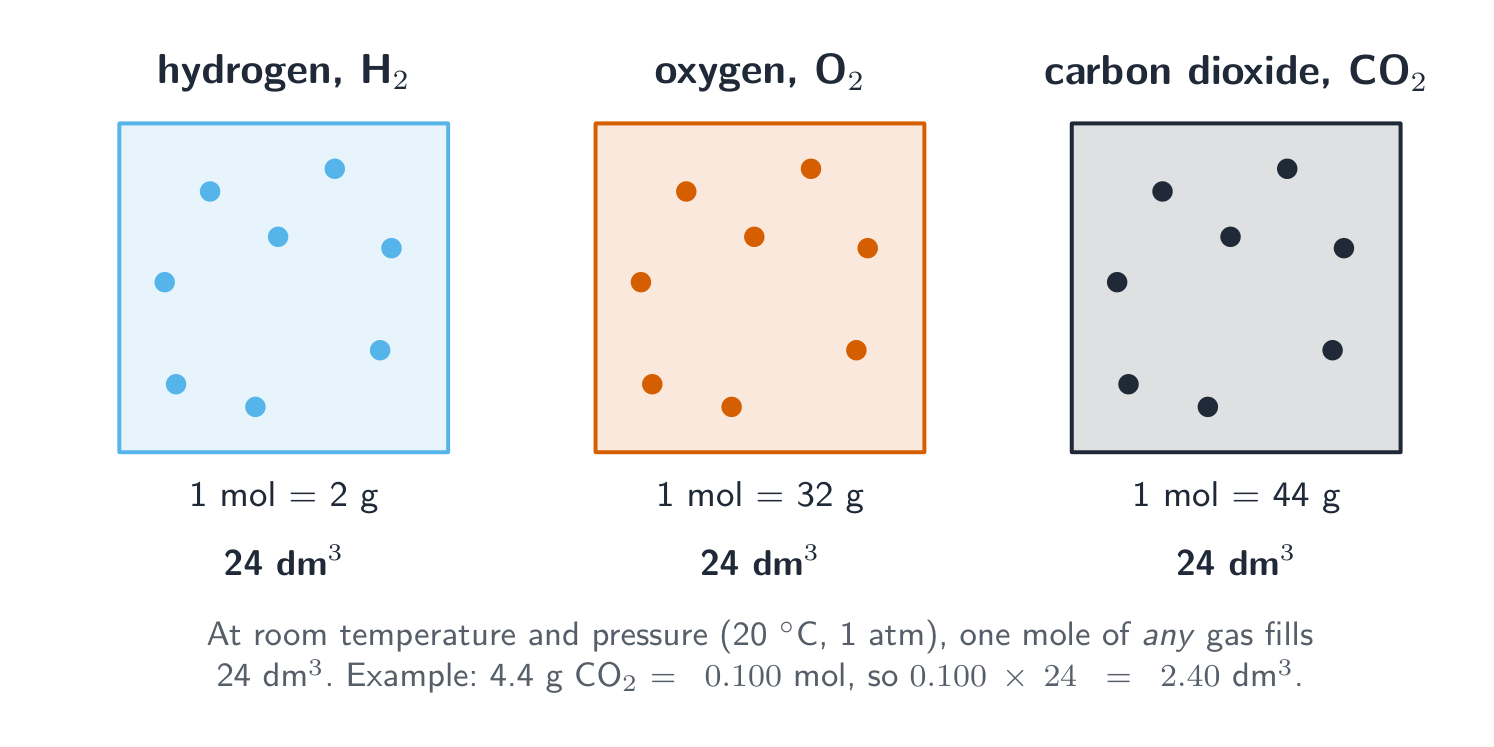
- At room temperature and pressure 室温室压 (RTP, 20 °C and 1 atmosphere), one mole of any gas occupies 24 dm³.
- This is the molar gas volume 气体摩尔体积.
What does RTP stand for?
Difficulté 1/5 · 100 pièces + un petit bonus lors de la première réussite aujourd'hui
20 °C and 1 atmosphere.
Two formulas
- Volume of gas (dm³) $= \text{moles} \times 24$.
- Moles $= \dfrac{\text{volume (dm}^3)}{24}$, or $\dfrac{\text{volume (cm}^3)}{24\,000}$.
What volume does 0.25 mol of oxygen occupy at RTP?
Difficulté 2/5 · 140 pièces + un petit bonus lors de la première réussite aujourd'hui
$0.25 \times 24 = 6.0$ dm³.
How many moles are in 480 cm³ of hydrogen at RTP?
Difficulté 2/5 · 140 pièces + un petit bonus lors de la première réussite aujourd'hui
$\dfrac{480}{24\,000} = 0.020$ mol.
Worked example: carbon dioxide
What volume does 4.4 g of CO₂ ($M_r$ 44) occupy at RTP?
- Moles $= \dfrac{4.4}{44} = 0.100$ mol.
- Volume $= 0.100 \times 24 = 2.40$ dm³.
One mole of any gas fills 24 dm³ at RTP
4.4 g CO₂ is 0.100 mol, so at room temperature and pressure it occupies 0.100 × 24 = 2.40 dm³.
What volume does 3.2 g of O₂ ($M_r$ 32) occupy at RTP?
Difficulté 2/5 · 140 pièces + un petit bonus lors de la première réussite aujourd'hui
0.100 mol × 24 = 2.40 dm³.
Gas volumes from equations
- Because equal moles have equal volumes, the mole ratio is also the volume ratio for gases.
- $2\text{H}_2 + \text{O}_2 \rightarrow 2\text{H}_2\text{O}$: 100 cm³ of H₂ reacts with 50 cm³ of O₂.
In $\text{N}_2 + 3\text{H}_2 \rightarrow 2\text{NH}_3$, what volume of H₂ reacts with 40 cm³ of N₂?
Difficulté 2/5 · 140 pièces + un petit bonus lors de la première réussite aujourd'hui
Volume ratio 1 : 3.
Worked example: gas from a reaction
What volume of hydrogen, in cm³, forms when 0.65 g of zinc ($A_r$ 65) reacts with excess acid at RTP? $\text{Zn} + 2\text{HCl} \rightarrow \text{ZnCl}_2 + \text{H}_2$
- Moles of Zn $= \dfrac{0.65}{65} = 0.0100$ mol.
- Ratio Zn : H₂ $= 1 : 1$, so 0.0100 mol H₂.
- Volume $= 0.0100 \times 24\,000 = 240$ cm³.
What volume of hydrogen, in cm³, forms at RTP when 1.2 g of magnesium (Ar 24) reacts with excess acid? Mg + 2HCl → MgCl₂ + H₂
Difficulté 2/5 · 140 pièces + un petit bonus lors de la première réussite aujourd'hui
1.2 ÷ 24 = 0.050 mol Mg → 0.050 mol H₂ → 0.050 × 24 000 = 1200 cm³.
Calcium carbonate decomposes: CaCO₃ → CaO + CO₂. What mass of CaCO₃ (Mr 100), in g, gives 480 cm³ of CO₂ at RTP?
Difficulté 2/5 · 140 pièces + un petit bonus lors de la première réussite aujourd'hui
480 ÷ 24 000 = 0.0200 mol CO₂ = 0.0200 mol CaCO₃ → 0.0200 × 100 = 2.00 g.
A heavier gas does not take up more space. 2 g of hydrogen (1 mol) and 44 g of carbon dioxide (1 mol) both fill 24 dm³ at RTP. Gas particles are tiny compared with the space between them.
At RTP, 1 mol of CO₂ occupies more volume than 1 mol of H₂ because it is heavier.
Difficulté 1/5 · 100 pièces + un petit bonus lors de la première réussite aujourd'hui
Both occupy 24 dm³.
At room temperature and pressure, one mole of any gas occupies 24 dm³. Volume = moles × 24, and in equations the mole ratio of gases is also their volume ratio.
Calculate the volume of CO₂ at RTP made when 10.0 g of CaCO₃ ($M_r$ 100) is heated: $\text{CaCO}_3 \rightarrow \text{CaO} + \text{CO}_2$.
Moles × 24.