Higher Tier: derive balancing numbers from reacting masses
Introduit| English | Sens |
|---|---|
| reacting masses | The masses of reactants and products in a reaction. |
| balancing numbers | The numbers placed in front of formulae to balance an equation. |
Finding the equation from the balance
- A chemist burns 5.4 g of aluminium powder and collects 10.2 g of white aluminium oxide. 4.8 g of oxygen was used.
- From these three masses alone, the balanced equation can be worked out.
- This lesson is Higher Tier.
Masses are not the ratio
- Reacting masses 反应质量 depend on how heavy each particle is, so they do not show the equation directly.
- Convert each mass to moles: the mole ratio gives the balancing numbers 配平系数.
Why must reacting masses be converted to moles before writing the ratio?
Difficulté 1/5 · 100 pièces + un petit bonus lors de la première réussite aujourd'hui
The equation counts particles.
Four steps
- 1. Moles of each substance: $n = \dfrac{m}{M_r}$.
- 2. Divide each by the smallest number of moles.
- 3. If any result is not a whole number, multiply all by the same factor.
- 4. Write the equation with these numbers.
Put the steps in order.
Difficulté 3/5 · 200 pièces + un petit bonus lors de la première réussite aujourd'hui
Moles first, then simplify.
Worked example: burning aluminium
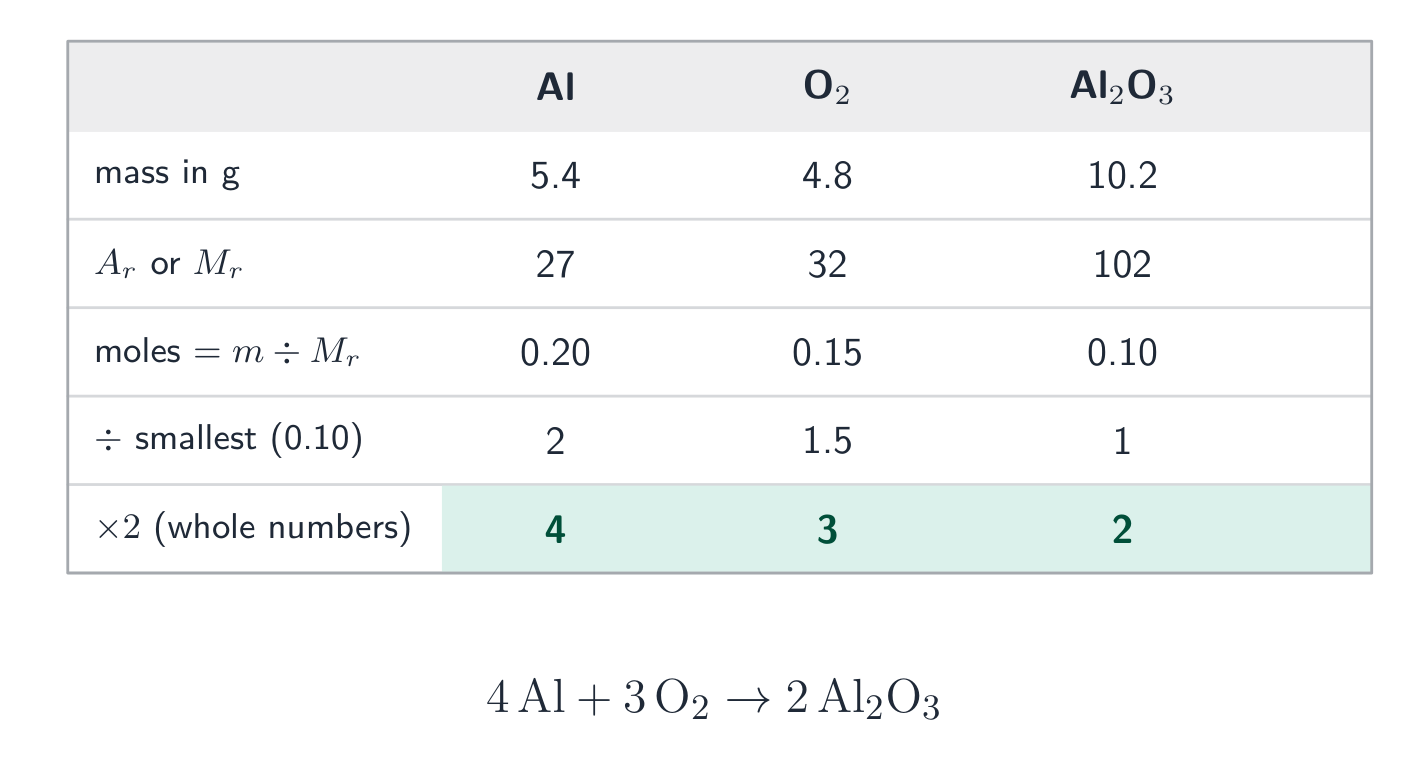
5.4 g Al, 4.8 g O₂ and 10.2 g Al₂O₃. ($A_r$ Al 27; $M_r$ O₂ 32, Al₂O₃ 102)
- Moles: Al $= \dfrac{5.4}{27} = 0.20$; O₂ $= \dfrac{4.8}{32} = 0.15$; Al₂O₃ $= \dfrac{10.2}{102} = 0.10$.
- Divide by 0.10: 2 : 1.5 : 1. Double: 4 : 3 : 2.
- Equation: $4\text{Al} + 3\text{O}_2 \rightarrow 2\text{Al}_2\text{O}_3$.
Balancing numbers from reacting masses
5.4 g Al, 4.8 g O₂ and 10.2 g Al₂O₃ are 0.20, 0.15 and 0.10 mol: the ratio 2 : 1.5 : 1, doubled to 4 : 3 : 2.
How many moles are in 8.1 g of aluminium ($A_r$ 27)?
Difficulté 2/5 · 140 pièces + un petit bonus lors de la première réussite aujourd'hui
$\dfrac{8.1}{27} = 0.30$ mol.
A mole ratio simplifies to 1 : 1.5 : 1. What are the balancing numbers?
Difficulté 1/5 · 100 pièces + un petit bonus lors de la première réussite aujourd'hui
Double every term.
Check by counting atoms
- Left: 4 Al and 6 O. Right: $2 \times 2 = 4$ Al and $2 \times 3 = 6$ O. Balanced.
- Mass check: $5.4 + 4.8 = 10.2$ g, so mass is conserved too.
2.4 g Mg (Ar 24) reacts with 1.6 g O₂ (Mr 32) to make 4.0 g MgO (Mr 40). What is the balanced equation?
Difficulté 1/5 · 100 pièces + un petit bonus lors de la première réussite aujourd'hui
0.10 : 0.05 : 0.10 = 2 : 1 : 2.
Don't stop at 2 : 1.5 : 1. Balancing numbers must be whole numbers, because you cannot have half a molecule in an equation. Multiply every term by the same factor.
A balancing number of 1.5 is acceptable in a final equation.
Difficulté 1/5 · 100 pièces + un petit bonus lors de la première réussite aujourd'hui
Scale to whole numbers.
To find balancing numbers from masses, convert every mass to moles, divide by the smallest, and scale to whole numbers. Check the result by counting atoms on each side.
4.6 g of sodium (Ar 23) reacts with 1.6 g of oxygen (O₂, Mr 32) to make 6.2 g of Na₂O (Mr 62). Find the balanced equation.
Moles, divide, scale.