Energy transfers: explain warming and cooling
Introduit| English | Sens |
|---|---|
| surroundings/səˈraʊndɪŋz/ | Everything outside the chosen reacting system that can exchange energy with it. |
| exothermic/eɡzəˈðɜːmɪk/ | exothermique |
| endothermic/ˌendəʊˈθɜːmɪk/ | endothermique |
| reaction profile/rɪˈækʃn ˈprəʊfaɪl/ | A diagram of energy against the progress of a reaction, showing the reactants, products and activation energy. |
| activation energy/ˌæktɪˈveɪʃn ˈenədʒi/ | The minimum energy that reacting particles need for a successful reaction. |
Hand warmers and cold packs
- Snap a hand warmer and it heats up for an hour. Squeeze a sports cold pack and it turns icy in seconds. Both are chemical reactions, but energy moves in opposite directions.
- Energy is never made or destroyed in a reaction. It only moves between the reacting chemicals and their surroundings 周围环境: the water, the beaker, the air, your hand.
Exothermic: energy out
- An exothermic 放热 reaction transfers energy to the surroundings, so the temperature of the surroundings rises.
- Examples: combustion (burning fuels), most oxidation reactions, and neutralisation (acid + alkali). Hand warmers use the oxidation of iron.
Exothermic: products end lower, the surroundings warm
A reaction that warms its surroundings (21.0 → 28.5 °C) has products at a lower energy than its reactants. The energy is transferred to the surroundings, not destroyed.
The temperature of a solution rises from 20 °C to 31 °C during a reaction. What kind of reaction is it?
Difficulté 1/5 · 100 pièces + un petit bonus lors de la première réussite aujourd'hui
The surroundings warmed up, so energy was transferred out of the reacting chemicals.
Endothermic: energy in
- An endothermic 吸热 reaction takes energy from the surroundings, so the temperature of the surroundings falls.
- Examples: thermal decomposition (such as heating calcium carbonate), and citric acid reacting with sodium hydrogencarbonate. Some cold packs use dissolving ammonium nitrate.
Match each reaction to its type.
Difficulté 2/5 · 140 pièces + un petit bonus lors de la première réussite aujourd'hui
Combustion and neutralisation give energy out; thermal decomposition and the citric acid reaction take energy in.
Reaction profiles
- A reaction profile 反应历程图 shows the energy of the reactants and products. In an exothermic reaction the products are lower; in an endothermic reaction they are higher.
- The hump is the activation energy 活化能: the minimum energy particles need to react when they collide. Both kinds of reaction have one.
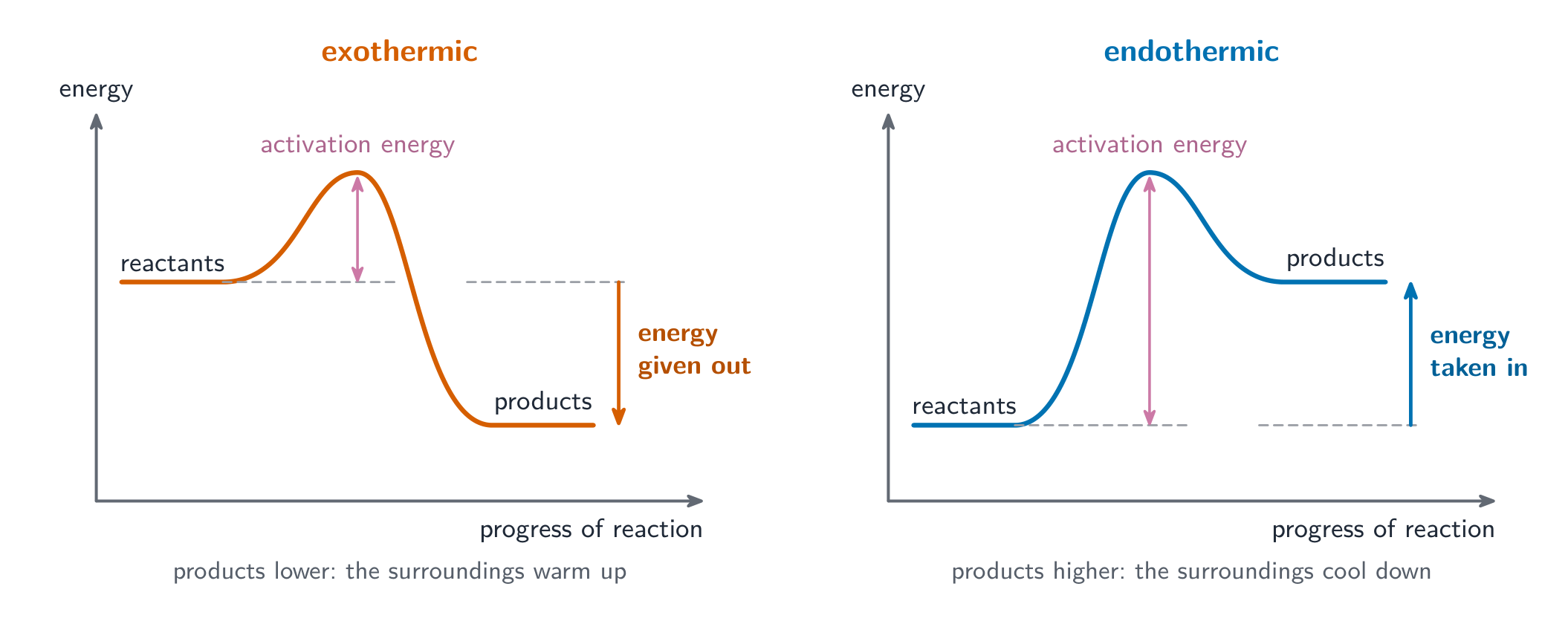
On a reaction profile the products are higher in energy than the reactants. What does this show?
Difficulté 1/5 · 100 pièces + un petit bonus lors de la première réussite aujourd'hui
The products have gained energy from the surroundings.
The minimum energy that colliding particles need in order to react is the ________ energy.
Difficulté 1/5 · 100 pièces + un petit bonus lors de la première réussite aujourd'hui
It is the hump on the reaction profile.
Measuring the change (Required Practical 4)
- Put the solution in a polystyrene cup with a lid (insulation cuts energy loss). Record the starting temperature, add the second reactant, stir, and record the highest or lowest temperature.
- Temperature change $=$ final $-$ starting temperature. A positive change means exothermic; a negative change means endothermic.
Two reactions are tested in insulated cups.
- A: starts at $21.0\,^\circ\text{C}$, reaches $28.5\,^\circ\text{C}$. Change $=28.5-21.0=+7.5\,^\circ\text{C}$: exothermic.
- B: starts at $22.0\,^\circ\text{C}$, falls to $17.0\,^\circ\text{C}$. Change $=17.0-22.0=-5.0\,^\circ\text{C}$: endothermic.
A reaction starts at 19.5 °C and ends at 27.0 °C. Find the temperature change in °C.
Difficulté 2/5 · 140 pièces + un petit bonus lors de la première réussite aujourd'hui
$27.0-19.5=+7.5\,^\circ\text{C}$, so the reaction is exothermic.
A reaction starts at 22.5 °C and ends at 16.0 °C. Find the temperature change in °C (include the sign).
Difficulté 2/5 · 140 pièces + un petit bonus lors de la première réussite aujourd'hui
$16.0-22.5=-6.5\,^\circ\text{C}$, so the reaction is endothermic.
A fair investigation
- To see how one variable, such as the mass of a metal powder, affects the temperature change, keep the volume and concentration of acid, the cup and the starting temperature the same.
- Repeat each measurement and find the mean. Energy still escapes through the cup, so the measured change is a little smaller than the true one.
Using a polystyrene cup with a lid makes the measured temperature change closer to the true value.
Difficulté 1/5 · 100 pièces + un petit bonus lors de la première réussite aujourd'hui
The insulation and lid reduce the energy lost to the air.
Choosing for a purpose
- Hand warmers and self-heating cans use exothermic reactions; instant cold packs use endothermic ones.
- A good product reaches a safe temperature, lasts long enough and does not leak. One that gets hotter is not better if it can burn skin.
"The reaction made energy" is wrong. Energy is transferred, never created or destroyed. And the thermometer measures the surroundings (the solution), so a temperature fall means the reaction took energy in.
Exothermic reactions give energy to the surroundings (temperature rises: combustion, oxidation, neutralisation). Endothermic reactions take energy from the surroundings (temperature falls: thermal decomposition, citric acid with sodium hydrogencarbonate). On a reaction profile, exothermic products are lower and endothermic products are higher; every reaction needs its activation energy.