Selecting Any Inference Procedure (Extension)
IntroduitThe whole toolbox
- This lesson reviews four taught inference families, including slope inference and goodness-of-fit as extensions beyond the revised AP exam.
- Proportions ($z$), means ($t$), chi-square (categorical counts), and slopes ($t$).
- The right choice comes from the type of data and the structure of the question.
- These are candidate methods; verify the design and method-specific assumptions before using them.
Start with the data type
- Categorical, and you want a proportion / count? → a $z$-procedure (proportions) or chi-square (tables).
- Quantitative average? → a $t$-procedure for means.
- Two quantitative variables, a linear trend? → slope $t$-inference.
- The data type narrows it to a family immediately.
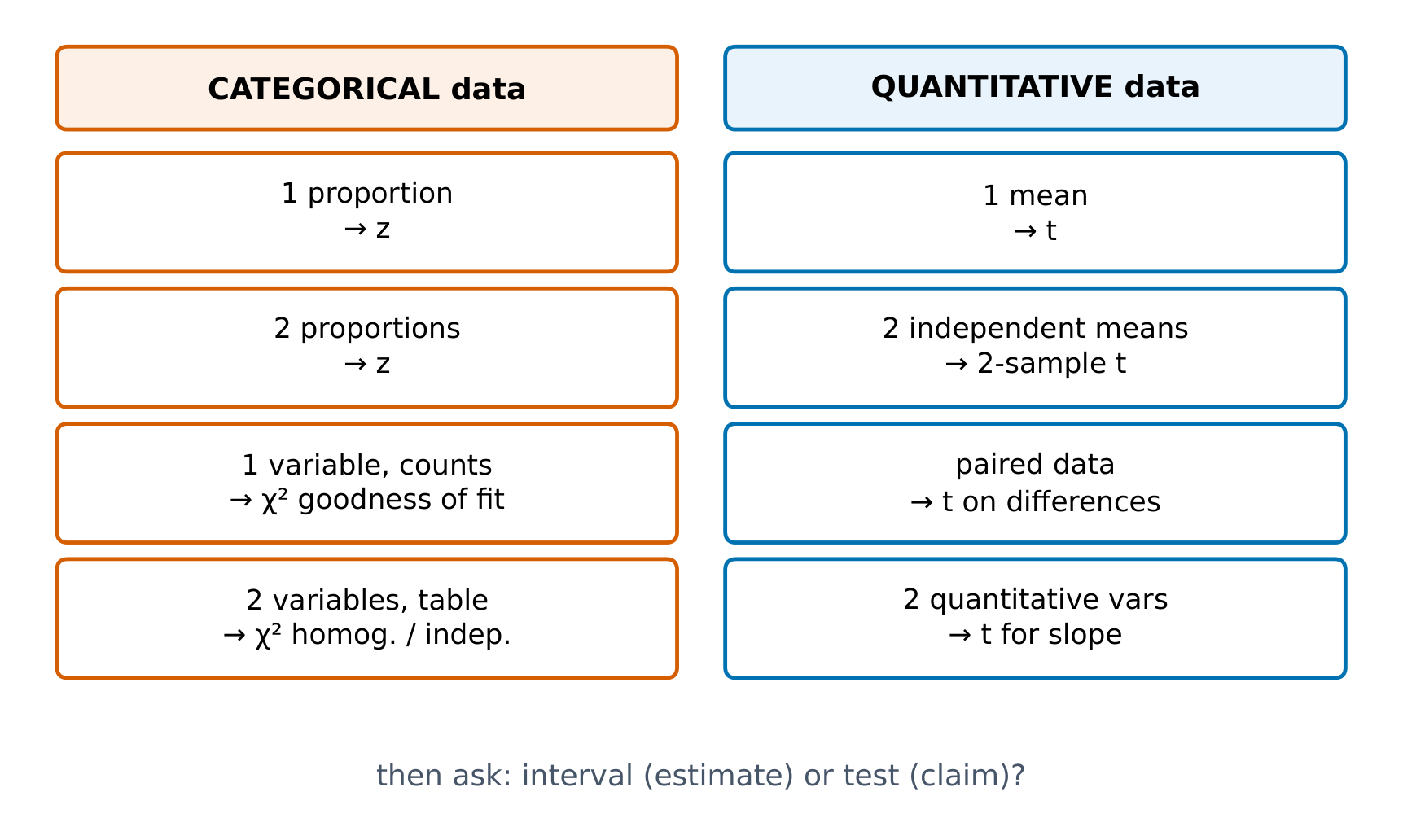
Choosing any inference procedure: type of data, number of groups, then estimate or test
Then count samples and variables
- One or two groups? Independent or paired?
- One categorical variable vs. a distribution → goodness-of-fit; two variables / several groups → homogeneity/independence.
- A relationship between two quantitative variables → slope inference.
- These structural questions pin down the exact procedure.
Implement and communicate
- Interval or test? — estimate a value, or judge a claim.
- State hypotheses/parameter, check conditions, compute, and conclude in context.
- Name the procedure and justify why the data fit it.
- Explain the method choice, conditions and contextual conclusion along with the calculation.
Two features decide everything: the DATA TYPE and the STRUCTURE. Categorical count → $z$-proportion or chi-square; quantitative average → $t$-mean; two quantitative variables' trend → slope $t$. Then: how many samples/variables, and interval or test. A wrong procedure can invalidate correct arithmetic; check both the method and the calculation.
"Is there a linear relationship between temperature and ice-cream sales?"
- Data: two quantitative variables; the question is about a linear trend.
- → slope $t$-inference (a test of $H_0: \beta = 0$, or an interval for $\beta$).
- (Had it compared mean sales on hot vs. cold days → a two-sample $t$; proportions of days → a $z$ or chi-square.)
Choose from all the course's methods by data type (proportion → $z$; mean → $t$; categorical table → chi-square; two quantitative variables' trend → slope $t$) and structure (samples, variables, interval-vs-test). Then implement fully and communicate the reasoning and conclusion clearly, in context.
Write from this case
- Both variables are quantitative.
- The question is whether the population slope is zero.
Two quantitative variables are recorded, and the question is whether the population linear regression slope is zero. Which taught inference procedure is a candidate?
Match a slope question to regression inference.
Which procedure fits a slope question?
Difficulté 1/5 · 100 pièces + un petit bonus lors de la première réussite aujourd'hui
Two quantitative variables and a slope mean regression t.
One family among many
Two quantitative variables' trend → slope t-inference.
A question about a linear relationship between two quantitative variables calls for...
Difficulté 1/5 · 100 pièces + un petit bonus lors de la première réussite aujourd'hui
Two quantitative variables + a trend → slope inference.
Comparing the mean of a measured quantity for two independent groups calls for...
Difficulté 1/5 · 100 pièces + un petit bonus lors de la première réussite aujourd'hui
Measured average, two independent groups → two-sample t.
Two categorical variables in one sample, testing association, calls for...
Difficulté 1/5 · 100 pièces + un petit bonus lors de la première réussite aujourd'hui
Two categorical variables, one sample → independence.
Which questions help you pick the right inference procedure?
Difficulté 2/5 · 140 pièces + un petit bonus lors de la première réussite aujourd'hui
Data type, structure, and goal — not the graph's color.
Choosing an inference procedure that does not fit the study design can invalidate a conclusion even when the arithmetic is correct.
Difficulté 1/5 · 100 pièces + un petit bonus lors de la première réussite aujourd'hui
The method must match the parameter, purpose and study design, and its assumptions must be checked.