Difference of Two Proportions
Introduit| English | Sens |
|---|---|
| difference of two sample proportions/ˈdɪfrəns ɒv tuː ˈsæmpl prəˈpɔːʃnz/ | différence de deux proportions d'échantillons |
Could the sample show the wrong winner?
- In a city, 55% of adults in District A support a new park, but only 45% in District B. A newspaper surveys a random sample from each district. Could its samples show B ahead, just by chance?
- To answer, we need the sampling distribution of the difference of two sample proportions 两个样本比例之差, $\hat p_1-\hat p_2$: all the values the difference could take over many pairs of random samples.
Center: the true difference
- Over many pairs of samples, $\hat p_1-\hat p_2$ is centred on the true difference:
- In the park example, $\mu = 0.55-0.45 = 0.10$. Some pairs of samples give a bigger gap and some a smaller one, but on average the gap is $0.10$.
p1=0.5, p2=0.4. Find the center (mean) of p-hat-1 − p-hat-2.
Difficulté 2/5 · 140 pièces + un petit bonus lors de la première réussite aujourd'hui
Mean = p1 − p2 = 0.5 − 0.4 = 0.1.
Spread: the variances add
- Each sample proportion varies on its own, so the difference varies more than either one. The variances add, even though we subtract the proportions:
- This formula assumes independent samples (or sampling with replacement). Sampling without replacement makes the true SD a little smaller, but if each sample is less than 10% of its population, the difference is negligible.
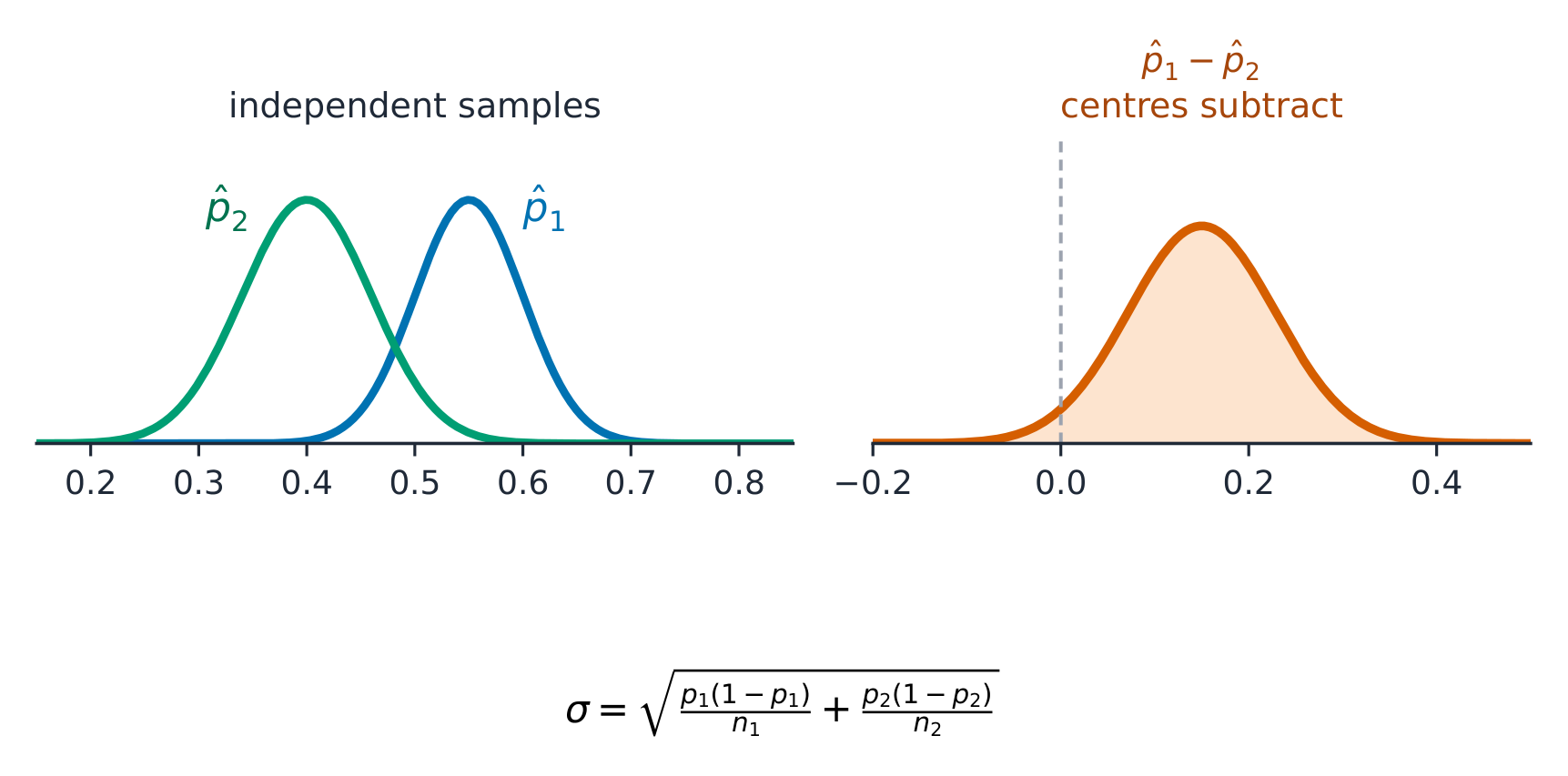
Distribution of p-hat-1 − p-hat-2
Centered at p1 − p2; the two variances add under the square root.
With p1=0.5,n1=100 and p2=0.4,n2=100: SD = √(0.0025+0.0024). Round to two decimals.
Difficulté 2/5 · 140 pièces + un petit bonus lors de la première réussite aujourd'hui
√0.0049 = 0.07.
To get the SD of a difference of two proportions, you subtract the two variances.
Difficulté 1/5 · 100 pièces + un petit bonus lors de la première réussite aujourd'hui
Variances ADD, even for a difference, then square-root.
The two samples must be independent of each other for this model.
Difficulté 1/5 · 100 pièces + un petit bonus lors de la première réussite aujourd'hui
Independence between samples is required.
When is it approximately normal?
- Large counts: check all four counts, with the population proportions:
- If any count is below 10, the distribution may be skewed, and a normal model can give wrong probabilities.
For a normal model of p-hat-1 − p-hat-2, the large counts condition must hold...
Difficulté 1/5 · 100 pièces + un petit bonus lors de la première réussite aujourd'hui
All four counts (both groups) must be ≥ 10.
Random samples: $n_1=80$ with $p_1=0.9$, and $n_2=120$ with $p_2=0.5$. Can the distribution of $\hat p_1-\hat p_2$ be modelled as approximately normal?
Difficulté 1/5 · 100 pièces + un petit bonus lors de la première réussite aujourd'hui
All four counts must be at least 10. $80(0.1)=8$ fails, so the shape may be skewed. Unequal sample sizes are fine.
Worked example: the full method
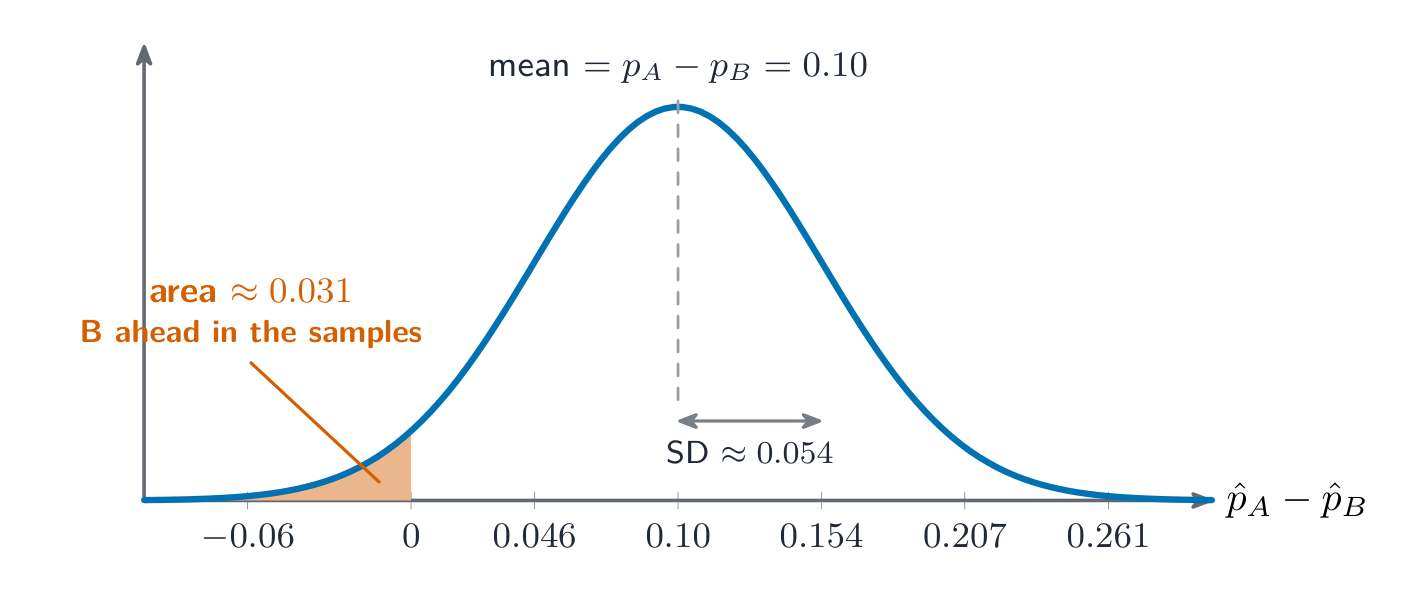
District A: $p_A = 0.55$, random sample $n_A = 200$. District B: $p_B = 0.45$, independent random sample $n_B = 150$. Each district has more than 10 000 adults. Find the probability that the samples show B ahead, $\hat p_A-\hat p_B<0$.
- Mean: $0.55-0.45=0.10$.
- SD: $\sqrt{\dfrac{0.55(0.45)}{200}+\dfrac{0.45(0.55)}{150}}=\sqrt{0.0012375+0.00165}\approx 0.0537$.
- Conditions: $200(0.55)=110$, $200(0.45)=90$, $150(0.45)=67.5$, $150(0.55)=82.5$, all $\ge 10$, so approximately normal. $200<10\%$ of 10 000 and $150<10\%$ of 10 000, so the SD formula is accurate.
- Standardize: $z=\dfrac{0-0.10}{0.0537}\approx -1.86$.
- Probability: $P(z<-1.86)\approx 0.031$ (calculator: normalcdf with lower $-1000$, upper $0$, mean $0.10$, SD $0.0537$).
- Conclusion in context: there is about a 3.1% chance that the random samples would show District B with higher support, even though A truly leads by 10 points.
$p_1=0.30$, $n_1=100$ et $p_2=0.20$, $n_2=100$ (independent random samples from large populations). Find $P(\hat p_1-\hat p_2>0.15)$. Give 3 decimal places.
Difficulté 2/5 · 140 pièces + un petit bonus lors de la première réussite aujourd'hui
Moyenne $=0.10$. SD $=\sqrt{0.0021+0.0016}=\sqrt{0.0037}\approx0.0608$. $z=(0.15-0.10)/0.0608\approx0.82$, so $P(z>0.82)\approx0.206$ (counts 30, 70, 20, 80 are all at least 10).
Interpreting the mean and SD in context
- Mean: "If we took many pairs of random samples, the difference (A − B) in the sample proportions who support the park would average 0.10."
- SD: "The difference in sample proportions typically varies by about 0.054 from the true difference of 0.10." Always name the populations and the variable; a bare number does not score.
In the park example the SD of $\hat p_A-\hat p_B$ is 0.054. Write one sentence interpreting it in context.
An SD interpretation needs the typical distance, the centre it is measured from, and the context.
How an FRQ is scored
An answer like the worked example earns full credit when it shows:
- Model named, with parameters: "approximately normal, mean 0.10, SD 0.0537". Calculator syntax alone, without labelled values, loses this point.
- Conditions checked with numbers: all four large counts, plus the 10% condition.
- Correct probability with a context sentence.
- Never subtract the variances. The SD of a difference uses a + under the square root.
- Use $p$, not $\hat p$, in the large-counts check when the population proportions are given.
- Keep the order of subtraction fixed. If you define the difference as A − B, then "B ahead" means the difference is below 0.
- The 10% condition is about the SD formula; the large counts condition is about the normal shape. They check different things.
If the difference is defined as $\hat p_A-\hat p_B$, then the event "the samples show B ahead" is $\hat p_A-\hat p_B<0$.
Difficulté 1/5 · 100 pièces + un petit bonus lors de la première réussite aujourd'hui
B ahead means $\hat p_B>\hat p_A$, so A − B is negative.
For independent random samples, $\hat p_1-\hat p_2$ has mean $p_1-p_2$ and SD $\sqrt{\frac{p_1(1-p_1)}{n_1}+\frac{p_2(1-p_2)}{n_2}}$ (variances add; accurate when each sample is under 10% of its population). It is approximately normal when all four counts $n_1p_1,\ n_1(1-p_1),\ n_2p_2,\ n_2(1-p_2)$ are at least 10. Interpret the mean and SD in context.