Sampling Distribution of p-hat
Introduit| English | Sens |
|---|---|
| sample proportion/ˈsæmpl prəˈpɔːʃn/ | proportion de l'échantillon |
| large counts condition/lɑːdʒ kaʊnts kənˈdɪʃn/ | condition des grands effectifs |
| 10% condition/ten pəˈsent kənˈdɪʃn/ | condition du 10 % |
The distribution of p-hat
- A sample proportion 样本比例 $\hat{p}$ estimates the true population proportion $p$.
- Its sampling distribution is centered at $p$: $\mu_{\hat{p}} = p$ (so $\hat{p}$ is unbiased).
- Different samples give different $\hat{p}$ — the spread is what we quantify next.
- Under the right conditions, this distribution is approximately normal.
Its standard deviation
- For independent random trials with the same success probability $p$, the standard deviation of $\hat{p}$ is:
-
$$\sigma_{\hat{p}} = \sqrt{\frac{p(1-p)}{n}}$$
- Bigger $n$ → smaller spread → a more precise estimate (the $\sqrt{n}$ in the bottom).
- This measures the typical distance of $\hat{p}$ from the true $p$.
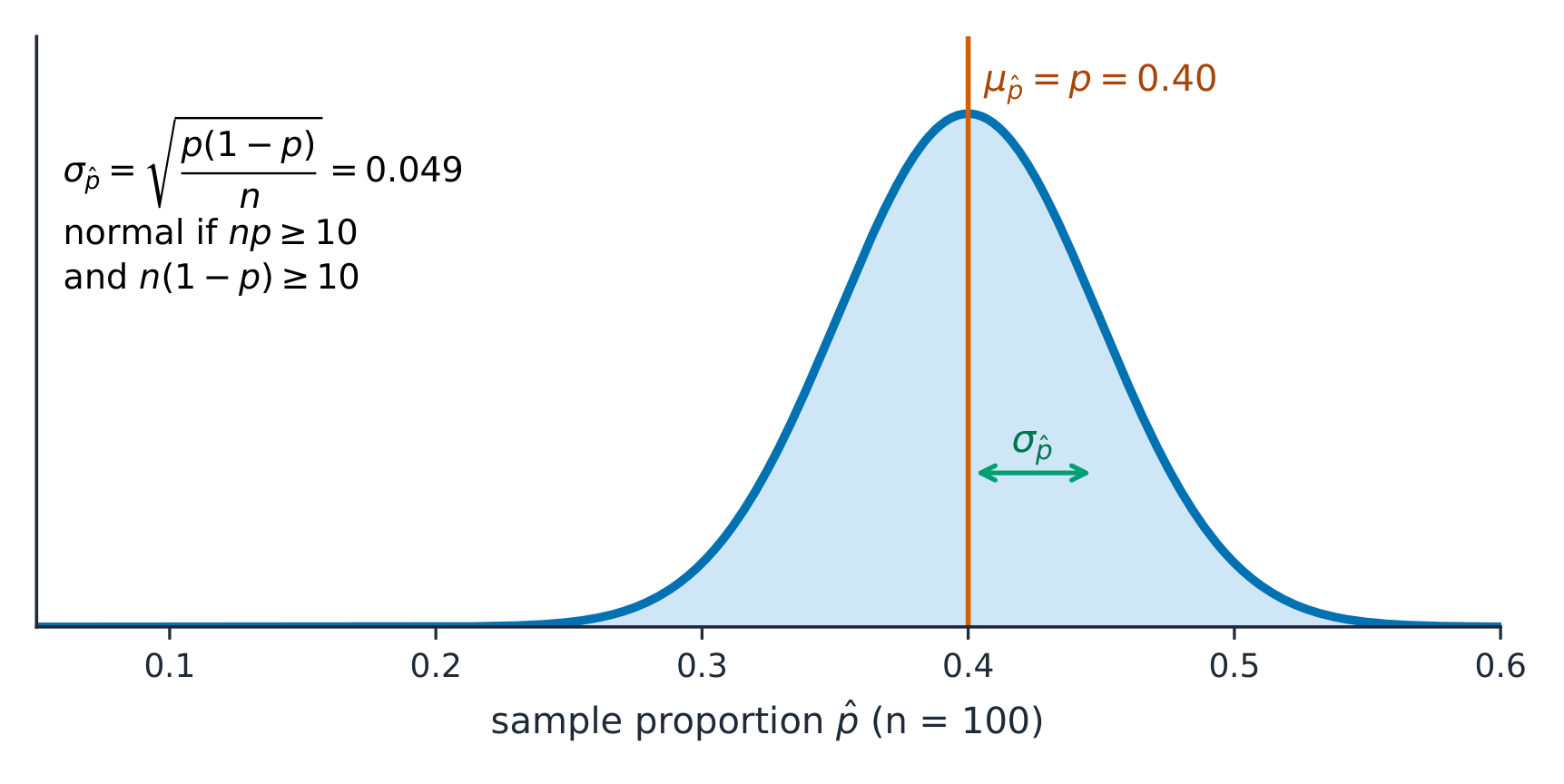
The sampling distribution of p̂ is centred at p with standard deviation √(p(1−p)/n)
The large counts condition
- To use a normal model for $\hat{p}$, check the large counts condition 大计数条件:
-
$$np \ge 10 \quad\text{and}\quad n(1-p) \ge 10$$
- In words: expect at least $10$ successes and at least $10$ failures.
- If either count is under $10$, this guideline does not justify a normal approximation; use a suitable discrete model.
The 10% condition
- When sampling without replacement, check the 10% condition 10%条件.
- The sample must be no more than $10\%$ of the population: $n \le 0.10 N$.
- This keeps the trials "close enough" to independent for the SD formula to be a good approximation.
- A small slice of a big population barely changes as you draw.
Two different conditions do two different jobs. The large counts condition ($np\ge10$, $n(1-p)\ge10$) justifies the normal shape; the 10% condition ($n\le0.10N$) justifies the independence behind the SD formula. Check both before modeling $\hat{p}$ as normal — check the relevant sampling conditions before later inference.
$p = 0.4$ of a population supports a plan; you take a simple random sample of $n = 100$ from a population of at least $1000$.
- Center: $\mu_{\hat{p}} = 0.4$. SD: $\sqrt{\dfrac{0.4 \times 0.6}{100}} = \sqrt{0.0024} \approx 0.049$.
- Large counts: $np = 40 \ge 10$ and $n(1-p) = 60 \ge 10$. ✓ Normal is OK.
- 10%: fine as long as the population has at least $1000$ members, since $100 \le 0.10(1000)$.
The sample proportion $\hat{p}$ has $\mu_{\hat{p}} = p$ and $\sigma_{\hat{p}} = \sqrt{\frac{p(1-p)}{n}}$. Model it as normal when the large counts condition ($np\ge10$, $n(1-p)\ge10$) holds; when sampling without replacement, also check the 10% condition ($n \le 0.10N$).
Write from the data: find the standard deviation
- The population proportion is 0.2.
- An independent random sample has size 100.
For independent random trials with p = 0.2 and n = 100, find the standard deviation of the sample proportion and check large counts.
The standard deviation shrinks as the sample grows.
For independent random trials with p = 0.2 and n = 100, what is the standard deviation of p-hat?
Difficulté 1/5 · 100 pièces + un petit bonus lors de la première réussite aujourd'hui
The square root of 0.0016 is 0.04. Other options — 0.05 (the other setup); 0.2 (the population proportion).
The sampling distribution of p-hat
Centered at p, spread √(p(1−p)/n); normal under the large counts condition.
p = 0.4, n = 100. Find σ of p-hat = √(p(1−p)/n). Round to two decimals.
Difficulté 2/5 · 140 pièces + un petit bonus lors de la première réussite aujourd'hui
√(0.4·0.6/100) = √0.0024 ≈ 0.049 ≈ 0.05.
The large counts condition for a normal model of p-hat requires...
Difficulté 1/5 · 100 pièces + un petit bonus lors de la première réussite aujourd'hui
At least 10 expected successes AND 10 expected failures.
The mean of the sampling distribution of p-hat equals the true proportion p.
Difficulté 1/5 · 100 pièces + un petit bonus lors de la première réussite aujourd'hui
μ(p-hat) = p, so p-hat is unbiased.
When sampling without replacement, the 10% condition requires...
Difficulté 1/5 · 100 pièces + un petit bonus lors de la première réussite aujourd'hui
The sample must be at most 10% of the population.
Increasing n makes the standard deviation of p-hat smaller.
Difficulté 1/5 · 100 pièces + un petit bonus lors de la première réussite aujourd'hui
n is under the square root, so larger n → smaller spread.