Motivation
Introduit| English | Sens |
|---|---|
| intrinsic/ɪnˈtrɪnsɪk/ | coming from inside a person, such as doing a task because it is enjoyable |
| extrinsic/ekˈstrɪnsɪk/ | coming from outside a person, such as doing a task for a reward |
| drive-reduction theory/draɪv rɪˈdʌkʃn ˈθɪəri/ | the theory that biological needs create drives that push us to restore balance |
| arousal theory/əˈraʊzl ˈθɪəri/ | the theory that people are motivated to keep an optimal level of arousal |
| sensation-seeking theory/senˈseɪʃn ˈsiːkɪŋ ˈθɪəri/ | the theory that people differ in how much they seek new and intense experiences |
| self-determination theory/self dɪˌtɜːmɪˈneɪʃn ˈθɪəri/ | The theory that people are motivated by autonomy, competence and relatedness. |
| belongingness/bɪˈlɒŋɪŋnəs/ | the need to form and keep close, lasting relationships |
| Lewin's motivational conflicts theory/ˈluːɪnz ˌməʊtɪˈveɪʃənl ˈkɒnflɪkts ˈθɪəri/ | the theory naming approach–approach, avoidance–avoidance and approach–avoidance conflicts |
| approach-avoidance/əˈprəʊtʃ əˈvɔɪdəns/ | conflit approche-évitement |
Paid to play with puzzles, 1971
- In 1971 Edward Deci gave students a cube puzzle called Soma. One group was paid $1 for each puzzle solved; another was not paid. Then the experimenter left the room for eight minutes of free time. Students who had been paid spent less of their free time on the puzzle than those who had never been paid.
- Paying for an enjoyable activity can weaken intrinsic 内在的 motivation — doing something for its own sake — and replace it with extrinsic 外在的 motivation, doing it for a reward.
In Deci's study, what did paid students do in their free time?
Difficulté 1/5 · 100 pièces + un petit bonus lors de la première réussite aujourd'hui
Intrinsic motivation was weakened.
Drive-reduction theory
- Drive-reduction theory 驱力减少理论: a physiological need (food, water) creates a drive, an unpleasant state that pushes us to act until the need is met and balance (homeostasis) returns.
- It explains hunger and thirst well, but not why people seek excitement when all needs are met.
Which behaviour does drive-reduction theory explain best?
Difficulté 1/5 · 100 pièces + un petit bonus lors de la première réussite aujourd'hui
A biological need.
Arousal theory
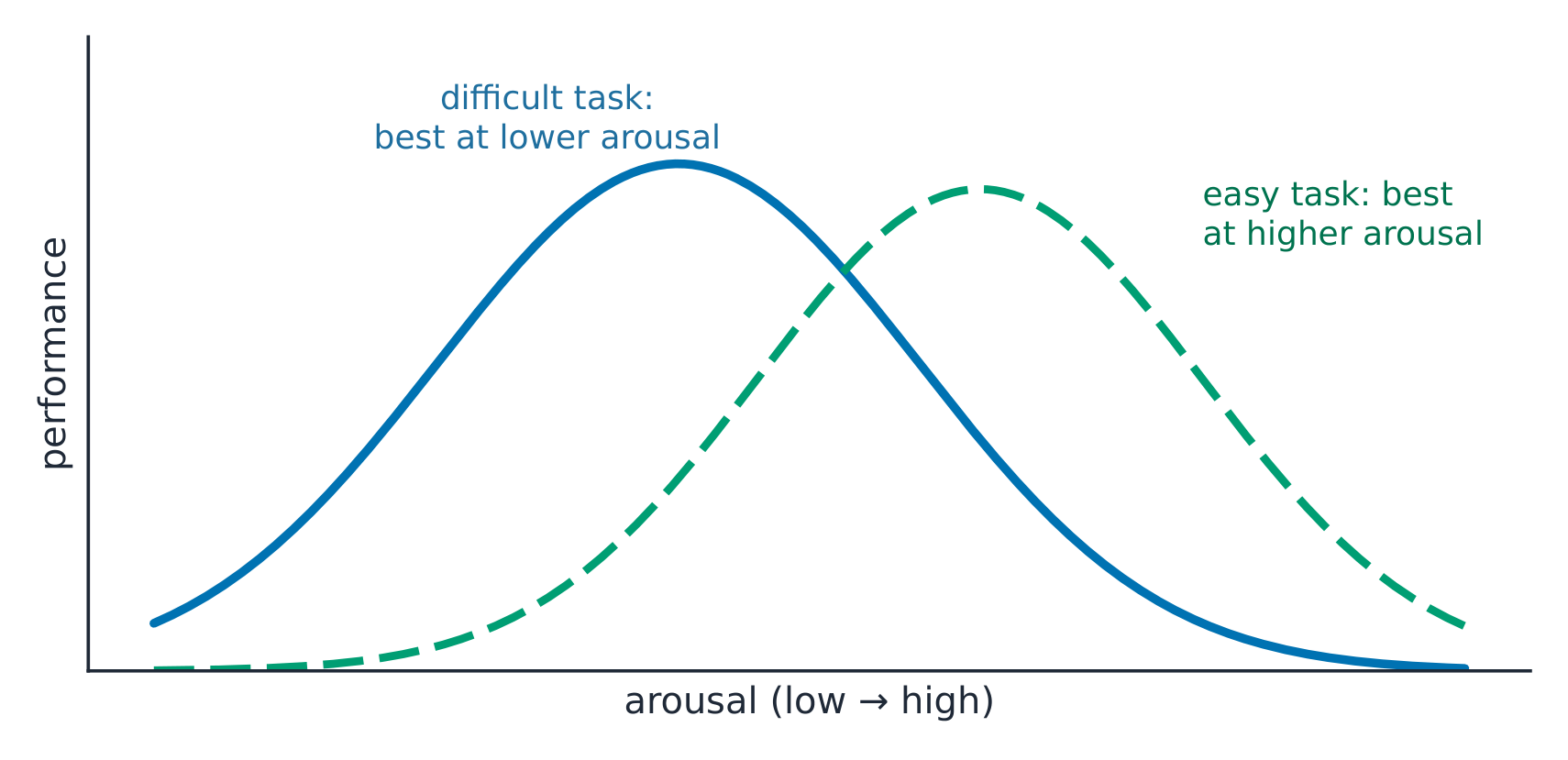
- Arousal theory 唤醒理论: people act to keep an optimal level of arousal. The Yerkes–Dodson law (1908) says performance is best at moderate arousal, and the best level is lower for difficult tasks.
- Sensation-seeking theory 感觉寻求理论: some people seek new, intense experiences more than others (Marvin Zuckerman).
Which motivation theory?
Sort each explanation by the theory it comes from.
According to the Yerkes–Dodson law, difficult tasks are done best at lower arousal.
Difficulté 1/5 · 100 pièces + un petit bonus lors de la première réussite aujourd'hui
Moderate arousal is best, lower for hard tasks.
Self-determination theory
- Self-determination theory 自我决定理论 (Deci and Ryan) says people thrive when three needs are met: autonomy, competence and relatedness.
- Relatedness links to belongingness 归属感: the need to form and keep close relationships.
Which are the three needs in self-determination theory?
Difficulté 2/5 · 140 pièces + un petit bonus lors de la première réussite aujourd'hui
Deci and Ryan.
Worked example: classify motivation
- A student studies maths because she enjoys solving problems: intrinsic.
- A student studies to win a $500 scholarship: extrinsic.
- A rock climber who feels bored by ordinary life: high sensation seeking; arousal theory explains the search for stimulation.
Match each example to the type of motivation.
Difficulté 2/5 · 140 pièces + un petit bonus lors de la première réussite aujourd'hui
For its own sake versus a reward.
Motivational conflicts
- Lewin's motivational conflicts theory 勒温的动机冲突理论 names conflicts: approach–approach (two good options), avoidance–avoidance (two bad options), and approach-avoidance 趋避冲突 (one option with both good and bad sides).
- Example of approach–avoidance: a well-paid job in a city far from family.
Match each situation to its conflict.
Difficulté 2/5 · 140 pièces + un petit bonus lors de la première réussite aujourd'hui
Lewin's conflicts.
Rewards do not always reduce motivation. In Deci's work the effect appeared for tasks that were already enjoyable; rewards can increase effort for dull tasks, and praise for real progress can support competence.
Rewards always reduce motivation.
Difficulté 1/5 · 100 pièces + un petit bonus lors de la première réussite aujourd'hui
They can raise effort on dull tasks.
Drive-reduction explains biological needs; arousal theory and the Yerkes–Dodson law explain seeking an optimal level; sensation seeking varies between people. Self-determination theory stresses autonomy, competence and relatedness; external rewards can undermine intrinsic motivation; Lewin describes motivational conflicts.
A school plans to pay students $5 for every book they read. Use Deci's findings and self-determination theory to evaluate the plan.
Evaluating rewards.