Travail
Introduit| English | Sens |
|---|---|
| work/wɜːk/ | travail |
| dot product/dɒt ˈprɒdʌkt/ | produit scalaire |
The effort that doesn't count
- Carry a suitcase horizontally at constant height and speed: your purely upward supporting force does no work on it.
- Strange? The force (up) is perpendicular to the motion (sideways).
- In physics, "work" has a precise meaning — and direction is everything.
- Get it right, and energy problems become easy.
Work of a constant force
- Work 功 is energy transferred when a force acts over a displacement:
- The dot product 点积 keeps only the part of the force along the motion.
- Force and motion aligned ($\theta = 0$) gives the most work.
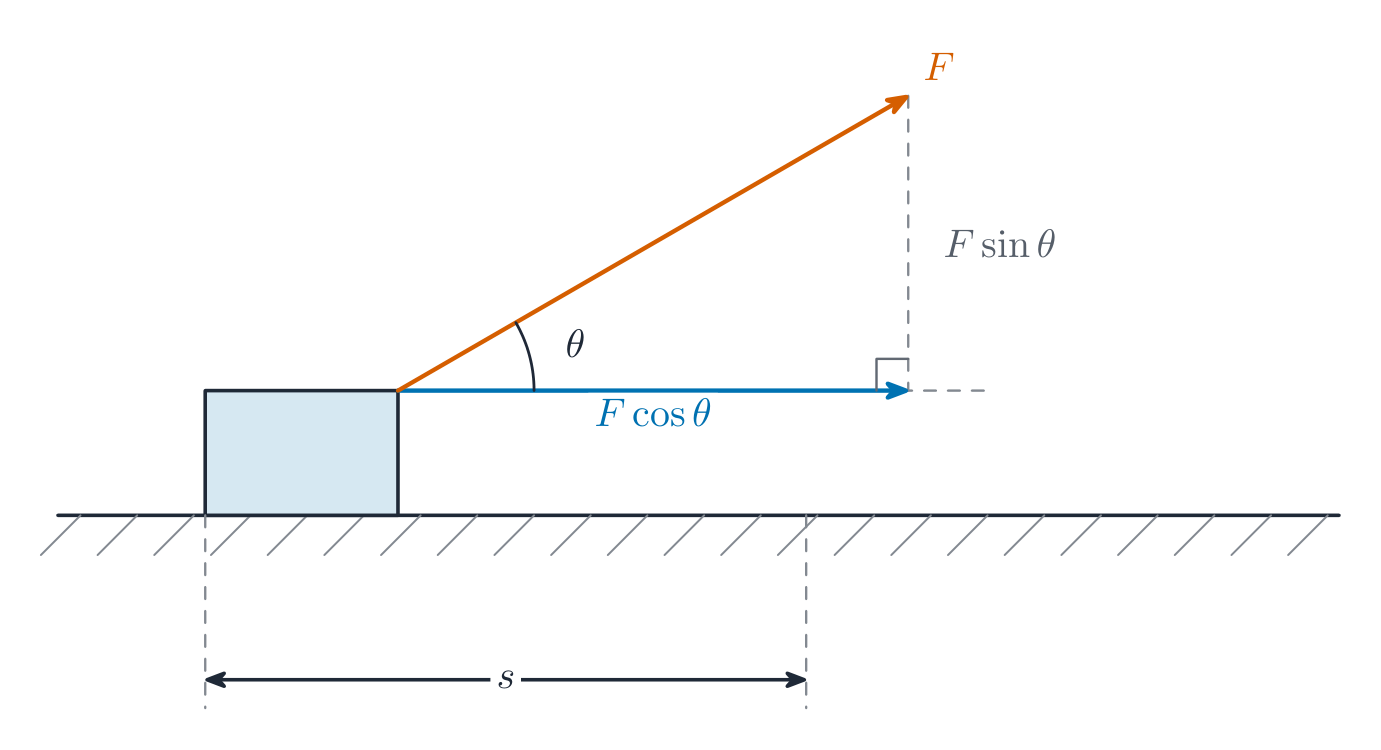
Only the component parallel to the pictured displacement contributes work
A $10\ \text{N}$ force pushes a box $4\ \text{m}$ in the same direction. How much work is done (in J)?
Difficulté 2/5 · 140 pièces + un petit bonus lors de la première réussite aujourd'hui
With $\theta = 0$, $W = Fd\cos 0 = 10 \times 4 \times 1 = 40\ \text{J}$.
A $50\ \text{N}$ force at $60^\circ$ to the motion drags a crate $3\ \text{m}$. Work done (in J)?
Difficulté 2/5 · 140 pièces + un petit bonus lors de la première réussite aujourd'hui
$W = Fd\cos\theta = 50 \times 3 \times \cos 60^\circ = 50 \times 3 \times 0.5 = 75\ \text{J}$.
The angle sets the sign
- Force along the motion → positive work (energy added).
- Force against the motion → negative work (energy removed, like friction).
- Force perpendicular ($\theta = 90^\circ$) → zero work — that is the suitcase.
You carry a bag horizontally across a room. The work gravity does on the bag is...
Difficulté 1/5 · 100 pièces + un petit bonus lors de la première réussite aujourd'hui
Gravity points down, motion is horizontal -- perpendicular, so $\cos 90^\circ = 0$ and the work is zero.
Friction, which opposes motion, does negative work on a sliding object.
Difficulté 1/5 · 100 pièces + un petit bonus lors de la première réussite aujourd'hui
The friction force points against the motion ($\theta = 180^\circ$), so its work is negative -- it removes energy.
Select tout cases where the force does zéro work.
Difficulté 2/5 · 140 pièces + un petit bonus lors de la première réussite aujourd'hui
Perpendicular force ($\cos 90^\circ = 0$) and no displacement both give zero work. A force along the motion does positive work.
Variable forces: integrate
- When the force changes along the path, sum the tiny bits:
- In one dimension, this is the signed area under a force-versus-position graph, between the initial and final positions.
- A stretching spring, whose force grows with $x$, needs exactly this.
Positive, negative or zero work?
Work depends on the angle between the force and the motion. Sort each case.
For a force that changes with position, work is the ____ under the force-position graph.
Difficulté 1/5 · 100 pièces + un petit bonus lors de la première réussite aujourd'hui
$W = \int F\,dx$ is exactly the area under the force-versus-position curve.
Work moves energy
- Work is how energy is transferred into or out of an object.
- Positive net work speeds it up; negative net work slows it down.
- That is the bridge to the work-energy theorem, $W_{net} = \Delta K$.
You pull a sled $10\ \text{m}$ with a $20\ \text{N}$ force angled $60^\circ$ above the ground.
- $W = Fd\cos\theta = 20 \times 10 \times \cos 60^\circ = 20 \times 10 \times 0.5 = 100\ \text{J}$.
- Only the along-the-ground part of the pull counts.
Effort is not work. Holding a barbell overhead is exhausting, yet does zero physics-work, because nothing moves. Work needs a force and a displacement along it — no motion, no work, however tiring.
Work $W = \vec{F}\cdot\vec{d} = Fd\cos\theta$ counts only the force along the motion (a dot product). Along-motion is positive, against is negative, perpendicular is zero. For a varying force, integrate: $W = \int \vec{F}\cdot d\vec{r}$, the area under the force-position graph.
Write from the data: find the work
- A force of 10 N pushes a box 5 m in the direction of the force.
- Find the work.
A force of 10 N moves a box 5 m in the same direction. How much work does that force do? What work does a second force do if it is perpendicular to the motion?
10 times 5 is 50. A right angle has no component along the motion.
A constant 10 N force moves a box 5 m in the direction of the force. How much work does this force do?
Difficulté 1/5 · 100 pièces + un petit bonus lors de la première réussite aujourd'hui
Force and displacement are parallel, so the work is 10 times 5. Other options — 40 J (the lesson work); 0 (as if the force were perpendicular).