Systems and Center of Mass
Introduit| English | Sens |
|---|---|
| center of mass/ˈsentə ɒv mæs/ | centre de masse |
| system/ˈsɪstəm/ | système |
| internal forces/ɪnˈtɜːnl ˈfɔːsɪz/ | forces internes |
| external forces/ekˈstɜːnl ˈfɔːsɪz/ | forces externes |
| point particle/pɔɪnt ˈpɑːtɪkl/ | particule ponctuelle |
| integral/ˈɪntɪɡrəl/ | intégrale |
| net external force/net ekˈstɜːnl fɔːs/ | force externe nette |
Throw a spinning wrench
- Toss a wrench across the room and it tumbles wildly — yet one single point traces a smooth, simple arc.
- That special point is the center of mass 质心.
- No matter how an object spins or wobbles, its center of mass moves as if all the mass were squeezed into that one spot.
- Find it, and a messy tumbling problem becomes a simple point-mass problem.
Treat a system as one point
- A system 系统 is any group of objects we choose to study together.
- Forces inside the system are internal forces 内力; forces from outside are external forces 外力.
- The whole system moves as if it were a single point particle 质点 located at its center of mass.
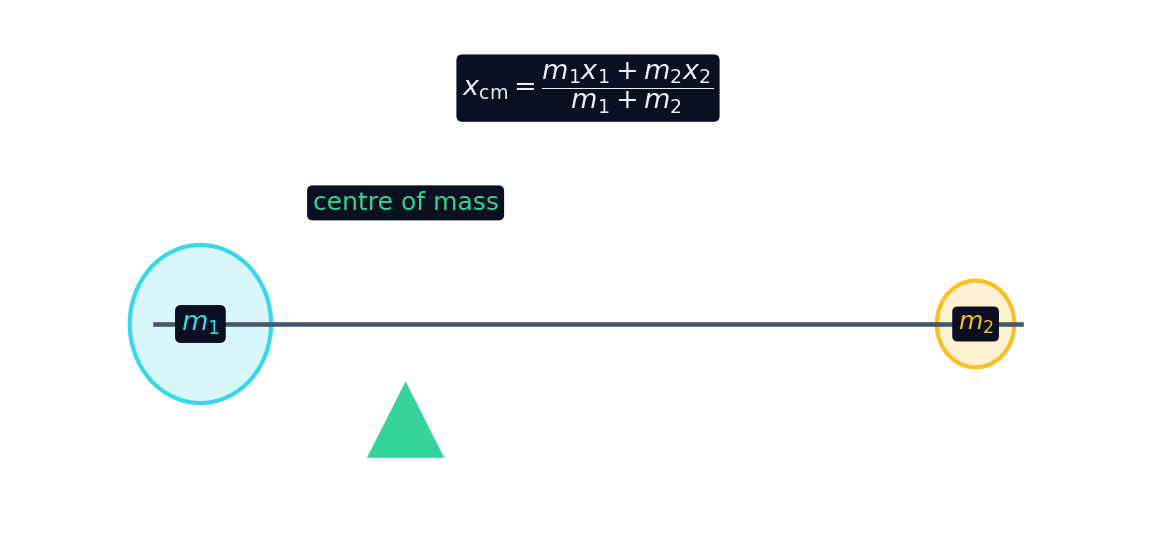
The centre of mass is the mass-weighted average position
Select tout true statements about the center of mass.
Difficulté 2/5 · 140 pièces + un petit bonus lors de la première réussite aujourd'hui
The first two are the core rules. The third is false -- it is the masse-weighted center, not the shape's midpoint.
Center of mass of discrete masses
- For separate point masses along a line, the center of mass is the mass-weighted average position:
- Heavier masses pull the center of mass toward themselves.
A $1\ \text{kg}$ mass is at $x = 0$ and a $3\ \text{kg}$ mass is at $x = 4\ \text{m}$. Where is the center of mass (in m)?
Difficulté 2/5 · 140 pièces + un petit bonus lors de la première réussite aujourd'hui
$x_{cm} = \dfrac{1(0) + 3(4)}{1 + 3} = \dfrac{12}{4} = 3\ \text{m}$ -- close to the heavier mass.
Move one mass farther from the others. The center of mass...
Difficulté 1/5 · 100 pièces + un petit bonus lors de la première réussite aujourd'hui
The mass-weighted average follows the mass -- moving a mass out pulls $x_{cm}$ toward it.
Masses $2\ \text{kg}$ at $x=0$, $2\ \text{kg}$ at $x=2$, and $4\ \text{kg}$ at $x=5$. Find $x_{cm}$ (in m).
Difficulté 2/5 · 140 pièces + un petit bonus lors de la première réussite aujourd'hui
$x_{cm} = \dfrac{2(0)+2(2)+4(5)}{2+2+4} = \dfrac{24}{8} = 3\ \text{m}$.
Center of mass by integration
- For a continuous object, replace the sum with an integral 积分 over its mass:
- Slice the object into tiny bits $dm$, weight each by its position, and add them up.
Centre of mass of a system
Tap the parts to see where the centre of mass of a two-body system sits.
For a continuous body the sum in the center-of-mass formula becomes an ____.
Difficulté 1/5 · 100 pièces + un petit bonus lors de la première réussite aujourd'hui
$x_{cm} = \tfrac{1}{M}\int x\,dm$ -- an integral over the mass distribution.
Only external forces accelerate it
- The center of mass accelerates only in response to the net external force 净外力.
- Internal forces — however violent — cannot change the velocity of the center of mass; it can still move at constant velocity.
- That is why the tumbling wrench's center of mass follows the same smooth path a simple thrown ball would.
A floating system has no outside forces. Can an internal explosion change the velocity of its center of mass?
Difficulté 1/5 · 100 pièces + un petit bonus lors de la première réussite aujourd'hui
No. Internal forces cancel in the system total, so its center of mass keeps its initial velocity. It stays fixed only if initially at rest.
A $2\ \text{kg}$ mass sits at $x = 0$ and a $4\ \text{kg}$ mass at $x = 3\ \text{m}$.
- $x_{cm} = \dfrac{2(0) + 4(3)}{2 + 4} = \dfrac{12}{6} = 2\ \text{m}$.
- The center of mass sits closer to the heavier $4\ \text{kg}$ mass, as expected.
The center of mass is not always the geometric center. For a uniform rod it is the middle, but load one end and the center of mass shifts toward the heavy end — it is the mass-weighted average, not the shape's midpoint.
The center of mass is the mass-weighted average position: $x_{cm} = \dfrac{\sum m_i x_i}{\sum m_i}$ (or $\tfrac{1}{M}\int x\,dm$ for a continuous body). A whole system moves as if all its mass were at that point, and only the net external force can accelerate it.
Write from the mass positions
- A 1 kg mass is at x = 0. A 4 kg mass is at x = 5 m.
- Find the centre of mass.
A 1 kg mass sits at x = 0 and a 4 kg mass sits at x = 5 m. Where is the centre of mass, in metres?
20 divided by 5 is 4.
A 1 kg mass is at x = 0 and a 4 kg mass is at x = 5 m. Where is their center of mass?
Difficulté 1/5 · 100 pièces + un petit bonus lors de la première réussite aujourd'hui
The mass-weighted average of 0 and 5 m is 4 m. Other options — 3 m (the lesson centre); 5 m (the position of the heavy mass).