Systems and Center of Mass
Introduit| English | Sens |
|---|---|
| centre of mass/ˈsentə ɒv mæs/ | centre de masse |
| system/ˈsɪstəm/ | système |
| external force/ekˈstɜːnl fɔːs/ | force extérieure |
| internal force/ɪnˈtɜːnl fɔːs/ | force intérieure |
| particle/ˈpɑːtɪkl/ | particule |
A wrench tumbles — yet one point glides straight
- Slide a spinning wrench across ice and every part traces a messy loop.
- But one special point drifts in a perfectly straight line — the centre of mass 质心.
- Treat a complicated object (or a group of objects) as if all its mass sat there.
- That single idea turns a whole system 系统 into one easy-to-track point.
What a system is
- A system is any group of objects you choose to study together.
- Everything else is the surroundings; forces from outside are external forces 外力.
- Forces between members of the system are internal forces 内力.
- By Newton's third law, internal forces come in canceling pairs — they cannot accelerate the centre of mass.
By Newton's third law, the internal forces of a system always ____ in pairs.
Difficulté 1/5 · 100 pièces + un petit bonus lors de la première réussite aujourd'hui
Internal forces are action–reaction pairs, so they sum to zero and cannot accelerate the centre of mass.
Locating the centre of mass
- The centre of mass is the mass-weighted average of every part's position.
- For point masses on a line: $\displaystyle x_{\text{cm}} = \frac{m_1 x_1 + m_2 x_2 + \cdots}{m_1 + m_2 + \cdots}$.
- It sits closer to the heavier mass — the big mass "pulls" the average toward it.
- It need not be inside the object: a ring's centre of mass is in the empty hole.
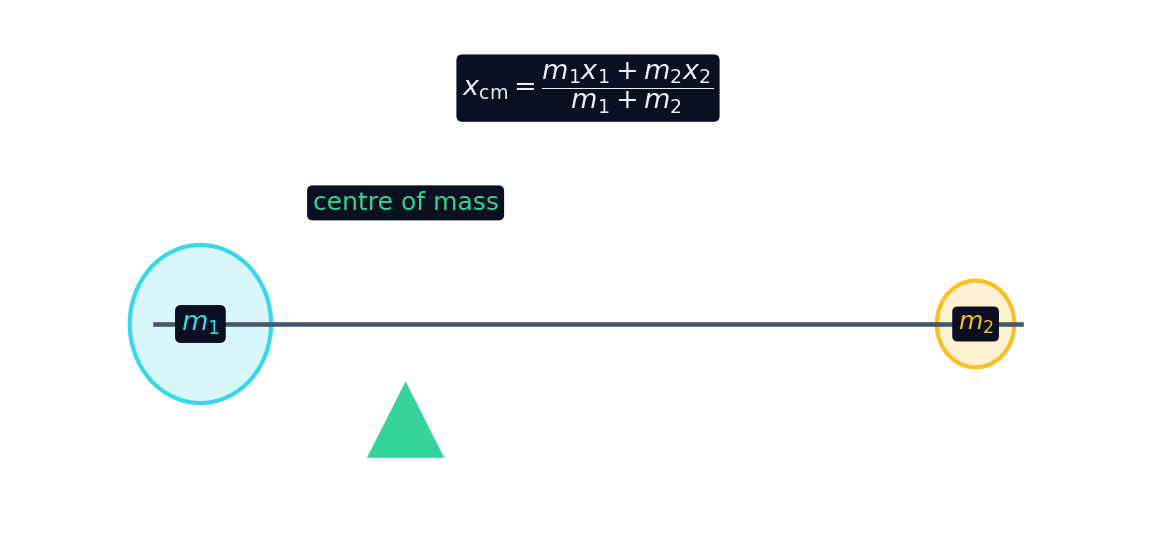
Find the balance point
Change the two masses and their distances, and see where the system balances — the centre of mass.
A $2\ \text{kg}$ mass is at $x = 0$ and a $6\ \text{kg}$ mass at $x = 8\ \text{m}$. Where is the centre of mass, in metres?
Difficulté 2/5 · 140 pièces + un petit bonus lors de la première réussite aujourd'hui
$x_{\text{cm}} = \dfrac{2(0) + 6(8)}{2 + 6} = \dfrac{48}{8} = 6\ \text{m}$ — closer to the heavier mass.
The centre of mass of a system is best described as the:
Difficulté 1/5 · 100 pièces + un petit bonus lors de la première réussite aujourd'hui
C'est $\frac{\sum m_i x_i}{\sum m_i}$ — each position weighted by its mass.
Two égales masses sit at $x = 2\ \text{m}$ et $x = 6\ \text{m}$. Where is their centre of mass, in metres?
Difficulté 2/5 · 140 pièces + un petit bonus lors de la première réussite aujourd'hui
Equal masses ⇒ the centre of mass is the midpoint: $(2 + 6)/2 = 4\ \text{m}$.
Why the centre of mass matters
- Only external forces can accelerate the centre of mass: $\vec F_{\text{net,ext}} = M\,\vec a_{\text{cm}}$.
- No matter how the parts spin or collide inside, the centre of mass obeys this simple law.
- A diver somersaults, but their centre of mass follows a smooth parabola.
- This is why we can model an extended object as a single particle 质点.
Select tout true statements about the centre of mass.
Difficulté 2/5 · 140 pièces + un petit bonus lors de la première réussite aujourd'hui
It is mass-weighted (closer to heavy parts), accelerated only by external forces, and lets us treat the body as a point — but it is not always the geometric centre.
The centre of mass is not always the geometric centre, and it need not lie within the material. For a doughnut or a boomerang it sits in empty space. Only for a uniform, symmetric object do the two coincide.
The centre of mass must always lie inside the material of the object.
Difficulté 1/5 · 100 pièces + un petit bonus lors de la première réussite aujourd'hui
A ring or boomerang has its centre of mass in empty space. Its location depends on the mass distribution.
A $2\ \text{kg}$ ball sits at $x = 0$ and a $6\ \text{kg}$ ball at $x = 8\ \text{m}$.
- $x_{\text{cm}} = \dfrac{(2)(0) + (6)(8)}{2 + 6} = \dfrac{48}{8} = 6\ \text{m}$.
The centre of mass is at $6\ \text{m}$ — much closer to the heavier $6\ \text{kg}$ ball.
A system is a chosen set of objects; its centre of mass is the mass-weighted average position, $x_{\text{cm}} = \frac{\sum m_i x_i}{\sum m_i}$, lying closer to heavier parts. Internal forces cancel in pairs; only external forces accelerate the centre of mass ($\vec F_{\text{net,ext}} = M\vec a_{\text{cm}}$).
Write from the data: find the centre of mass
- A 3 kg mass is at x = 1 m. A 1 kg mass is at x = 9 m.
- Find the centre of mass.
A 3 kg mass sits at x = 1 m and a 1 kg mass sits at x = 9 m. Where is the centre of mass, in metres?
Use the mass-weighted position: $x_{cm}=(m_1x_1+m_2x_2)/(m_1+m_2)=[3(1)+1(9)]/(3+1)=12/4=3\ \text{m}$. The result is nearer the 3 kg mass than the 1 kg mass.
A 3 kg mass sits at x = 1 m and a 1 kg mass sits at x = 9 m. Where is the centre of mass, in metres?
Difficulté 1/5 · 100 pièces + un petit bonus lors de la première réussite aujourd'hui
Use the mass-weighted position: $x_{cm}=(m_1x_1+m_2x_2)/(m_1+m_2)=[3(1)+1(9)]/(3+1)=12/4=3\ \text{m}$. The result is nearer the 3 kg mass than the 1 kg mass.