Real Interest Rates and International Capital Flows
Introduit| English | Sens |
|---|---|
| real interest rates/rɪəl ˈɪntrest reɪts/ | taux d'intérêt réels |
| capital inflow/ˈkæpɪtl ˈɪnfləʊ/ | flux de capitaux entrants |
| capital flows/ˈkæpɪtl fləʊz/ | flux de capitaux |
Money chases the best return
- Savers everywhere want the highest return they can get.
- So real interest rates 实际利率 drive money between countries.
- Raise your real rate above the world's, and foreign money flows in.
- This is the last link that ties the whole open economy together.
International capital flows are driven mainly by differences in:
Difficulté 1/5 · 100 pièces + un petit bonus lors de la première réussite aujourd'hui
Money moves toward the highest real return.
Foreign savers sending money into a high-rate country create a capital ______.
Difficulté 1/5 · 100 pièces + un petit bonus lors de la première réussite aujourd'hui
A capital inflow is money entering to earn the higher rate.
A capital inflow appreciates the currency because foreigners:
Difficulté 1/5 · 100 pièces + un petit bonus lors de la première réussite aujourd'hui
Buying the currency to invest raises demand, so it appreciates.
Capital inflows raise the currency
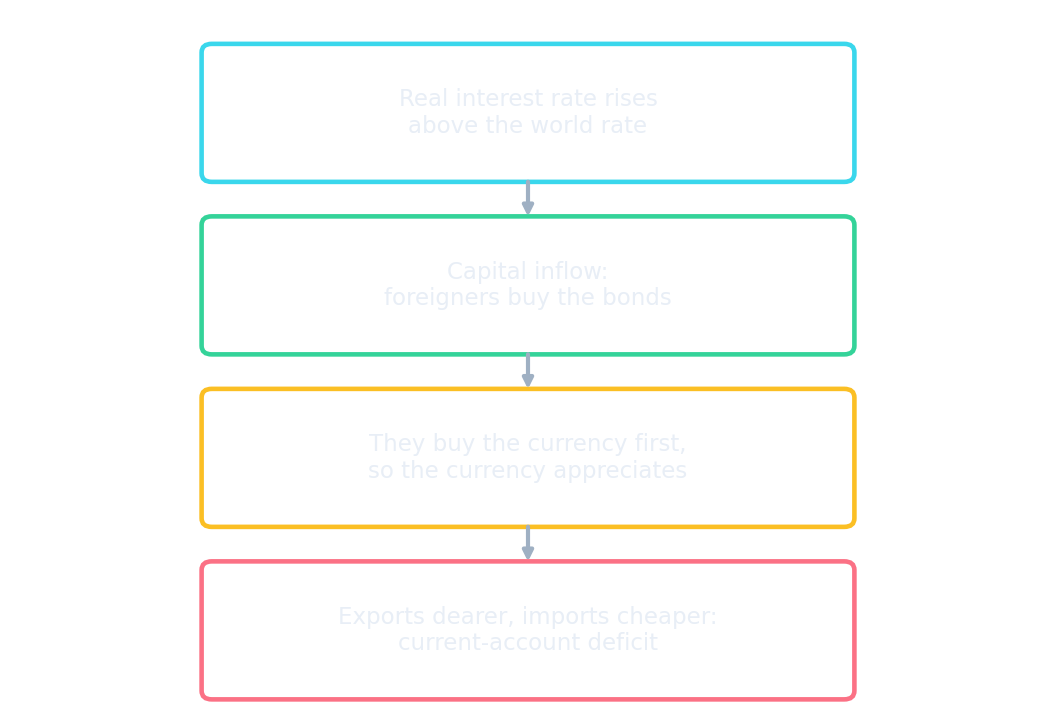
- When a country's real interest rate rises above the rest of the world's, foreign savers send money in — a capital inflow 资本流入.
- To invest, those foreigners must first buy the country's currency.
- So the inflow raises demand for the currency, and it appreciates.
- High real rates therefore mean a strong currency.
A financial account surplus (capital inflow) is matched by a current account:
Difficulté 1/5 · 100 pièces + un petit bonus lors de la première réussite aujourd'hui
The appreciation makes exports dearer and imports cheaper, pushing the current account to deficit.
How the two accounts tie together
- These capital flows 资本流动 link the two balance-of-payments accounts.
- A financial account surplus (money flowing in to buy assets) matches a current account deficit.
- Why? The stronger currency the inflow creates makes exports dearer and imports cheaper.
- That pushes the trade balance the other way — into deficit — exactly offsetting the inflow.
A country raises its real interest rate from 2% to 5%. By how many percentage points did it rise?
Difficulté 2/5 · 140 pièces + un petit bonus lors de la première réussite aujourd'hui
5 − 2 = 3 percentage points, far above the world rate — drawing capital in.
Order the chain from a higher real rate to a current-account deficit.
Difficulté 3/5 · 200 pièces + un petit bonus lors de la première réussite aujourd'hui
Higher rate → inflow → appreciation → trade gap widens.
Worked example
- Worked idea. A country lifts its real interest rate from 2% to 5%, far above the world's.
- Foreign investors pour money in to buy its bonds — a capital inflow — buying its currency first, so it appreciates.
- The stronger currency then makes exports dearer, so the current account moves toward deficit.
- Higher real rates draw in capital but widen the trade gap — the two accounts offset.
Capital inflow or outflow?
Money chases the best real return. Sort each case by which way capital flows.
Worked example: a link-FRQ chain
Mexico's central bank sells government bonds while US policy is unchanged. Trace the effects on (a) Mexico's real interest rate, (b) the value of the peso, (c) Mexico's net exports.
- (a) Selling bonds cuts the money supply and raises the nominal rate; with sticky prices in the short run, Mexico's real interest rate rises.
- (b) Foreign savers move funds into Mexican assets (a capital inflow), raising demand for pesos: the peso appreciates. (c) Mexican goods become dearer abroad and imports cheaper, so Mexico's net exports fall.
A country's real interest rate falls relative to the rest of the world. What tends to happen?
Difficulté 1/5 · 100 pièces + un petit bonus lors de la première réussite aujourd'hui
Savers move funds abroad to earn more, selling the currency.
A capital inflow that strengthens the currency tends to push the current account toward deficit.
Difficulté 1/5 · 100 pièces + un petit bonus lors de la première réussite aujourd'hui
A stronger currency cuts exports and raises imports.
Real interest rates drive capital flows. A rate above the world's brings a capital inflow: foreigners buy the currency, which appreciates. The stronger currency makes exports dearer and imports cheaper, moving the current account toward deficit — so a financial account surplus offsets a current account deficit ($2\% \to 5\%$ draws capital in but widens the trade gap).
Write from the data given
- A country raises its real interest rate from 1 percent to 6 percent.
- Find the rise and say what capital does.
A country raises its real interest rate from 1 percent to 6 percent, while the rest of the world does not. By how many percentage points did the rate rise, and what happens to capital flows and the currency?
6 minus 1 is 5.
By how many percentage points did the real rate rise?
Difficulté 1/5 · 100 pièces + un petit bonus lors de la première réussite aujourd'hui
6 percent minus 1 percent is a rise of 5 percentage points. Other options — 3 (the lesson rise); 6 (the new rate).