Materials, Processes, and Ideas
Introduit| English | Sens |
|---|---|
| materials/məˈtɪərɪəlz/ | matériaux |
| process/ˈprəʊses/ | A series of actions or changes that produces an outcome. |
| idea | The concept or meaning an artwork is about. |
Drawing, erasing, drawing again, 1989
- In 1989 the South African artist William Kentridge made a short film from one charcoal drawing at a time. He drew a scene, filmed it, rubbed part of it out, drew the change and filmed again. Each final sheet kept the grey ghosts of everything erased.
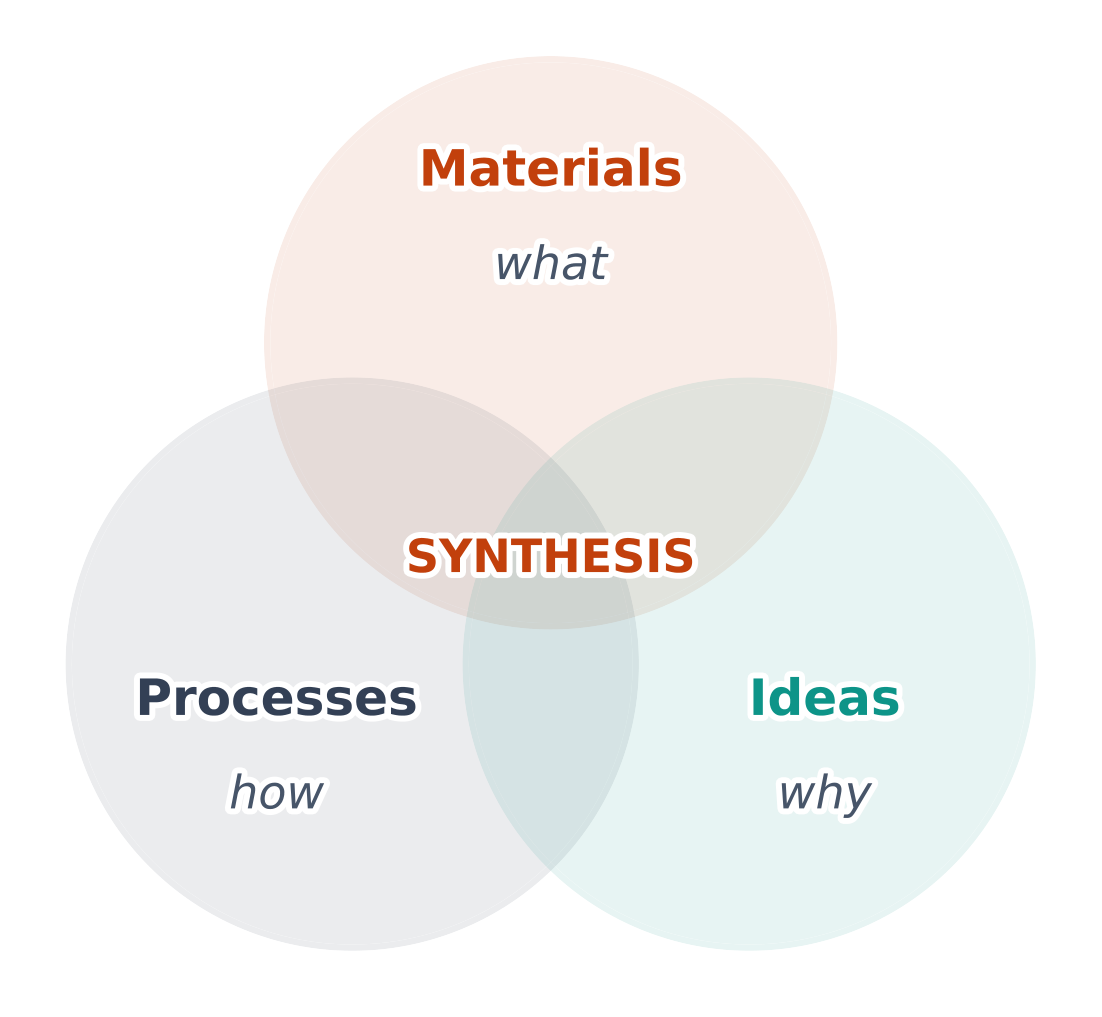
- The materials 材料 (charcoal, paper), the process 过程 (erase and redraw) and the idea 想法 (a city that cannot forget its past) explain each other. That link is what AP Drawing calls synthesis.
In Kentridge's 1989 films, what was the main process?
Difficulté 1/5 · 100 pièces + un petit bonus lors de la première réussite aujourd'hui
The erased marks stayed visible.
Three questions for every work
- Material: what is it made of? Process: what did you do to it? Idea: why — what is it about?
- A strong work answers all three, and each answer supports the others: smudgy charcoal suits a theme of fading; a hard steel pen would fight it.
Matériau, procédé ou idée ?
Sort each item into the CED component it names.
The actions of making a work are its
Difficulté 1/5 · 100 pièces + un petit bonus lors de la première réussite aujourd'hui
Processes are what you do.
The physical substances used to make a work are its ____.
Difficulté 1/5 · 100 pièces + un petit bonus lors de la première réussite aujourd'hui
Charcoal, paper, ink.
Let one corner lead
- Sometimes the idea chooses the material: drawings about decay made with rust or tea stains.
- Sometimes a material starts the idea: ink bleeding on wet paper may lead to drawings about rain or tears.
Match each item to its component.
Difficulté 2/5 · 140 pièces + un petit bonus lors de la première réussite aujourd'hui
What, how, why.
A material can be the starting point for an idea.
Difficulté 1/5 · 100 pièces + un petit bonus lors de la première réussite aujourd'hui
Ink bleeding on wet paper can suggest rain.
Worked example: one drawing, three decisions
Idea: forgetting a grandparent's face.
- Material: soft 6B graphite on smooth paper, because it smudges easily.
- Process: draw the face from a photo, rub half of it away with a cloth, then redraw it fainter from memory.
- Written evidence sentence: "I rubbed out and redrew the face in smudging graphite so the portrait fades the way my memory of her has."
Change one thing at a time
- To learn what a material does, keep the idea and process the same and change only the material: the same face in charcoal, in fineliner, in ink wash.
- Compare the versions and note which one carries the idea best; that note becomes evidence.
To learn what a material does, change several components at once.
Difficulté 1/5 · 100 pièces + un petit bonus lors de la première réussite aujourd'hui
Change one at a time to see its effect.
Name all three in writing
- Your written evidence should state the material, the process and the idea, and say how they connect.
- "Charcoal on torn brown paper, layered and erased, to show a house falling apart" is stronger than "I used charcoal".
Which written evidence sentence is strongest?
Difficulté 1/5 · 100 pièces + un petit bonus lors de la première réussite aujourd'hui
It names all three and links them.
"It looks cool" is not a reason. A material chosen at random weakens the work. If you cannot say why a material or process suits the idea, test another one.
Every drawing joins materials (what), processes (how) and ideas (why). Let one lead, test one change at a time, and state all three and their link in your written evidence: the tighter the link, the stronger the synthesis.
Plan a drawing about rain. Name a material, a process and the idea, and explain how they connect.
Planning for synthesis.