Sciences : points de vue contradictoires et preuves qui distinguent les modèles
Introduit| English | Sens |
|---|---|
| viewpoint/ˈvjuːpɔɪnt/ | point de vue |
| prediction/prɪˈdɪkʃn/ | prédiction |
Two scientists disagree
- Scientist 1 says a lake's fish died because of low oxygen; Scientist 2 says a new parasite killed them. Both use the same event.
- In conflicting-viewpoints 观点 passages, write down each model's assumption and prediction 预测, then find the observation that only one model predicts.
Represent each model
- Scientist 1: low oxygen → fish die in deep, still water first; adding air pumps would help.
- Scientist 2: a parasite → infected fish found everywhere in the lake; treating the parasite would help.
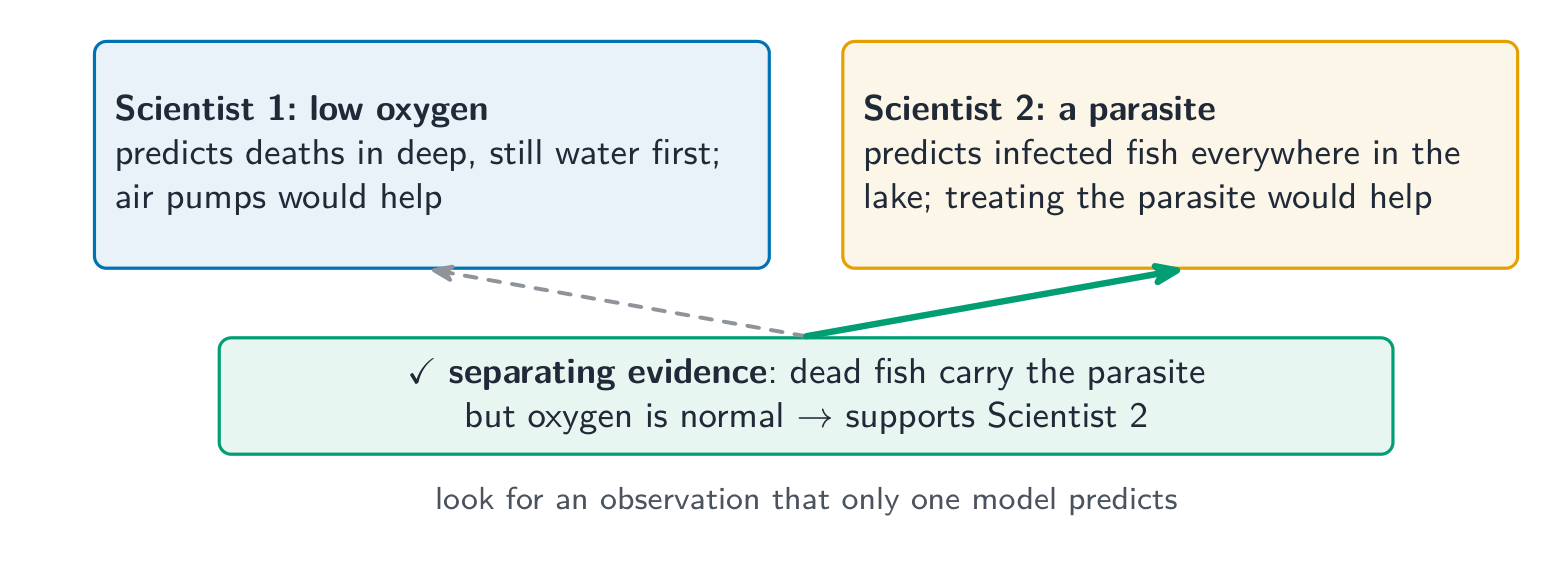
For each viewpoint, note its assumption and its ____.
Difficulté 1/5 · 100 pièces + un petit bonus lors de la première réussite aujourd'hui
Predictions are what data can test.
Evidence that separates them
- The useful observation is one that the two models predict differently: if dead fish carried the parasite but oxygen levels were normal, Scientist 2 is supported.
- An observation both models predict (fish died) cannot choose between them.
New data: oxygen in the deep water fell to near zero, and no parasites were found in tested fish. This supports Scientist 1 and weakens Scientist 2.
Quel scientifique cela soutient-il ?
Utiliser des prédictions différentes pour trancher entre les modèles.
Scientist 1: a bird species declined because of habitat loss. Scientist 2: because of a new disease. Which finding would best support Scientist 2?
Difficulté 1/5 · 100 pièces + un petit bonus lors de la première réussite aujourd'hui
It fits the disease model and contradicts habitat loss.
An observation predicted by both models supports one model over the other.
Difficulté 1/5 · 100 pièces + un petit bonus lors de la première réussite aujourd'hui
It cannot distinguish them.
Put the conflicting-viewpoints method in order.
Difficulté 3/5 · 200 pièces + un petit bonus lors de la première réussite aujourd'hui
Separate, then compare predictions.
Evaluating a model
- Ask what a model assumes and whether the data meet that assumption.
- "Which statement would both scientists agree with?" — look for the shared facts, usually the observation itself.
In the bird example, which statement would both scientists agree with?
Difficulté 1/5 · 100 pièces + un petit bonus lors de la première réussite aujourd'hui
The decline is the shared observation.
Traps
- Using evidence both predict as support for one side.
- Mixing up the scientists: write a one-line summary of each before answering.
Recap
- Summarise each viewpoint's assumption and prediction separately.
- The deciding evidence is what one model predicts and the other does not.
- prediction: A statement of what an experiment or model expects to happen.