Anglais : précision, concision et style constant
Introduit| English | Sens |
|---|---|
| tone/təʊn/ | ton |
| redundancy/rɪˈdʌndənsi/ | redondance |
Say it once
- "The annual festival, which happens every year, attracts visitors." The phrase "which happens every year" repeats "annual".
- ACT style questions reward concise, precise language that keeps the passage's tone 语气 — and they often make "DELETE" or the shortest option correct.
Remove redundancy 赘余
- Cut words that repeat a meaning: "annual … every year", "past history", "return back", "completely finished".
- Keep words that add needed meaning: "nearly finished" ≠ "finished" — "nearly" is a necessary qualification.
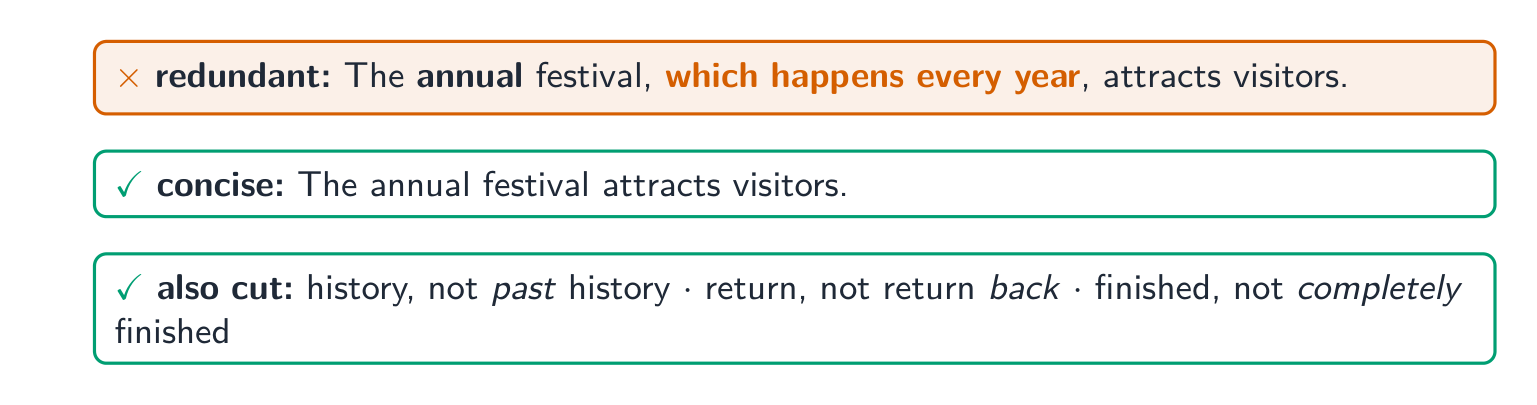
La couper ou la conserver ?
Distinguer les mots superflus des qualifications nécessaires.
“She returned back to her hometown in 2019.” Which choice is best?
Difficulté 1/5 · 100 pièces + un petit bonus lors de la première réussite aujourd'hui
“Back” repeats the meaning of returned.
“The bridge is nearly finished.” A student suggests deleting “nearly”. Should they?
Difficulté 1/5 · 100 pièces + un petit bonus lors de la première réussite aujourd'hui
“Nearly finished” and “finished” mean different things.
“Annual” already means “every ____”, so “annual … every year” is redundant.
Difficulté 1/5 · 100 pièces + un petit bonus lors de la première réussite aujourd'hui
Remove the repeated meaning.
Choose the precise word
- Prefer the specific word: "The scientists measured the temperature" over "did something with the temperature".
- Check that the word fits the sentence's exact meaning: "The policy affected prices" (influenced) vs "effected change" (brought about).
"The researcher found that the medicine sort of helped some patients feel better kind of." Concise and precise: "The researcher found that the medicine helped some patients."
“Affect” and “effect” can always be swapped.
Difficulté 1/5 · 100 pièces + un petit bonus lors de la première réussite aujourd'hui
Affect (verb) = influence; effect (verb) = bring about; effect (noun) = result.
Keep the tone consistent
- A formal passage needs formal words: "The committee rejected the proposal", not "The committee totally trashed the proposal".
- A friendly personal essay can be less formal, but should not suddenly switch to technical jargon.
In a formal report: “The committee ___ the proposal.” Which fits the tone?
Difficulté 1/5 · 100 pièces + un petit bonus lors de la première réussite aujourd'hui
Formal and precise.
Traps
- Cutting a needed qualifier: "some patients" → "patients" changes the meaning.
- Slang in a formal passage: even if the meaning is right, the tone is wrong.
Recap
- Delete repeated meaning; keep qualifiers that change meaning.
- Choose the precise word and keep the passage's tone.