Compétences essentielles dans un modèle pratique à plusieurs étapes
Introduit| English | Sens |
|---|---|
| assumption/əˈsʌmpʃn/ | hypothèse |
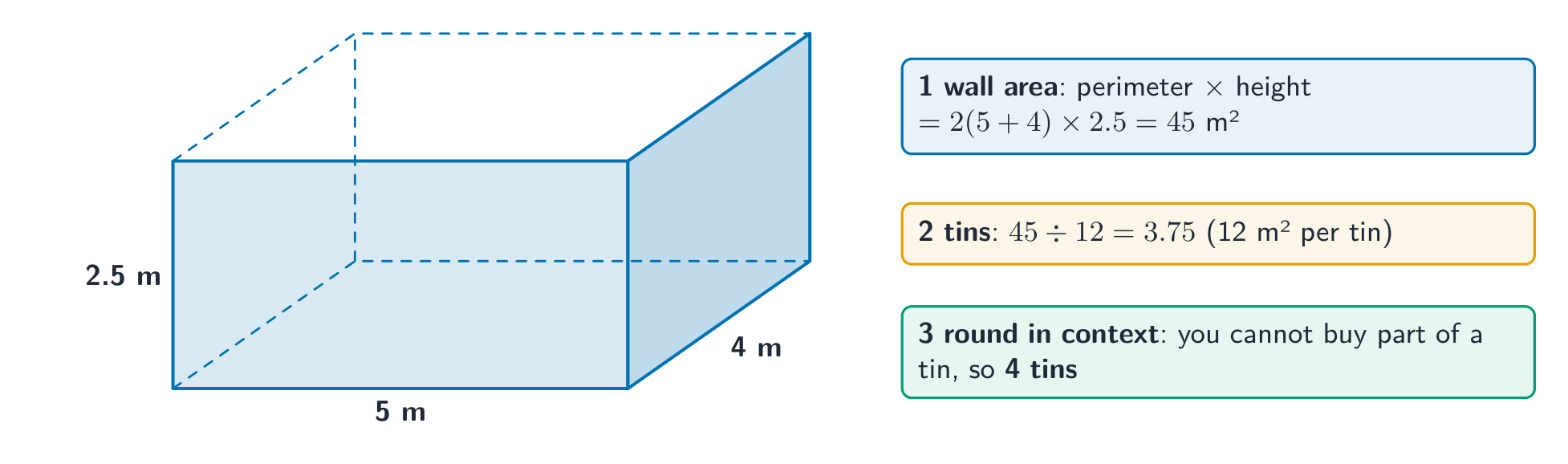
Painting a room
- A room is 5 m by 4 m with walls 2.5 m high. One tin of paint covers 12 m². How many tins are needed for the walls, ignoring the door and window?
- Integrating essential skills questions chain several simple steps: geometry, rates, units and rounding in context.
Break the problem into steps
- Wall area: perimeter $\times$ height $= 2(5 + 4) \times 2.5 = 45$ m².
- Tins: $45 \div 12 = 3.75$, so 4 tins (you cannot buy part of a tin).
A wall is 6 m long and 2.5 m high. One tin covers 4 m². How many tins are needed for one coat?
Difficulté 2/5 · 140 pièces + un petit bonus lors de la première réussite aujourd'hui
$15 \div 4 = 3.75$, round up to 4.
Models and their assumptions 假设
- Every model ignores something: here, the door and window. If they total 4 m², the area is 41 m² — still 4 tins.
- Ask whether an assumption would change the decision; if two coats are needed, the answer doubles to $90 \div 12 = 7.5$ → 8 tins.
A car travels 480 km on 32 L of fuel. Fuel costs 1.50 dollars per litre. Cost per km $= \dfrac{32 \times 1.50}{480} = 0.10$ dollars.
A car uses 6 L per 100 km and fuel costs 1.25 dollars per litre. What is the fuel cost in dollars for a 400 km trip?
Difficulté 2/5 · 140 pièces + un petit bonus lors de la première réussite aujourd'hui
$24 \text{ L} \times 1.25 = 30$.
If an assumption in a model changes, the final decision may stay the same.
Difficulté 1/5 · 100 pièces + un petit bonus lors de la première réussite aujourd'hui
True. Test the effect: for example, 41 m² instead of 38 m² still needs 4 tins of paint, so the decision does not change.
Round in context
- Round up when you need enough (tins, buses, boxes); round down when you can only use complete units (how many full boxes can be filled).
- Check units at every step: m × m = m²; m² ÷ (m² per tin) = tins.
Arrondir au supérieur ou à l'inférieur ?
Choisissez la direction de l'arrondi selon le contexte.
130 students go on a trip. Each bus holds 45. How many buses are needed?
Difficulté 2/5 · 140 pièces + un petit bonus lors de la première réussite aujourd'hui
$130 \div 45 \approx 2.9$, round up to 3.
100 eggs are packed in boxes of 12. How many full boxes can be filled?
Difficulté 2/5 · 140 pièces + un petit bonus lors de la première réussite aujourd'hui
$100 \div 12 \approx 8.3$; only 8 complete boxes.
A recipe needs 2.3 bags of flour. How many bags must you buy?
Difficulté 1/5 · 100 pièces + un petit bonus lors de la première réussite aujourd'hui
You need enough, so round up to 3.
Traps
- Rounding the wrong way: 3.75 tins means you must buy 4.
- Using floor area for walls: the question decides which surfaces count.
Recap
- Chain the steps with units; state the model's assumptions and test whether they matter.
- Round up for "enough", down for "complete units".