Vecteurs et matrices comme modèles quantitatifs organisés
Introduit| English | Sens |
|---|---|
| matrix/ˈmeɪtrɪks/ | matrice |
| vector/ˈvektə/ | vecteur |
| component/kəmˈpəʊnənt/ | composante |
A table that multiplies
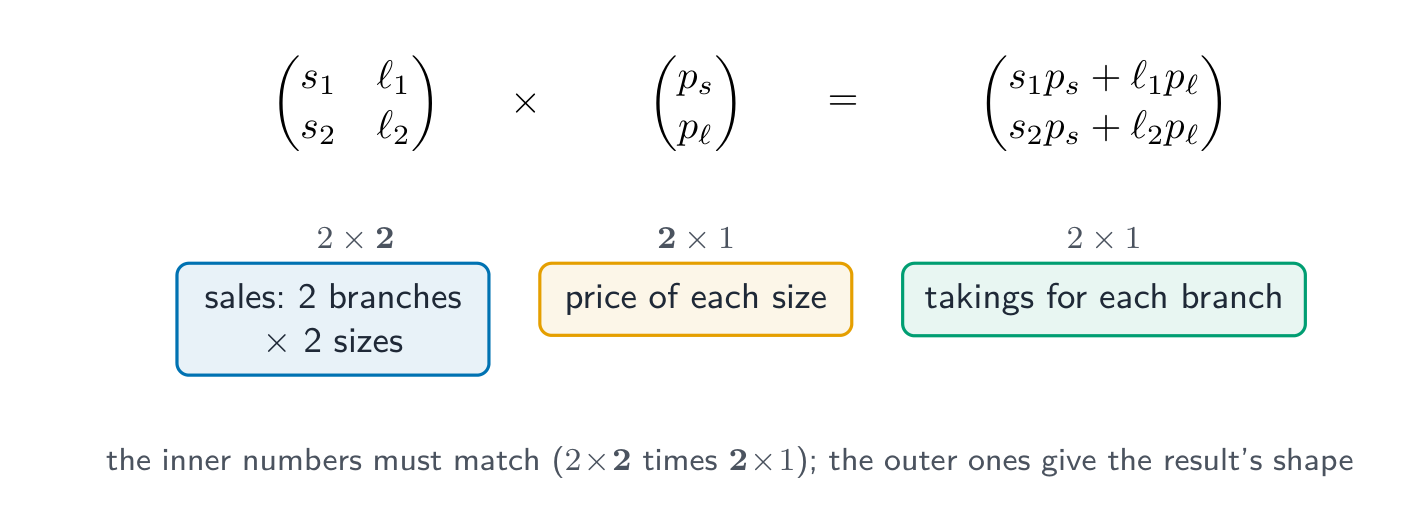
- A café sells small and large coffees at two branches. A matrix 矩阵 of daily sales times a price vector 向量 gives each branch's takings in one step.
- ACT asks about vectors and matrices as organised data: adding, scaling and multiplying with matching dimensions.
Vectors
- A vector has components 分量: $\vec{u} = \langle 3, -1 \rangle$. Add component by component: $\langle 3, -1 \rangle + \langle 2, 4 \rangle = \langle 5, 3 \rangle$.
- Scale every component: $2\langle 3, -1 \rangle = \langle 6, -2 \rangle$. Length: $|\langle 3, 4 \rangle| = \sqrt{9 + 16} = 5$.
What is $3\langle 1, -2 \rangle + \langle 4, 5 \rangle$?
Difficulté 1/5 · 100 pièces + un petit bonus lors de la première réussite aujourd'hui
$\langle 3, -6 \rangle + \langle 4, 5 \rangle = \langle 7, -1 \rangle$.
What is the length of the vector $\langle 6, 8 \rangle$?
Difficulté 2/5 · 140 pièces + un petit bonus lors de la première réussite aujourd'hui
$\sqrt{36 + 64} = 10$.
Matrix dimensions
- A matrix with $m$ rows and $n$ columns is $m \times n$. You can add matrices only of the same size.
- You can multiply $A$ ($m \times n$) by $B$ ($n \times p$) only if the inner numbers match; the result is $m \times p$.
Sales $\begin{bmatrix} 40 & 25 \\ 30 & 50 \end{bmatrix}$ (rows: branches; columns: small, large) times prices $\begin{bmatrix} 3 \\ 4 \end{bmatrix}$ gives $\begin{bmatrix} 40 \cdot 3 + 25 \cdot 4 \\ 30 \cdot 3 + 50 \cdot 4 \end{bmatrix} = \begin{bmatrix} 220 \\ 290 \end{bmatrix}$ dollars per branch.
Peut-on les multiplier ?
Utiliser les dimensions des matrices pour déterminer si un produit existe et sa taille.
Matrix $A$ est $3 \times 2$ and matrix $B$ est $2 \times 4$. What size is $AB$?
Difficulté 1/5 · 100 pièces + un petit bonus lors de la première réussite aujourd'hui
Inner numbers match (2); the result is outer numbers, $3 \times 4$.
Reading the entries
- Each entry of a product is a row of the first matrix times a column of the second: multiply in pairs and add.
- Units follow: (cups) × (dollars per cup) = dollars.
Compute the top entry of $\begin{bmatrix} 2 & 5 \\ 1 & 3 \end{bmatrix}\begin{bmatrix} 4 \\ 6 \end{bmatrix}$.
Difficulté 2/5 · 140 pièces + un petit bonus lors de la première réussite aujourd'hui
$2 \cdot 4 + 5 \cdot 6 = 38$.
Traps
- Order matters: $AB$ and $BA$ are usually different, and one of them may not even exist.
- Mismatched sizes: a $2 \times 3$ matrix cannot multiply a $2 \times 3$ matrix.
For square matrices, $AB$ et $BA$ can be different.
Difficulté 1/5 · 100 pièces + un petit bonus lors de la première réussite aujourd'hui
True. Matrix multiplication is generally not commutative, so the order of the product matters.
Recap
- Vectors: add and scale component by component; length by Pythagoras.
- Matrices: $m \times n$ times $n \times p$ gives $m \times p$; each entry is row × column.