Lecture : détails, structure et intégration
Introduit| English | Sens |
|---|---|
| paraphrase/ˈpærəfreɪz/ | paraphrase |
| narrator/nəˈreɪtə/ | narrateur |
Four passages, 35 minutes
- ACT Reading has passages in literary narrative, social science, humanities and natural science, each with about ten questions.
- The questions test key ideas and details, craft and structure, and integrating information — including paired passages and sometimes a graph.
Details and inferences
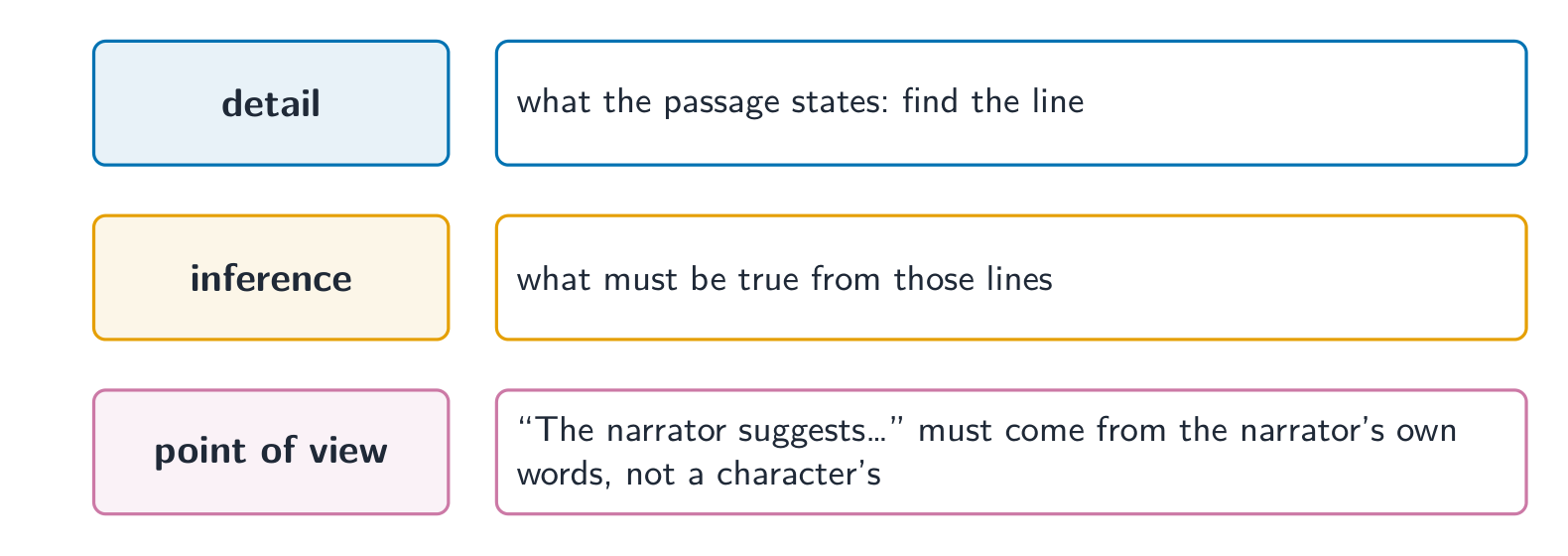
- Detail questions ask what the passage states; line references help you find it. Inference questions ask what must be true from it.
- Answer only from the passage; the correct choice usually paraphrases 释义 a specific sentence.
The correct answer usually ____ (restates in other words) a specific sentence in the passage.
Difficulté 1/5 · 100 pièces + un petit bonus lors de la première réussite aujourd'hui
Look for the line it restates.
Craft, structure and point of view
- Ask why the author included a detail or how a paragraph functions (introduces, contrasts, gives an example).
- In literary passages, separate the narrator's 叙述者 view from a character's: "The narrator suggests that her father was…" must come from the narrator's words.
"Mira laughed, though she felt the room tilt beneath her." The word though contrasts outward behaviour with inner feeling: Mira hides her distress.
Soutenu par le passage ?
Évaluez si un choix de réponse est entièrement étayé.
“Tom smiled at the guests and said all was well, then closed the door and sat down heavily, his face in his hands.” What does this suggest about Tom?
Difficulté 1/5 · 100 pièces + un petit bonus lors de la première réussite aujourd'hui
The contrast between his public smile and private despair shows hidden worry.
Paired passages
- Read Passage A and answer its questions, then Passage B, then the questions about both.
- For comparison questions, state each author's view separately before deciding whether they agree, disagree or qualify each other.
Passage A: “Zoos are vital for saving endangered species.” Passage B: “Zoos help some species, but most conservation must happen in the wild.” How does B relate to A?
Difficulté 1/5 · 100 pièces + un petit bonus lors de la première réussite aujourd'hui
B accepts that zoos help but limits their role.
Put the paired-passage method in order.
Difficulté 3/5 · 200 pièces + un petit bonus lors de la première réussite aujourd'hui
Separating the passages first prevents mixing their views.
Traps
- Half-right choices: the first half matches the passage, the second half adds something it never says.
- Extreme words: "always", "completely", "never" rarely match a careful passage.
If the first half of an answer choice matches the passage, the choice is correct.
Difficulté 1/5 · 100 pièces + un petit bonus lors de la première réussite aujourd'hui
The whole choice must be supported; half-right choices are a common trap.
Recap
- Answer from the passage; find the line that proves your choice.
- Separate narrator from character and author A from author B; reject half-right and extreme choices.
- paraphrase: A restatement of an idea in different words with the same meaning.
- narrator: The voice that tells a story, inside or outside the events.